(Bloomberg Businessweek) --
Riding in a van behind a moving truck, Rogelio Quiñonez, 20, is between homes for the fourth time in as many months. He’s 5 feet tall, and his high-cropped bangs, protruding forehead, and slight smile give him an impish look. With him are his wife and toddler and infant sons, four of the roughly 500 indigenous Warao people of Venezuela seeking refuge in the Brazilian city of Manaus.
On this afternoon in July, the local government is relocating dozens of the Warao to temporary accommodations in an apartment building in a neighborhood called, aptly, Cidade Nova—“New City” in Portuguese. As they drive, a downpour sends water sluicing toward the Manaus waterfront, where the Rio Negro becomes the Amazon. “The sun can’t shine the entire day,” Quiñonez says in halting Spanish, his second language. “It has to rain for the plants and animals and people to not be too hot.”
The Warao pull up to their latest home, and the van’s door slides open. The first person out is nearly mowed down by a teen zipping past on a motorcycle. But soon enough all the refugees are scrambling about the two-story building, testing faucets in the apartments and arguing over dibs in the Warao language—an “isolate” that has no connection to any other on Earth. Their new Brazilian neighbors gawk from behind their gates. “Is it true they make bonfires and shoot arrows?” asks Analise Lima, 38. “Do they speak Portuguese, even a little?”
Quiñonez settles his family into a two-room apartment and plugs in an old cell phone he bought on the street for 20 reais ($6.40). It can’t make calls; he uses it to record songs off the radio, and he plays Ed Sheeran’s Shape of You from its tinny speaker while holding his baby.
Since Venezuela’s economy began to melt down in 2014, violence, triple-digit inflation, and shortages of food and medicine have caused hundreds of thousands of people to flee in the ways available to them. Elites have obtained U.S. visas and left for Miami. Those in the middle class have escaped by plane to places such as Buenos Aires. The poor have walked across the border to Colombian cities. But there is no refugee flow quite like that of the Warao to Manaus.
Anthropologists believe that for as long as 9,000 years, the Warao and their ancestors have lived in what is now the northeastern corner of Venezuela, paddling dugout canoes through the Orinoco Delta and subsisting on what they can fish, hunt, and gather. Their population there is about 40,000. In recent decades the Warao began to make regular trips to nearby population centers, coming to rely on occasional medical care, some consumer goods, and aid from the Venezuelan government. These newfound necessities have vanished amid the country’s recent political and social collapse. To regain them, in December 2016, the first Warao embarked on a thousand-mile journey, passing south through midsize Venezuelan cities and Brazilian border towns to reach a true metropolis: Manaus. Almost none of the Warao had ever been to a place so large.
Manaus is a marvel—a river city of 2 million at the heart of the world’s largest tropical rainforest. The capital of the state of Amazonas, its waterfront buzzes with the docking of 40,000 ships a month: low-lying launches for swift transport to smaller cities nearby, chubby tubs three stories tall with wooden balustrades to ferry passengers deeper into the jungle, gleaming trans-Atlantic cruise liners, and aluminum two-seaters with sputtering outboards threading through them all.
Although Manaus is almost equidistant from the Atlantic and Pacific oceans, it is closer than other Brazilian cities to the rest of the world in terms of trade. Since the late 1960s, Manaus has been home to the nation’s only free-trade zone. The east side of the city today has factory after factory, owned by domestic companies and global powerhouses such as Samsung, Honda, Harley-Davidson, and Procter & Gamble.
Quiñonez was born at the opposite end of the development spectrum—he was delivered in the woods while his mother was on a foraging expedition and raised in a stilted hut. In July 2016, Quiñonez made his first visit to a Venezuela-Brazil border town to sell baskets and hammocks woven from moriche palm fiber, as other family members begged. While he was there, word reached him that a brujo—a witch—at home had inflicted sickness upon his father. By the time Quiñonez made it back, his father was dead and buried, at 36. Then, in February 2017, Quiñonez’s wife gave birth to their second child, two months premature. The family decided to join the trail of Warao headed for a better chance of survival in Manaus.
By April, 318 Warao had made their way to the city, and government agencies and charities rallied to care for them. According to the local human-rights secretariat, 232 of the refugees occupied five large houses near the city center’s hectic fish markets. But 86 others camped under an overpass by the bus terminal, with tarps hanging from lines next to drying clothes, and the site was growing into an eyesore as more Warao continued to arrive. On May 4 the mayor declared a state of “social emergency.” The next day, one of the five houses, a neocolonial hostel known as Hippielandia, was doused with gasoline and set ablaze. The Warao fled over a back wall, leaving their few possessions—mostly donated clothes—to go up in flames. It’s unclear if the arsonists’ motive was run-of-the-mill xenophobia or anger that the Warao had drawn government attention unwanted by local drug pushers and human traffickers, whose trades are rampant in the Amazon. Either way, the incident didn’t stem the influx of Warao, and at the end of the month, those remaining at the bus station encampment were transferred to a gymnasium shelter, where they slung hundreds of colored hammocks.
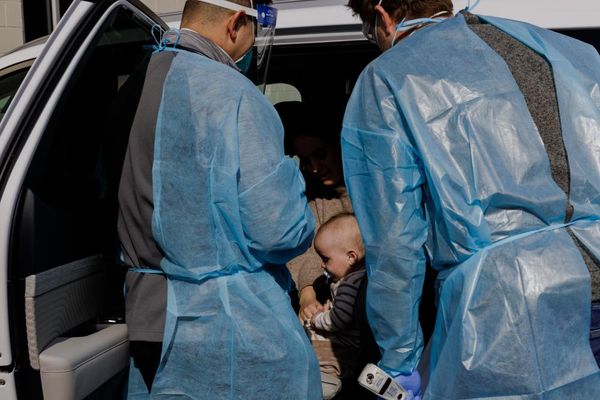
Medical care was high on the refugees’ list of priorities. Some of the Warao found treatment in a small, air-conditioned room near the city center, often using two translators—one for Warao to Spanish, and another for Spanish to Portuguese. City doctors, who’ve instructed the Warao on hygiene and how to take medicine, have administered more than 1,000 examinations. The most common afflictions are respiratory infections, parasites, and heat rashes.
Quiñonez’s infant survived a cold he caught soon after arrival, and shortly before the rainy-day move to the apartment complex, he brought the boy back to a doctor to be treated for heat rash. “In Venezuela, they kill kids,” he said as the doctor pressed a stethoscope to the baby’s bare chest. “Here, they cure them.”
But four other Warao babies have died in Manaus, at least two from infections related to chicken pox and pneumonia. The refugees at the shelter elected Juan Perez, 36, to serve as their cacique—chief—to keep order and interface with government officials. After the babies died, he received a handwritten letter from a Warao who’d remained in the Orinoco Delta, stating that two of the deaths were the work of a brujo. Perez believed it enough to inform the whole group, and he wrote back to get more details. But he also resolved to remain in Brazil for as long as Venezuela lacked food.
Perez is almost certainly the most widely traveled of the refugees. He once represented his community in the delta on a trip to Caracas to propose two projects to Socialist President Hugo Chávez: one for a provision of boats, motors, and nets, and the other for a footbridge, a school, and housing. While in the capital, he met the vice president, who invited him to watch a broadcast of Chávez’s Sunday TV show, Aló Presidente, which on several occasions had trotted out the Warao on-air to make the regime seem benevolent. Perez got his schoolhouse, but it was built with wood instead of cement; the elements ravaged it within four years. Venezuela itself fell apart, too. “There’s crisis now in Venezuela, without work, food, medicine, clothes like these I’m wearing,” Perez says, gesturing to his canary-yellow Brazil soccer jersey. “This government in Manaus, in Amazonas, is much better.”
The Warao may be getting a relatively friendly reception because many Manaus residents are descended from the refugees of the economic and climatic disasters of previous eras. The city has been a magnet for migrants since the second half of the 19th century, when it transformed from a backwater of 3,000 into a rubber boomtown. Tens of thousands poured in, mainly from Brazil’s drought-stricken northeast. The city was among the country’s first to get electricity and telephones. In 1884 construction began on a massive belle epoque opera house, with materials drawn from across Europe; the surrounding boulevards were built of rubber bricks to hush the hooves of horse-drawn carriages. The wealthy shipped their laundry down the Amazon and across an ocean to be washed in France, and Manaus earned the sobriquet “Paris of the Tropics.” Today, the well-heeled can dine beneath a wall-mounted canoe at Banzeiro, an acclaimed restaurant that serves individual Amazonian ants off silver spoons. (They’re crunchy and taste of lemongrass and ginger.)
Romanticizing the native way of life is common in Manaus. In a July show at the opera house, dancers swayed as a poem was read about local women’s heritage being a mixture of indigenous people and migrants. The city has a new “indigenous” health center, where a shaman whispers blessings into cups of water, transmuting them into tonics for an almost entirely city-born clientele. The design of the local soccer stadium, built for the 2014 World Cup, is based on a woven basket. The municipal market near the cruise dock sells bucolic paintings of unclothed native women and packets of “regional Viagra” powder. It also offers chicken-feather headdresses and spears for tourists wishing to mug for souvenir photos.
“The debacle of the Venezuelan government was expected, but we didn’t expect such an intense migration”
Among the Warao now living in the city, Quiñonez finds his connections to his homeland fraying. He’s selling bottled water at stoplights while hoping to land a job laying pavement, doing construction, or cleaning homes—anything to earn at least 50 reais a day to buy diapers and food for four mouths. He dreams of purchasing a stove, a TV, a washing machine, a bed. He’s in the minority—most of the Warao intend to return to the Orinoco. Their time in Manaus is just a megasize version of what their people have done for the past several decades: Venture into the money economy to obtain necessities before returning to the delta. At least 125 Warao went back to Venezuela between May and mid-July, according to the state government of Amazonas, bearing huge bags of clothes and food for family members left behind.
Most of the Warao women obtain these goods by donning colorful folk dresses and asking for alms in traffic. The Warao see begging as identical to traditional gathering, adapted to an urban environment, says Alvaro García-Castro, a Venezuelan anthropologist who’s studied the culture. Valdiza Carvalho, who coordinates migrant outreach for the local Catholic archdiocese, notes that the Warao’s choice of a campsite by the bus terminal was intended to draw people’s attention to their plight. It succeeded. “They’re not fools,” she says. “They’re strategic.”
During a two-hour-long interview, Manaus Mayor Arthur Virgílio Neto relates the tale of a fierce Manaó guerrilla who, many years ago, once caught and chained by the Portuguese, hurled himself into the Amazon rather than be exhibited as a trophy. Legend has it that the wind that kicks up around midday to stir the water’s surface is actually the spirit of this warrior, whom Virgílio Neto calls “a moral icon.” In another breath, he notes that while Manaus has always done right by refugees—taking in 7,000 Haitian earthquake victims since 2010 and now the Warao and thousands of other Venezuelans—it is time to build a refugee center on the border. “The debacle of the Venezuelan government was expected, but we didn’t expect such an intense migration,” Virgílio Neto says. “We have grave problems here,” he continues. “As mayor, even working day and night, I can’t attend to the basic needs of all the Manauaras and Brazilians living here. [Brazil needs] a very serious, very dense program to attend to these people at the border. If not, we’re going to receive waves and waves and waves.”
Virgílio Neto isn’t exaggerating the challenges his city faces. Homicides were up 25 percent in the first six months of 2017 from last year. The 21 percent jobless rate is the highest among Brazil’s 26 state capitals, and a line at the city center’s unemployment office often extends around the block. A quarter-million people are out of work, almost triple the level before Brazil’s crushing, two-year recession. Lately, the city’s all-important industrial hub has struggled: At its peak in 2014, it employed 122,000; today there are about 85,000 workers. Virgílio Neto notes that those are only the direct jobs—in indirect ways, the center is responsible for almost all employment in Manaus.
There are signs the hub is churning back into gear. Companies’ combined sales in the first five months of 2017 were up 10 percent from a year earlier, reaching 31.4 billion reais ($10 billion). But, while educated and experienced Venezuelan refugees might land factory jobs, it’s hard to imagine the Warao will.
On July 16, Venezuelans in Manaus, all of them nonindigenous, gathered to vote in absentia against a constitutional reform pushed by Chávez’s successor, Nicolás Maduro. Any Warao with the required documentation could have joined them, but not a single one cast a ballot—they learned about the opportunity too late. Instead, at the apartment complex, the Warao on the bottom floor are in a pitched screaming battle with the others upstairs. One of them dropped a bag full of garbage down onto the sidewalk, and a stray dog has ripped into it. Neighbors emerge from their homes to film the spat on their cell phones.
Quiñonez, at least, is optimistic that he can keep his family alive in Manaus. He’s in his room with the door closed and his fan whirring. His wife is in the shower, and he sits on the tile floor with his naked baby laid across his lap. The doctor has said the infant is up to “adequate” weight; the heat rash has passed. Quiñonez says he wants his sons to learn Warao, Spanish, and Portuguese. If he stays in Manaus long enough, perhaps they’ll attend the public school a few blocks away. On one of its walls, facing the street, is a long mural depicting life on the river: a man fishing in a canoe and an indigenous person on the shore carrying a baby in a sling. It’s a life he’s begun leaving behind.
To contact the author of this story: David Biller in Rio De Janeiro at dbiller1@bloomberg.net.
To contact the editor responsible for this story: Bret Begun at bbegun@bloomberg.net, Nick Summers
©2017 Bloomberg L.P.