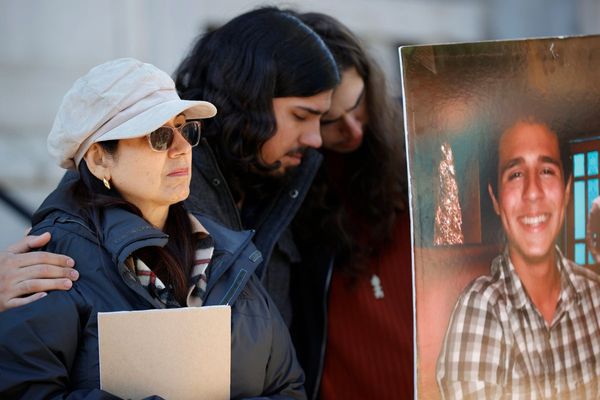
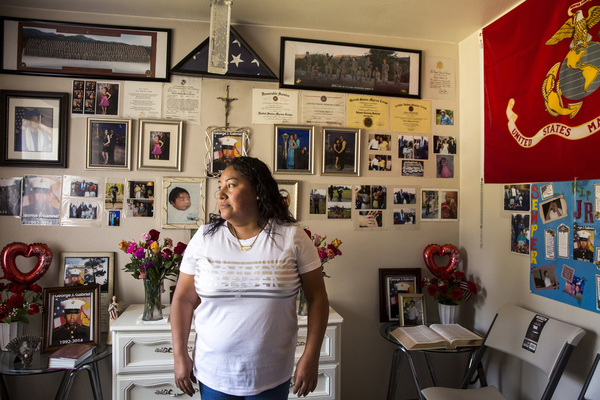
FEDERAL WAY, Wash. _ One of the bedrooms in Lourdes Reyes' home in Federal Way belongs to her son George Gabriel Jr.
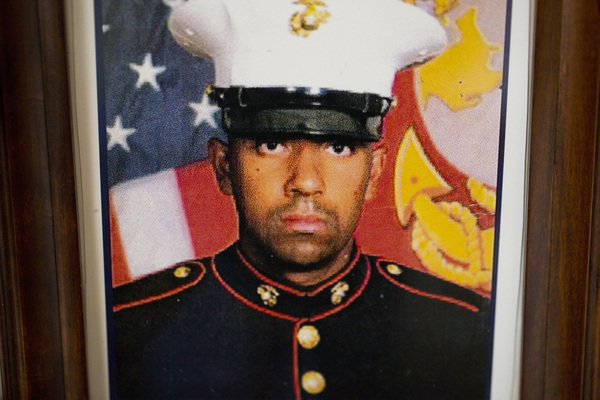
Its walls are covered with framed photos of Gabriel when he was an adorable kid, posing at high-school dances with girls who found him adorable (in a distinctly more grown-up way) and gazing into the camera while dressed in his blue Marines uniform and white cap.
But Lance Corporal Gabriel has never set foot in this house.
This room full of lovely memories is, in fact, a loving memorial.
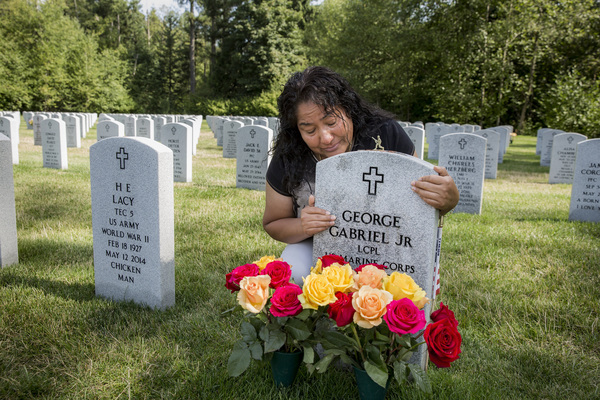
Gabriel was killed by a stray bullet fired during a shooting on May 13, 2014, while he was on leave, visiting his mother at the Federal Way apartment complex where she lived at the time.
Gabriel and his new wife had just driven home from a night out and were waiting for a parking space when they got caught in the crossfire of a dispute, police said.
It was his birthday.
When shots ring out, the pierced air causes ripples that spread well beyond the trauma of the wounded.
They send shock waves through a community's consciousness that don't diminish after the headlines fade away and the cameras gravitate toward the next day's news.
The perverse thing about much of the Seattle-area gun violence that has captured the public's attention in recent years _ including a series of incidents, some fatal, this spring and summer _ is that shootings too often go unsolved for months and even years, with witnesses refusing to cooperate and investigations stalling.
Families and friends of the victims are then left with the dual traumas of grief and mystery, making it that much harder to heal the wounds of loss.
Gun violence, no matter where it happens, damages our sense of the natural order of things.
It is not natural, in any community, to say goodbye to a son or daughter or neighbor when they head out into the world, and wonder whether you'll ever see them again.
Reyes heard the commotion outside that night, but she never imagined that her son was caught up in it.
That revelation came a short time later, when police knocked on her door to deliver the news that her son was gone.
Gabriel was a born engineer. He installed auto alarms and sound systems for people and could take the shell of a Honda or Acura and build it out into a fully functioning car.
Reyes, 50, admits with a smile that she spoiled her son. She let him eat dinner in front of the TV in his bedroom when he was younger. Gabriel never washed his own dishes.
One day, when he was 18, Gabriel told his mother he'd just signed papers to join the Marines.
Reyes remembers saying, stunned, "You're kidding, right?"
Gabriel said no; he was serious.
"You don't even know how to wash a plate," she retorted.
But the decision had been made.
"He was my baby, and you always expect the worst," Reyes says. "But he was happy ... When he left, I was crying, crying, crying, but he called me every single day."
Reyes was 19 when she came to the United States from Tamaulipas state in Mexico. She worked seven days a week in janitorial services and ran her own cleaning business. She raised Gabriel on the income from the business. When he died, Reyes stopped working, and her husband, Gabriel's stepdad, stepped in to support them.
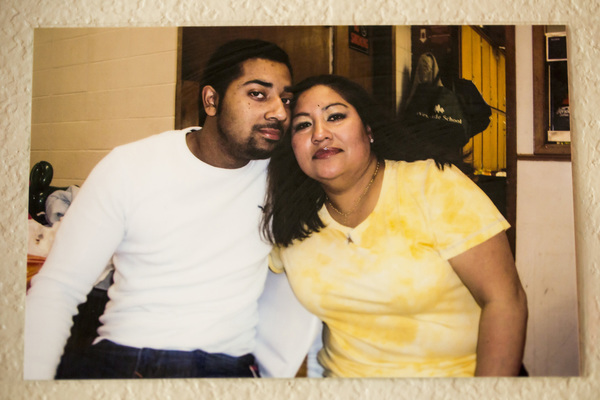
She and her son were always close. Gabriel, known as "Junior" to most people in the apartment complex, never missed an opportunity to tell his mother he loved her, sometimes five or 10 times a day, even in front of his high-school buddies.
He might have been a devoted mama's boy, but Gabriel stunned Reyes once more when he called three weeks before his death to say he'd gotten married to a fellow member of the military in San Diego, where he was based.
But Reyes couldn't stay upset at her son for long.
She had tried to protect him from danger once before.
When Gabriel was in high school, a young man visited the apartment, she says. He put a gun to Reyes' head and demanded to know where "George" was. Because of the way he referred to her son, she assumed the stranger knew him from school. Terrified, Reyes pulled Gabriel out of school and sent him to live with relatives in Miami. But only a month later, she had Gabriel sent back to be with her after he complained.
She decided to move the family to a different apartment complex, thinking the new location would be safer. A few years later, that's where the shooting happened.
Gabriel's room is lined with chairs. A U.S. flag folded into a triangle, which Reyes received at her son's military funeral, hangs above the portrait of him in his Marines uniform.
Reyes takes a seat in one of the chairs. "It's my favorite place," she says.
"I still have his clothes," she says. "People always tell me to get rid of them, but I'm not ready."
The gold pendant hanging from a chain around her neck spells out "George Jr.," with angel wings around the "Jr."
"He lives in me," Reyes says.
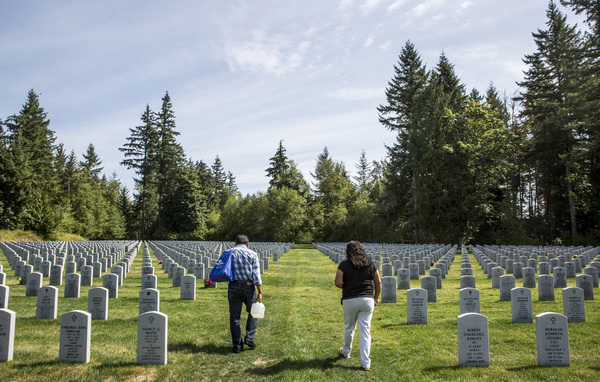
She visits Gabriel's gravesite every weekend.
Every 13th of the month, she hosts a gathering to celebrate his life. On his birthday this year, Reyes arranged for a mariachi band to play in his memory.
Some relatives have urged her to let her son rest, to let go of her grief. But it is grief that has a hold on her.
To lose any child, but especially in such a random and horrific way, brings a distinct kind of pain, she says. "I think I'm never going to get up from this."
Even worse, three years later, no arrests have been made in her son's death.
Federal Way police said at the time that a man who was suspected of involvement in two other shootings around the same time, one a fatal shooting, was a person of interest in Gabriel's, as well. The man spent a year in prison on murder charges connected to that other fatal shooting, but was released in 2015 for lack of sufficient evidence to carry out a successful prosecution.
"All I want is justice," Reyes says. "If there was justice, my son could rest in peace."