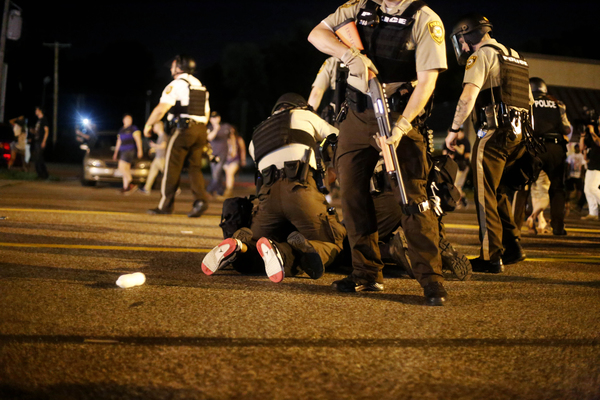
CLAYTON, Mo. _ In September 2014, St. Louis County Police Chief Jon Belmar announced to a room full of local and national reporters in town to cover the civil unrest in Ferguson that he had invited the U.S. Department of Justice to review his policies and procedures, hoping to become a better department.
A 182-page report followed in October 2015 report that outlined 50 findings with 109 recommendations, ranging from concerns about the department's racial profiling data to its cumbersome website. Federal officials said they would continue to work with the department and promised at least two progress reports would follow.
Now, with months of federal delays and no follow-up reports from the Justice Department, Belmar says he's unsure his department is any better for its collaboration.
"It's just lingering and dwelling, and we don't know why," Belmar said.
It's also unclear how the impending inauguration of President-elect Donald Trump may affect the process, which Belmar volunteered to undergo after his department was criticized by the Obama administration and others for its forceful response to demonstrations and rioting that followed the Ferguson police shooting of Michael Brown in August 2014.
Belmar said he had been promised the first progress report from federal officials by April.
"By August, we were like, 'Where are we with this, is there an impediment to this?'" he said.
The Community Oriented Policing Services, or COPS office of the Justice Department's Civil Rights Division, is overseeing the process. Its deputy director, Rob Chapman, said recently that deadlines vary and noted that the St. Louis County report has an "extensive" amount of findings and recommendations.
"We've continued to work with the police department in collecting documents, interviews and analyzing data and validating the progress that's been made, and that takes a little bit of time because of the importance of the recommendations and the gravity of this report, not only for the department, but for the community," Chapman said.
Chapman said the county police department is "making good progress on a substantial amount of the work," and that his agency expects to have the first progress report done in "fewer than three months."
"I certainly understand that the chief wants the report, and we're working as quickly as we can. ... Once the chief sees the full report in its entirety, hopefully he'll be more comfortable with the status of our assessment of their implementation."
The Justice Department developed collaborative reform as an alternative to the costly, lengthy and legal consent decree process, which has been used in other cities at the center of controversies, including Ferguson.
Belmar assigned Sgt. John Wall to serve full time as the department's liaison with the Justice Department during the process. Wall's selection was symbolic, as he was commended for lowering the rifle of a St. Ann officer who wrongfully pointed it at protesters during a Ferguson demonstration. The officer was later fired.
U.S. Rep. William Lacy Clay, D-St. Louis, and Sen. Claire McCaskill, D-Mo., lauded Belmar's initiative when he asked for the Justice Department's review in 2014.
McCaskill called it "a step in the right direction."
Belmar said he initially thought so, too, telling reporters at the time, "The legacy of the St. Louis County Police Department is to be open and transparent, and I'm not afraid to have outside reviews in here _ and I can't think of a better time to do it."
Now, Belmar isn't so sure.
"I think there was a misconception early on that perhaps we had lost our way, and that was never an accurate assessment of our police department," Belmar said. "We have no problem with folks coming in and looking at our patterns and practices, but it was very scattershot after that."
About $5 million was awarded to five private research groups to conduct the reviews; in St. Louis County, it was the Washington-based Police Foundation. The organization's leaders declined comment and referred questions to the Justice Department.
The group anticipated its cost for the St. Louis County report to be $780,000, according to the documents obtained through the Freedom of Information Act.
Belmar said members of the Police Foundation were "consummate professionals," but early on, Belmar said he believed the researchers were surprised by the department's credentials _ including its certification from the Commission on Accreditation for Law Enforcement Agencies, or CALEA.
"If there is a positive to this, it's the fact that we did this and we were one of the first, so in many ways we're a national model, but I would never recommend another police department go through collaborative reform. What did they bring to bear? We already get a better assessment through CALEA."
The initial report released in October 2015 concluded that racial-profiling data from the St. Louis County police department are concerning, its culture is too tactically minded and the department doesn't do enough to engage the public or reflect the community it serves.
But it also noted that its use-of-force percentage is nearly half the national average of 1.4 percent, and the racial-profiling statistics alone do not prove whether county officers are biased.
Ron Davis, director of the Justice Department division overseeing the process, said at the time of the report's release: "The county police is a solid department, but obviously there is room for improvement, and when the department corrects these things, it will not be just a solid department but a model department."
He noted that the initial report and two progress reports for the St. Louis County police department will be public documents.
"The community will know exactly what we think," he said. "They will know what recommendations we provided. They will know whether or not the department actually implemented any of those recommendations."
But, Belmar said, the initial report was "scattered," and has lacked guidance as to how to meet the recommendations.
"I think this was a real missed opportunity here," he said.
Chapman said help in the form of training and other resources does come with the process, and that other reformed departments have given him "positive feedback."
"We don't want to just release 109 recommendations without also looking to provide whatever help we can through training ... but the level of training and technical assistance resources are not unlimited," Chapman said.
Belmar said his department has so far paid for implicit bias training and launched a Police Athletic League and cadet program without federal assistance _ all things Belmar said he would have done regardless of the federal intervention. And he has reassigned Sgt. Wall to the police academy, saying, in part, that he could not justify using an $80,000-a-year employee's time on a project that seemed to lack feedback from the feds.
The success of consent decrees can vary, in part, based on the personalities and bureaucracies involved, notes Matthew Barge, a partner and co-director of the Police Assessment Resource Center, which helps police forces on reform initiatives across the country.
Barge is the court-appointed monitor overseeing a federal consent decree between the Justice Department and the city of Cleveland _ a legally binding agreement overseen by career federal lawyers who are not as likely to leave as political appointments with the arrival of a new administration.
But unlike consent-decree agreements, there "is not really a backstop in collaborative reform," which is what St. Louis County police are undergoing.
Trump promised "law-and-order" in the 2016 presidential campaign, leading some to believe that the Justice Department will move away from collaborative reform, consent decrees and other oversight of local police departments.
Vanita Gupta, the principal deputy assistant attorney general and head of the Civil Rights Division at the Department of Justice, told the St. Louis Post-Dispatch several weeks ago that she "can't speculate on what is going to happen in the next administration."
But, she added, "I think there has been in the last many years a real bipartisan push on criminal justice reform."
Regardless of whether the Justice Department holds up its end of the process in St. Louis County, Belmar promised his department will.
"We're going to accomplish those recommendations because it's our responsibility whether we get a progress report or not," Belmar said.