The year 2018 has been an eventful one in terms of environmental issues.
Residents in Bangkok and major towns got choked by tiny dust particles known as PM 2.5 from late 2017 to January 2018. Meanwhile, the whole country was outraged at news of a Thai business mogul illegally poaching a black leopard in February. Later that anger turned to heartache at the sight of a beached pilot whale that had died after consuming too much plastic and other waste in June. And in August, the public was perplexed to learn just how much electronic waste was being sent from overseas to Thailand, a de facto dumping ground.
Despite the wealth of environmentally-themed news, these five stories had one thing in common -- they highlighted the government's reinvigorated crackdown on wrongdoers and its attempt to resolve nagging problems by revising the law.
The year was significant in that the government acknowledged both the volume and severity of environmental crimes taking place. Pundits say it suggests the regime will get even tougher on those who violate the law and jeopardise the environment in 2019.
1 Premchai put on leopard hunt spot
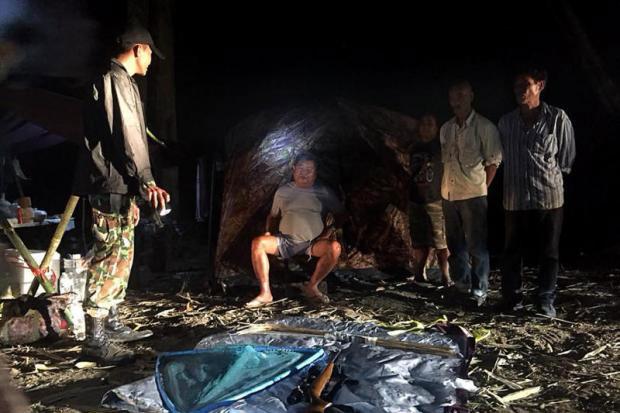
In February, the whole country was shocked by an illegal poaching case that involved Premchai Karnasuta, a construction tycoon and president of Italian-Thai Development Plc, a construction firm listed on the Thai bourse.
Mr Premchai and three other suspects were apprehended on Feb 3 by a team of forest rangers in a no-camping zone in Thungyai Naresuan Wildlife Sanctuary, a Unesco World Heritage site in Kanchanaburi's Thong Pha Phum district.
The carcasses of a black Indochinese leopard, an endangered species, and a number of other animals, together with three expensive long-barrelled guns, were found and confiscated by the rangers. Photos of the carcasses, and the tycoon with the weapons in front of him at the scene, stirred public anger.
Mr Premchai and the three others faced six charges relating to carry firearms in a protected wildlife area and hunting protected wildlife in a sanctuary. The maximum penalty for all charges totals 28 years.
Conservationists condemned Mr Premchai and launched a campaign to pressure legislators into ensuring justice was served, in a country where wealthy elites often find ways to escape punishment for their crimes.
The court in Kanchanaburi started hearing the case in December. Mr Premchai maintains he was not at the crime scene when the animals were killed, and has had nothing to do with the hearing so far.
But legal experts say it won't be so easy for the tycoon to walk away from this one. He may not be collared for killing the black leopard, but proving he was not an accomplice will not be an easy feat.
2 Chinese 'Mulan' robs the forest
Mulan, a shrewd Chinese businesswoman who goes by the Thai name Chalida Suphanthamat, is suspected of illegally trading prized wood to China after removing it from Thai forests. She was formerly married to a Thai soldier.
Police have gathered enough evidence to show that she sent the expensive timber, including sought-after Siamese rosewood, to China. Officers obtained a court warrant for her and launched their crackdown on illegal logging in August.
The case required the combined forces of forest rangers, police and soldiers to track her down. They hunted her in various provinces -- and came close in Surin before Mulan evaded their clutches yet again. She made her escape by pretending to be a Chinese translator.
Police have so far confiscated 412 logs of wood, including Siamese rosewood and Burma padauk, with an estimated value of 36 million baht.
Officers also arrested her ex-husband, who was a senior-ranking military man before he retired, at his home in Samut Prakan province. There they confiscated 150 logs of illegally obtained wood that was about to be shipped to China.
Police believe Mulan has since fled to Laos and made her way back to China, but her current whereabouts are not known.
3 Pilot whale OD's on plastic
The death of a short-finned pilot whale in June on a beach in Songkhla woke the public from its slumber and shone a light on just how precarious the issue of sea waste is becoming.
The male whale ran aground on the beach in Chana district on May 28 and died a few days after. The autopsy revealed eight kilogrammes of plastic waste inside its stomach, among them 80 single-time use plastic bags. This spurred a social campaign urging people and shops to use fewer plastic bags while also calling for better management of used plastic.
Weighing just 500kg when it was discovered on the beach, the whale was already in a critical condition and little could be done to save it. The Department of Marine and Coastal Resources deployed a team of veterinarians but the cetacean was too far gone. As though attempting to communicate with its last breath, or more likely evacuate its stomach and save itself, the whale spat out five plastic bags before it gave up the ghost.
Thailand saw around 300 marine animals die untimely deaths in 2018, including whales, dolphins and sea turtles, mainly due to the use of fishing gear and plastic and other waste.
The country now ranks among the top 10 producers of marine waste in the world, with 1.3 million tonnes a year. China holds the top spot (8.82 million tonnes) followed by Indonesia (3.22 million tonnes) and the Philippines (1.88 million tonnes).
During next year's Asean Ministerial Meeting, Thailand as host will raise the issue of marine debris management in the hope that the regional bloc can find better ways of protecting and preserving the marine ecological system. It will also push for more substantial measures to reduce the amount of plastic consumed in the region.
4 E-waste and paradise lost
A crackdown on at least five electronic waste (e-waste) recycling plants in Chachoengsao province in May drew attention to how the kingdom is becoming a new repository for the world's garbage.
China formerly held this title before Beijing dialled things back by excluding imported shipments of plastic waste and discarded electronic goods from its recycling industry, due to their harmful impact on the environment.
Police investigators in Thailand found many companies had been exploiting legal loopholes by mixing their e-waste with plastic waste due for recycling. The law still permits factories to receive non-hazardous plastic garbage for this purpose.
Officers later launched a crackdown at Laem Chabang port in Chon Buri province, where they discovered 400 containers carrying illegal and hazardous e-waste.
Thai factories claim to have legally imported 145,000 tonnes of plastic waste for recycling in 2018, according to the Customs Department, but checks at the port showed the registered amount was significantly higher at 212,000 tonnes. Police suspected this was because of all the e-waste bundled into the cargo in an attempt to disguise it.
Gen Surasak Kanjanarat, the minister of natural resources and environment, chaired the sub-committee dealing with e-waste and plastic from overseas. He said the panel decided it was crucial to ban 422 used electronic items, such as TV screens, computer monitors and refrigerators, from entering to the country to limit the negative environmental affect.
5 Dust particles a present danger
The end of the year ought to be a joyous time when all Thais can celebrate the season of giving. But a dampener was put on things this year when dust pollution grew more severe, prompting the widespread use of face masks in a bid to to filter out some of the harmful particles.
The haze turned the Bangkok sky grey while the drier weather in November and December helped trap burnt fossil fuels and emissions from construction sites, causing pollution levels to spike. This has been a persistent trend in recent years.
The government has tried to solve the problem but it has met with little success. Meanwhile, local environmentalists have called on the Pollution Control Department (PCD) to include PM2.5 -- a particularly nasty form of fine particulate matter than can burrow deep inside the lungs and is hard to guard against -- in a formula for calculating the weather quality, especially in the capital.
In August, the PCD added PM 2.5 to its air pollution index. It also launched a smartphone app called Air4Thai to keep the public informed of the air quality in real time. It said levels of PM2.5 should not exceed 50 microgrammes per cubic metre as this is the threshold after which it can pose a serious danger to people's health.
The PCD and Ministry of Public Health have moved to revise several laws this year to give the government more power in controlling this threat, for example by designating "crisis areas".
If they are enacted as expected, officials will have full authority to halt any activities that are considered detrimental to the public health, including shuttering construction sites that are spreading too much dust and harmful particles.
According to a survey by Greenpeace Southeast Asia, Chiang Mai, Khon Kaen and Bangkok are among the five cities with the highest levels of PM2.5 in Thailand since 2014.