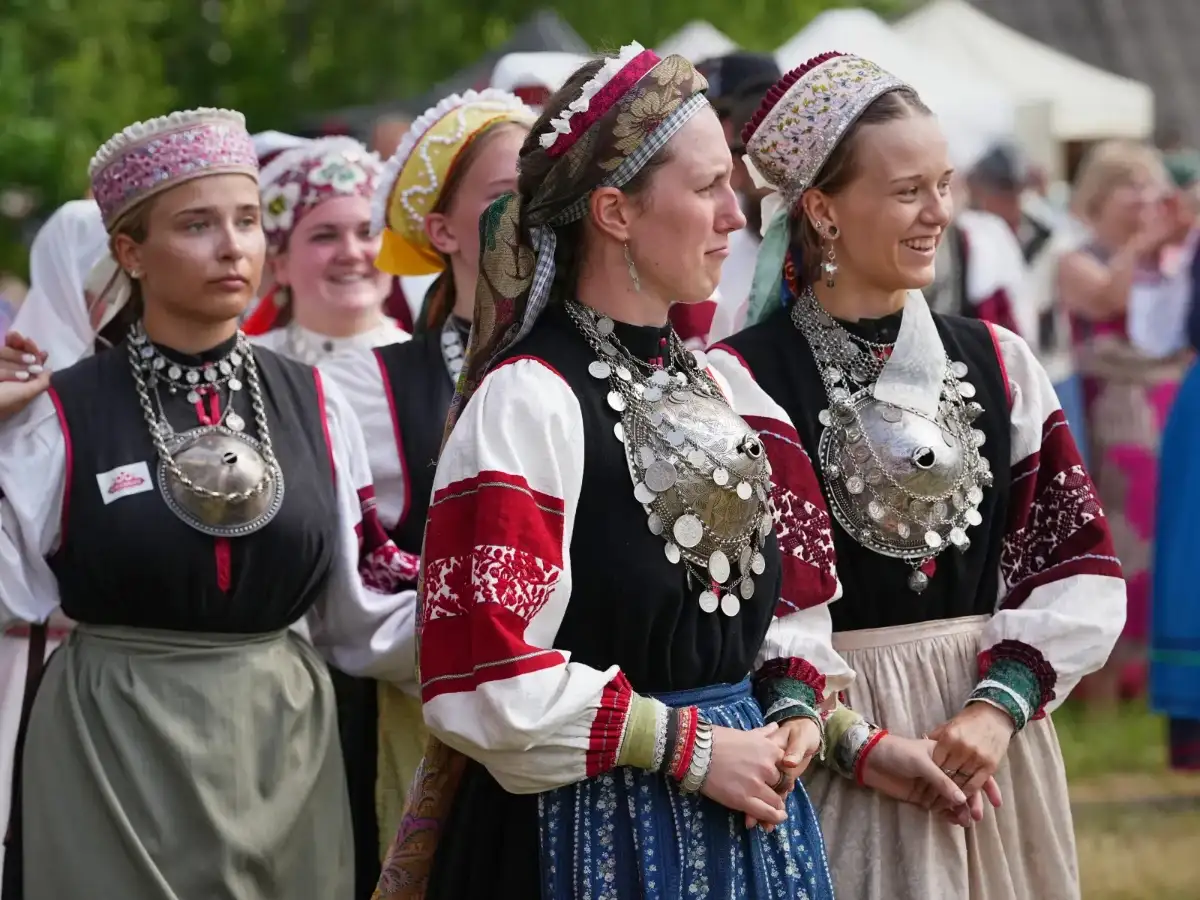
As an accordion plays, 80-year-old Maime Kapten spins across a grassy field, her embroidered skirt swirling around her as the silver chains and coins around her neck jangle with every step.
For one day each year, the quiet village of Mikitamäe in southeastern Estonia transforms into something that does not exist on any map: a kingdom.
There are entry visas instead of tickets, a mock currency, a military parade and an elected community leader who serves as the representative of the mythical King Peko, a fertility god rooted in Seto folklore.
The kingdom is fictional. The culture behind it is not.
The annual celebration is the most visible expression of the Seto people, a small ethnic community whose traditional homeland straddles the border between Estonia and Russia. The Setos have lived in the region for centuries, maintaining their own traditions, songs, costumes and language.
Kapten is one of only a few thousand people who speak Seto fluently in everyday life.
“This is an important cultural day for us,” Kapten said, as cited by AP. “We get to meet people we know, we get to talk, exchange a few words, give each other a hug.”
The kingdom day was created in 1994, after the collapse of the Soviet Union left the Seto homeland divided by an international border. The event was designed to celebrate the community's distinct identity, preserve its language and bring together Setos scattered on either side of the border.
The division has had a lasting effect.
Many Setos who lived on the Russian side eventually abandoned or sold their homes and moved to Estonia. Fewer than 200 remained there. Those living on opposite sides could no longer move around the region as freely as they once had and needed visas to visit relatives and family graves.
Today, Setos live across Estonia, while the Setomaa parish in their traditional homeland has fewer than 3,000 residents.
Also Read: Selena Gomez accused of fraud, sued by investors over collapse of mental health startup 'Wondermind'
According to Estonia's 2021 census, about 25,000 people said they could speak Seto. But linguists estimate that only a few thousand use the language in everyday life.
That makes gatherings such as the annual kingdom day more than a celebration. They are also an effort to keep a culture alive.
A kingdom for a people without one
Mikitamäe is usually a quiet village. On Saturday, however, its streets filled with people wearing brightly colored Seto folk costumes.
A local saying holds that you hear a Seto woman before you see her, thanks to the sound of the silver chains and dangling coins that adorn traditional clothing.
The clothes themselves carry information about the wearer, according to cultural activist Piret Torm-Kriis, 62. A century ago, such clothing was worn every day; today it is generally reserved for special occasions.
“Seto clothes say a lot about the person who wears them,” Torm-Kriis said, as reported by AP. “If you look at a Seto woman, you can understand whether she is married or single, whether she is going to the church or to the market, to a party or to work.”
Seto culture blends Eastern Orthodox Christianity with older pre-Christian beliefs.
Setos attended church while also turning to Peko, a figure in local folklore associated with fertility and regarded as the king of the Setos. The connection survives through the annual election of an Ülemsootska, the community's representative and Peko's messenger.
The election is theatrical but serious.
Candidates — a man and a woman — present their programs to the community while standing on tree stumps. Supporters then line up behind their preferred candidate, holding onto threads that can stretch for hundreds of meters.
This year's longest line formed behind folk costume maker Ingrit Kala, who was declared the new Ülemsootska.
Her priorities include promoting Seto culture and ensuring the survival of the Seto language.
“We have so many different things, so many skilled craftspeople, to show what a rich culture we have and to really introduce it,” Kala told AP.
A language carried through song
One of the defining features of Seto culture is leelo, a distinctive form of traditional singing believed to be more than 1,000 years old and recognized by UNESCO as intangible cultural heritage.
A woman typically begins by singing the first line. A choir joins in on the final syllables, creating a layered sound as the voices merge.
The songs, whose themes often draw on mythology, were traditionally passed from one generation to another by word of mouth. They once accompanied almost every aspect of daily life, from work and rituals to celebrations.
Leelo is also a record of a world that has largely disappeared.
The songs contain clues about how earlier generations understood their surroundings and what they valued, said Mari Palolill, a leelo researcher and teacher, after performing with her choir.
It tells us, she said to AP, “How were they thinking, what was important, what did they believe in.”
That oral tradition remains central to the survival of Seto.
There is now a Seto-speaking kindergarten group in Setomaa, as well as a newspaper published in the language. Several books have also been translated into Seto, including Antoine de Saint-Exupéry's “The Little Prince.”
But the language remains largely a family language, Kala added.
“If Seto isn’t spoken at home, then what children learn at school doesn’t help much,” she said.
For younger Setos, the challenge is not simply to preserve an inheritance but to make it feel relevant.
Maria Grünberg, 23, learned Seto by listening to leelo songs as a child and attempting to sing along. She now leads a youth leelo choir.
Wearing a traditional Seto dress that she customized herself, along with jewelry belonging to her grandparents, Grünberg said she wants younger generations to see the culture as something they can claim as their own.
“We all together try to preserve the songs, the language, and show also other young people that Seto songs and Seto language is not only for old people,” Grünberg said, as cited by AP. “We want to show that this is for everyone.”
For a community whose homeland was split by a border and whose language is spoken by only a small number of people in daily life, the one-day kingdom offers an unusual kind of continuity.
The kingdom may have its own ruler, currency and army, but its real purpose is simpler: to give the Seto people a place, at least for a day, where their culture is at the center of everything.