LOS ANGELES _ The young Ethiopian dreamed of owning his own business. It's what he had worked toward since moving more than a decade ago from Addis Ababa to Los Angeles.
Things seemed to be looking up for the 28-year-old. He taught himself investment banking and day trading and got a job as a project manager for a mortgage company.
But he is also in the country illegally _ a situation further complicated by the color of his skin.
When he accepted his job, he hoped his legal status wouldn't come up.
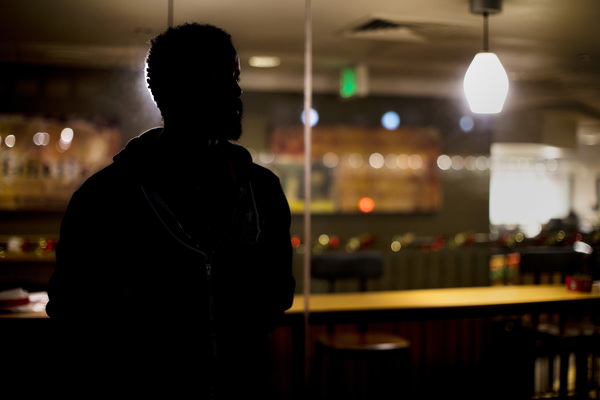
"I didn't know if my direct manager knew about my status when he gave me that offer," he said, asking to be identified as Mesfin for fear of being targeted for deportation. "But we'll see how that turns out."
There are approximately 575,000 black undocumented immigrants in the U.S. By comparison, there are more than 1.4 million Asians and more than 8 million from Mexico and Latin America, the largest group of people in the country illegally.
When angry debates blow up in online forums about illegal immigration and President Donald Trump vows to crack down on it _ including by building a "beautiful wall" _ there is little question about which immigrants are front and center: Mexicans _ and, by extension, many from Latin America.
This sense of constantly being under political siege has created fear, but also a large network of activists and politicians who advocate, not exclusively but most obviously, for the large number of Latino immigrants in the country illegally.
Such a robust network doesn't exist for other groups, especially black immigrants.
According to the Black Alliance for Just Immigration, black immigrants make up one out of five facing deportation on criminal grounds, even though they make up only about 7 percent of the noncitizen immigrant population.
Zack Mohamed, an organizer for the alliance, said he is trying to counter a narrative that illegal immigration is overwhelmingly a Latino issue.
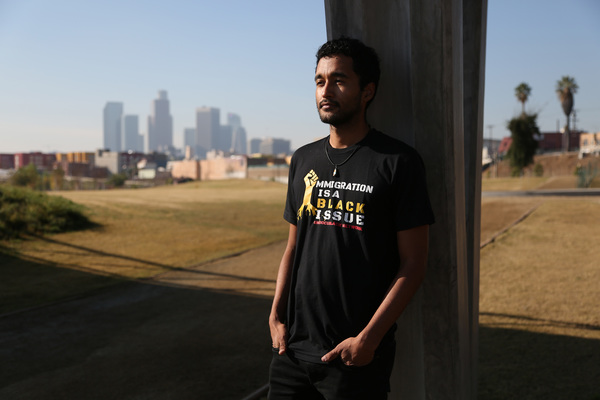
The alliance "was created to basically have the dialogue and the narrative around that black migrants do exist," Mohamed said. "And that is true in L.A., as (it) is (in) all the nation."
Patrice Lawrence, a coordinator for the UndocuBlack Network, invoked the term "driving while black," which is used to describe the racial profiling of black motorists. But she said the feeling is magnified if you're black and in the country illegally.
It's like "the fear that you would have if you were to drive and you forgot your wallet at home and the cops pull up," she said. "Except some of us feel that same level of anxiety every single day."
In addition to the fear of deportation, black immigrants face the same systemic racism that has plagued blacks in the U.S. for years.
"Black people in this country have historically been invisible in a lot of legislation, a lot of public policy," said Abraham Paulos, communications director for the Black Alliiance for Just Immigration. "That invisibility only gets amplified as an immigrant."
After graduating from the University of Southern California with a degree in business, Mesfin was unable to find work in his field. He sought the help of an attorney when President Barack Obama issued the 2012 executive order for the Deferred Action for Childhood Arrivals. The program gave an estimated 800,000 young people renewable two-year shields from deportation and eligibility for work permits.
Through DACA, Mesfin got a job at a bank where he worked for 3 { years, eventually managing more than 20 people. But when it was time to renew his work permit, delays in processing times stalled the arrival of his paperwork and his permit expired, leaving him out of a job.
Though a new contract position seemed promising, in September Trump announced the end of DACA and set a date in March for permits to begin expiring.
Dressed in a salmon-colored button-down shirt from work, Mesfin shared his story in the same place he spent nearly every evening the first year he arrived in the United States: a Starbucks near the Third Street Promenade in nearby Santa Monica.
In 2005, he left Ethiopia to join his brother in Los Angeles. As a student at West Los Angeles Baptist High School, he would study nearly every day after school at the coffee shop, waiting for his brother to pick him up late at night and take him home to the one-bedroom Inglewood apartment they split among five people.
It took him years, but he said he finally felt as though he had found his place in L.A. But the feeling that he never fully controlled his destiny never went away.