Growing up in Peshawar, Saumaira Jabeen dreamed of making a difference – which led her to an unusual career choice. “I wanted to help people from a very early age,” she says. “That is what motivated me to join the police force.”
Jabeen, 32, is a rarity in Pakistan, where women account for just 1% of the police. Raising the number of women officers, and their public visibility, is an important goal of the UK government-funded Department for International Development (DfID) Aitebaar programme, to improve justice services in the north-western Khyber Paktunkhwa province. Peshawar is the capital of this region near the Afghan border, which is one of the most challenging to police in Pakistan.
Ayesha Durrani of development consultancy Coffey International, which manages the programme, paints a bleak picture of life for women in the province. Nine out of 10 experience violence, usually at the hands of family, but few go to police. “It’s OK to hit a woman. It’s OK to throw acid on a woman. It’s OK to kill a woman. These are the areas we live in and the times we live in,” Durrani says.
Most women are not allowed to get education, to work, or even go out on their own without a male relative. “There are so many reasons why women wouldn’t report domestic abuse. They may not be aware that police can help them. Or they feel shame or fear that their husband will beat them more, or that they will become outcasts from their family,” Durrani says.
Such an environment, says Durrani, drastically reduces women’s access to justice. “For a woman to go to the police to make a complaint against a male in her household, that is a huge, huge step.”
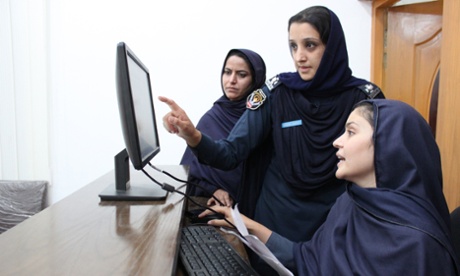
Jabeen is in the frontline of efforts to change this. She runs a special women’s desk right at the entrance to the police station in Peshawar’s Faqirabad district which makes it as easy as possible for women to come and talk to her. She explains that any woman who plucks up the courage to enter does not have to deal with men, or venture further into the building – getting around strict taboos on women entering what is seen as an all-male preserve.
Jabeen’s is one of five women’s desks established by the Aitebaar programme so far. According to UK programme donor DfID, the five stations with women’s desks have seen a 57% increase in reporting of incidents in the past year. Another two refurbished police stations with women’s desks will open next year.
Working on a women’s desk for the past three years has allowed Jabeen to help hundreds of women get justice. She says her job is to ensure that all women who come to her get the help they need. This often means taking a victim of violence to hospital or a women’s shelter and accompanying her through every step of the judicial process.
Jabeen tells of a case where a man kidnapped a young woman when her parents refused to allow him to marry her. When the parents came to the police for help, Jabeen worked alongside male investigators in the three months it took to find her. Then, she was at the girl’s side at all times before she was released from police protection.
Durrani points out that, in most such cases, a family would refuse to take the girl back and she would bear the stigma for life. “The presence of a woman police officer softened the blow to the family,” Durrani said. “It made it acceptable for them to bring her back into the house.”
In another case Jabeen’s unit intervened when parents stopped a girl from going to school, fearing that, when leaving the house, she was coming into contact with a female neighbour who had a bad reputation. The neighbour had reported to police that the girl had marks from being beaten. “We took the case to the courts and got an order for them not to keep her home from school,” says Jabeen. “I also have a daughter and I wanted this beautiful girl to go to school.”
The Aitebaar programme is also helping women officers get equal access to training. Jabeen has been trained in using a computer, forensics and finger-printing – skills she had never been taught in her previous eight years with the police, unlike her male counterparts.
Durrani explains that in Khyber Paktunkhwa women officers have historically been relegated to low-level tasks and never seen in public. “Women want to make a giant leap and be treated as equals, but there’s a lot of resistance to accommodating them,” she says. The existence of the women’s desks “is a statement [to men] that we exist and we can do what you can do.”
That message is one women’s desk officers are taking to the wider community, going to schools to talk about their work. The Aitebaar programme aims to get another 100 women in the province working as police officers to cope with increased demand for their services.
Durrani says an unprecedented 250 women have applied to be assistant sub-inspectors in the province since the programme started – though none have yet made it through the bureaucratic recruitment process.
But Aitebaar isn’t only trying to recruit more women police officers. Coffey believes local women will get better justice if women also take posts higher up the justice system. Durrani says her programme has been supporting female prosecutors with professional training, which it also offers to their male colleagues, mixing in gender sensitisation training.
Sahibzadi Yasmeen, who became a prosecutor in Peshawar after her law degree at the urging of her police officer father, says the programme has made an impact. When she joined three years ago she was only the third woman prosecutor among 150 men, but another 17 or 18 women have joined the prosecution service since. “When I went to the courts in my uniform people started to notice that an educated girl from a reputable family was there, and I became a role model,” she says.
Though not all her cases involve women, judges often ask her to take on women’s cases. “Women talk to us [female prosecutors] more freely and they are able to narrate the facts more easily,” she says.
And while women police officers encounter a lot of prejudice, this seems less of an issue for prosecutors. Yasmeen says that, while male colleagues tend to believe that women should be housewives or working as doctors or teachers, they still respect her as a professional. “Women are more hard working and dedicated,” she says. “They don’t have visitors coming all the time to meet them, they just work.”
Of course, while Aitebaar is starting to bring about change, the road to equal access to justice is going to be a long and challenging one. Durrani points out that the cultural barriers that women have to overcome in Khyber Paktunkhwa start from an early age. “I am from that province and, as children, girls are told not to react or to cry when injustice is done to them,” Durrani says. “It’s not just the role of the police to address violence against women.”
Content on this page is paid for and provided by Coffey, a sponsor of the Guardian Global Development Professionals Network