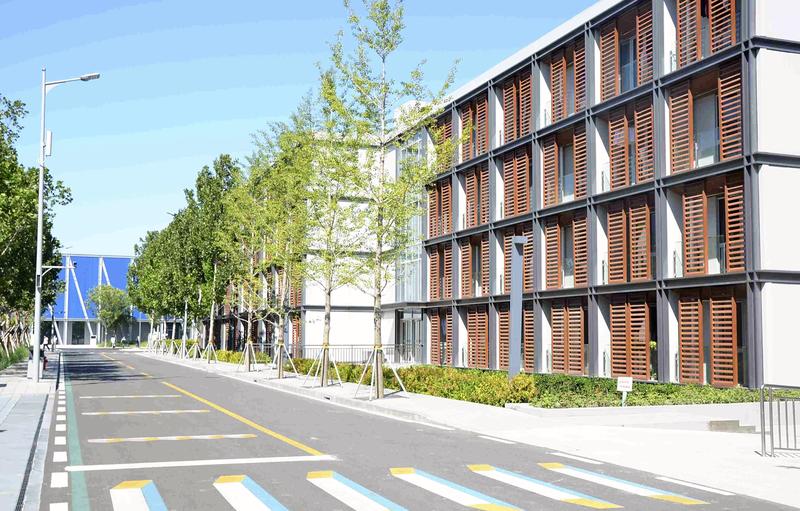
A futuristic city has arisen about 100 kilometers south of Beijing, surrounded by lush greenery and lakes. This is Xiongan New Area, where self-driving buses operate and you can buy bread via facial recognition technology at unmanned supermarkets. This special zone is being developed as part of Chinese President Xi Jinping's "millennium plan."
Development of cutting-edge autonomous driving technology is in progress in the area, which was home to a large amount of farmland until about two years ago. In addition to Chinese companies, automakers from Europe, the United States and Japan, including Volkswagen AG, Ford Motor Co. and Honda Motor Co., are participating in a project dubbed "Apollo," led by internet search provider Baidu.
In China, special zones have been built one after another in such cities as Shanghai, Shenzhen and Hangzhou, to facilitate the development of cutting-edge technologies including artificial intelligence and autonomous driving. The zones have spawned a herd of so-called unicorns, or unlisted start-ups valued at more than 1 billion dollar each.
In August, Tokyo Gov. Yuriko Koike visited Xiongan New Area and Zhongguancun in Beijing, where more than 22,000 high-tech companies are located. After observing the areas, Koike said: "This sense of speed is remarkable. I feel a sense of urgency [regarding competition with overseas cities]."
In China, there are many problems, including the government's control over private companies. There is always criticism that government-led projects are pursued merely as political achievements.
However, regarding the top-down approach of development in China, a senior Tokyo government official said, "It's difficult to develop at that speed in Tokyo."
Utilizing 2020 Olympics
Competition among cities around the world to secure people, businesses and money is intensifying.
According to the comprehensive ranking of the Global Power City Index 2019 published by the Mori Memorial Foundation in November, Tokyo held third place for the fourth consecutive year, after London and New York. The index has six function-specific rankings. Regarding its economy, Tokyo fell from third place to fourth, overtaken by Beijing.
The Tokyo metropolitan government is aiming to move into the lead by taking advantage of next year's Olympics, following in the footsteps of London, which became No. 1 after the 2012 Olympics. To strengthen the international competitiveness of cities, the central government established the National Strategic Special Zones system in 2013, which allows deregulation in specific areas. As of the end of November, 335 projects had been approved in eight prefectures and nine cities.
However, it takes time to obtain approval in the system. For example, it took Tokyo two years and five months to win approval for a project to attract talented financial experts from overseas. The metropolitan government has applied for seven other projects that are still waiting for approval. Among them, the longest waiting time is two years and three months.
A source close to the central government said, "It's also necessary to give consideration to industry organizations that are to be hit hard by deregulation."
According to a senior official of the metropolitan government, "If the situation remains the same, Japanese companies will lose business opportunities to their rivals in China and other countries, even if they have the same technologies as overseas companies."
Experts brought in
The metropolitan government has launched a series of policy measures since autumn, in an effort to win out in the competition among cities.
On Aug. 29, the day she returned to Japan from China, Koike announced that she would promote the introduction of 5G, a next-generation communications standard that would increase communication speed by 100 times from the current level. The most advanced self-driving technology can avoid traffic jams based on sensors in cars. Because these systems generate a large amount of data, 5G is essential.
In September, Koike appointed Manabu Miyasaka, 52, former president and chairman of IT giant Yahoo Japan Corp., to the post of vice governor. He has accelerated the speed of internal decision-making and became famous for his "ultraspeedy management" in the business sector.
"Even if we're twice as fast as last year, that's meaningless if our neighbors are four times as fast. The perspective of 'Did we beat other cities?' is important," Miyasaka, who visited China many times while at Yahoo, told The Yomiuri Shimbun.
On Dec. 16, Tokyo hired nine people with expertise in digital technology. The metropolitan government will also establish a new ICT (information and communications technology) job category when hiring new graduates in fiscal 2021. This is the first time in 46 years that the metropolitan government has set up a new job category.
"The United States and China are both great, but Tokyo needs to compete in its own way," Miyasaka said.
About seven months remain until the Tokyo Olympics. The exhilaration brought about by the Games must be harnessed to improve the future of the city.
Read more from The Japan News at https://japannews.yomiuri.co.jp/