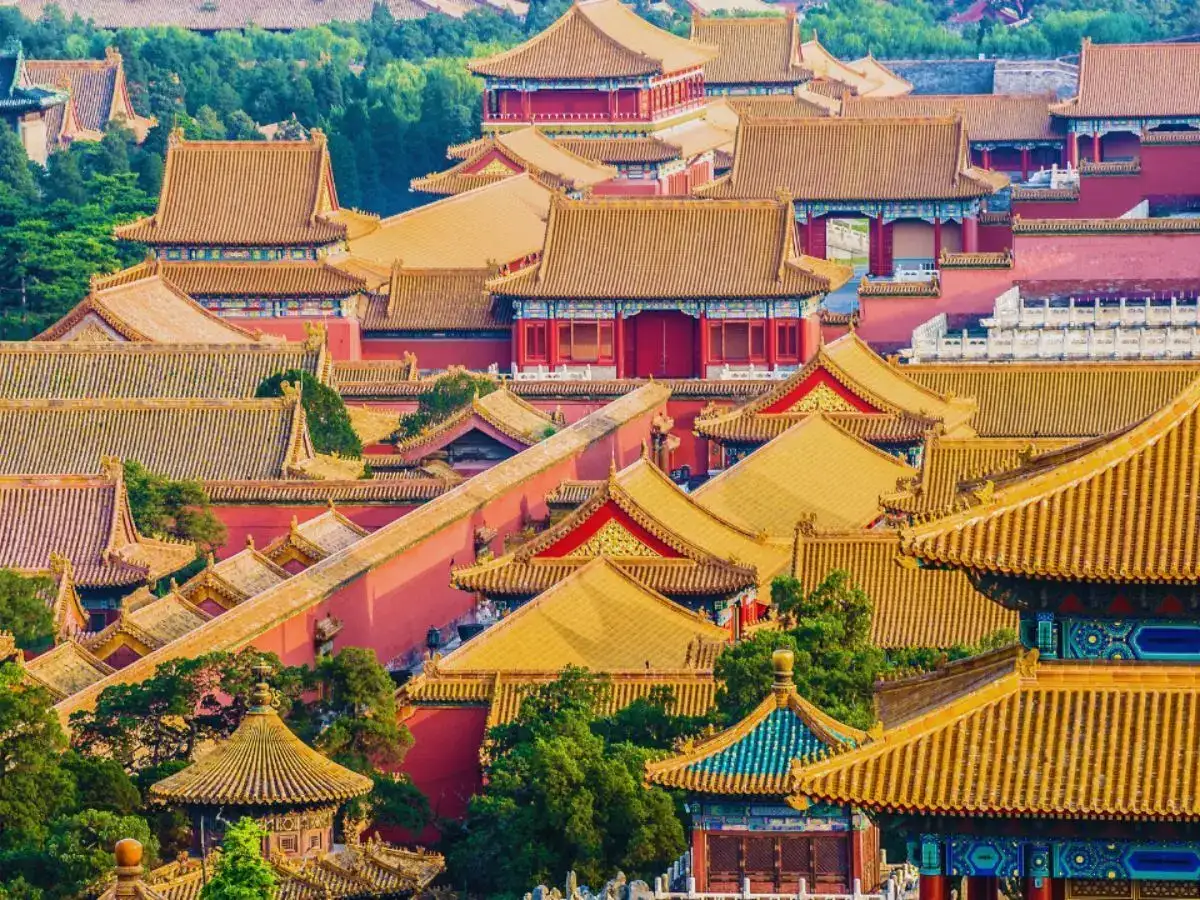
At the centre of Beijing lies a sprawling palace complex that once operated as a city within a city. Known as the Forbidden City, it served as the political, ceremonial and residential heart of imperial China for nearly five centuries.
Its story began during a turbulent period in the Ming dynasty. After securing the throne, the Yongle Emperor moved the imperial capital from Nanjing to Beijing and ordered the construction of a new centre of power.
The result was a vast walled complex surrounded by a moat, designed not merely as a palace but as a carefully controlled world where government, ritual and family life could exist within a single enclosed space.
Why does the layout of the Forbidden City look so organised?
The arrangement of the Forbidden City was shaped by long-standing Chinese ideas about hierarchy, balance and social order.
Nothing was placed randomly. Gates, halls, courtyards and residences were positioned to reflect distinctions between ruler and subject, public and private life, and different ranks within society.
Architecture itself became a tool of governance. Larger buildings, wider courtyards and more elaborate decorations were reserved for those with higher status, creating a landscape where power could be seen as much as it could be exercised.
Even today, visitors moving through the complex follow pathways that once reflected strict social boundaries.
Where did emperors conduct official business?
The southern section of the Forbidden City functioned as the public face of imperial rule.
This was where state ceremonies, official gatherings and major announcements took place. Visitors entering through the main southern gate encountered enormous courtyards and grand halls designed to create a sense of awe and reinforce the distance between ordinary people and imperial authority.
Officials often arrived before sunrise for court proceedings, spending hours waiting according to strict schedules and ceremonial protocols.
The largest halls were not simply administrative spaces. They served as stages where authority was displayed through ritual, architecture and carefully choreographed events.
What was daily life like inside the Forbidden City?
Beyond the formal halls existed a very different world.
The northern section housed the imperial family and formed the private side of palace life. Here, emperors, empresses and other members of the royal household lived among residences, gardens and ceremonial spaces.
Several major palaces occupied the central axis of the complex, each associated with different members of the imperial family and different functions within court life.
Despite their grandeur, some of these buildings proved impractical for everyday living. Over time, emperors often moved into smaller and more comfortable residences elsewhere within the complex, while former living quarters gradually became ceremonial spaces.
How did the imperial household live behind the palace walls?
Life within the inner court followed strict rules.
Imperial consorts lived in separate residential compounds where rank determined accommodation, privileges and access. Architecture reinforced these divisions, creating distinct domestic spaces within the larger palace system.
The palace also evolved over time. During the nineteenth century, renovations carried out under Empress Dowager Cixi altered parts of the inner court and changed some of the earlier arrangements.
These modifications showed that while the overall structure of the Forbidden City remained stable, powerful individuals could still reshape parts of it to suit changing realities.
Did the Forbidden City serve purposes beyond government?
Yes.
The complex was far more than a political headquarters. It accommodated retired emperors, dowager empresses and other senior members of the imperial family.
Religious life also played an important role. Temples and shrines stood alongside residences and ceremonial buildings, reflecting the presence of Buddhist, Daoist and Qing-era traditions within palace life.
As a result, the Forbidden City functioned simultaneously as a centre of government, a family residence and a place of worship.
What happened to the Forbidden City after imperial rule ended?
The fall of the Qing dynasty in the early twentieth century brought a dramatic transformation.
Although former rulers remained in parts of the complex for a period, the palace eventually entered a new chapter as a public museum.
Areas that had once been inaccessible to almost everyone gradually opened to visitors. Restoration projects helped preserve historic structures, while galleries began displaying artworks and treasures connected to China's imperial past.
Today, the Forbidden City remains one of China's most important cultural landmarks, attracting millions of visitors while balancing preservation with public access.
(With TOI inputs)