“I was recently watching the third Test between India and West Indies,” wrote Manas Phadke in July 2011. “I was quite surprised to see Billy Doctrove (who is an umpire) sitting in a stand named after him wearing a Liverpool jersey and kissing the badge for the cameras. Are there any other umpires in international cricket (present or past) who have publicly pledged their allegiance to a football club?”
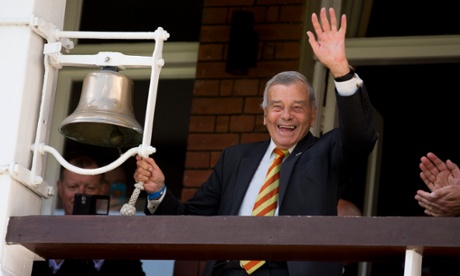
Roy Proctor is on hand with a few answers. “The most obvious cricket umpire to have a publicly acknowledged football affiliation is the incomparable Harold ‘Dickie’ Bird, who in an article for the Guardian in 2008 proclaimed: “I’ve supported Barnsley for 70 years so there’s no way I will miss this afternoon.” The afternoon in question was an FA Cup quarter-final between the Tykes and Chelsea, a match that Barnsley won. “Another, more current, umpire is Ian Gould, a wicketkeeper who played in goal for Slough Town and Arsenal, earning him the nickname ‘Gunner’. In July 2009, Gould became chairman of Burnham FC of the Southern Football League. And although I’m not sure which team he supports, the legendary West Indian umpire Steve Bucknor, like Gould, was a goalkeeper, playing for Jamaica at schoolboy level. He went on to be a referee and took charge of a World Cup qualifier.”
Correct use of ‘United’
“Just along the coast from me Chichester City merged a few years ago with Portfield FC,” wrote Brian O’Valbian in January 2011. “They now go by the somewhat unwieldy moniker of ‘Chichester City United’. Have any other teams got a similar double-barrelled suffix?”
Take heart, Chichester. You are not alone. Just after the Second World War, the Welsh teams Flint Town and Flint Athletic joined forces to become Flint Town United, while over in Cambridgeshire Chris Litchfield reports a similar story at March Town United.
Richard Pattison points us in the direction of the rather brilliantly-named South Hetton Cricket Club Football Club of the Peterlee and District League.
And in Scotland Inverness Caledonian Thistle (a merger of Caledonian and Inverness Thistle) are obvious double-barrellers, while, as Algy Taylor points out, Albion Rovers are worthy of mention, their name being essentially a pair of suffixes.
Also last week, John McDougall asked, on the back of the battle for the Olympic Stadium, if any clubs have changed their names for legal reasons.
“Here in Japan, New Wave Kitakyushu changed to the unlikely name of Giravanz Kitakyushu shortly before being promoted to the J-League,” writes Alastair Bourne. “The club feared that ‘New Wave’ could cause trademark issues, and decided to play safe and go for a name that nobody had registered. Incidentally the name ‘Giravanz’ is a combination of the Italian words for ‘sunflower’, the official flower of Kitakyushu, and ‘advance’ (‘girasole’ and ‘avanzare’). Unfortunately for the J-League new boys there was little evidence of any ‘avanzare’ as their initial season reaped just one win and a league record for the lowest points won.”
The original shootout villain
“Who was the first player to miss a penalty in a shoot-out in a football match in Britain?” asked Albert Lippett some 13 years ago.
Cast your mind back to the summer of 1970, if you will, Albert. Elvis was enjoying a six-week stay at No.1 with the Wonder of You, Carlos Alberto was basking in the glory of lifting the Jules Rimet Trophy for Brazil, and a beaming Ted Heath had just become British Prime Minister. Meanwhile, on August 1, a full-strength Manchester United team found themselves in Hull, playing in the semi-final of the Watney Mann Invitation Cup.
What (or Wat?) you might you ask? And we’re inclined to do the same. Bizarrely, it was a Cup tournament restricted to the two highest scoring teams from each Division - excluding those recently promoted, relegated or in Europe. United made it by scoring 66 goals as they finished 8th in the First Division, while Hull qualified by topping the Second Division scoring charts with 72 goals in 42 games.
More bizarrely still, the FA had decided to allow - for the first time - penalty shoot-outs to be used if the matches were tied.
Guess what happened next? That’s right - both Hull and United made it through their quarter-finals (against Reading and Peterborough respectively) and, when their match finished 1-1 after extra time, the scene was set for the world’s first penalty shoot-out.
George Best took the first penalty, scoring low to the keeper’s right. The next five penalties were also dispatched with ease. And then Denis Law stepped up and saw his penalty saved by Ian McKechnie, thus becoming the first player ever to miss in a shoot-out.
Not that it mattered too much. Hull missed their next two penalties and United sneaked through to the final. You know the rest: that year the shoot-out was adopted by Uefa and Fifa, and before long England and missed penalties were going together as nicely as butter on hot toast.
One final thing: the official Airdrie website - and Knowledge reader Sandy Sneddon - both reckon the first penalty shoot-out occurred in the 1970 Texaco Cup (another infathomable Cup tournament match between Airdrie and Nottingham Forest. However that game didn’t take place until the September 14, 1970. By which time, Smokey Robinson had replaced Elvis at the top of the charts.
Sharing a name
On 31 March 2012, towards the end of Stockport’s heroic 3-1 win at Kettering, a substitution took place with Daniel Lucas Rowe being replaced by Daniel Martin Rowe,” wrote Alex Dixon in, er, 2012. “Both are known as Danny Rowe – is the first substitution involving two players with the same name?”
No, is the short answer. But luckily Henrik Hansen is on hand to elaborate and help us flesh this answer out. “In the 1995-96 Danish Superliga season, FC Copenhagen had two players in their squad named Morten Nielsen,” he reveals. “One of them was usually referred to as Morten B Nielsen (short for Morten Bøhme Nielsen) to avoid confusion. On one occasion, an away game on 31 March at Vejle, the two players were substituted with Morten Nielsen replacing Morten B. Nielsen after 73 minutes of play.”
- Send your questions to knowledge@theguardian.com or tweet @TheKnowledge_GU