“I recall a few seasons ago my club, Wolves, earning a shock win against a then-unbeaten Manchester United in early February,” wrote Daniel Yambao. “This got me thinking, what’s the latest in the season that a club’s unbeaten run has come to an end? Obviously, Invincible seasons don’t count. How about the latest a 100% winning run coming to an end?”
We’ve found a couple of examples of teams losing for the first time on the final day of a season. Perhaps most notably, it happened to Rangers in 1967-68, where not only did the club’s first reverse, a 3-2 slip at home to Aberdeen, deny them an unbeaten season at the very last, but it also denied them the league title. Celtic had been beaten just once in their campaign – at Ibrox the previous September – and won their last 16 league games on the spin to take their third successive championship (they’d win the next six as well) by two points. Ouch.
The 2012-13 Portuguese title chase was a cracker of its ilk, with both Porto and Benfica making it to the penultimate game of the season undefeated. In their 28th game of the season they played each other in a title decider with Benfica two points clear, but they lost that game 2-1 and despite winning their final fixture they lost the title by a point. Worse, having developed a taste for crucial 2-1 defeats three days later Benfica lost the Europa League final by the same score (to Chelsea), and then 10 days after that they lost, again 2-1, in the final of Portugal’s domestic cup, the Taça de Portugal, to Vitória de Guimarães, and so ended the season empty-handed. “It was so hard to take,” said Nemanja Matic, a member of the desolated side and now of Chelsea. “We lost the title, the Europa League and the Portugese Cup in two weeks. These things happen maybe once in a thousand years.”
Another notable undefeated run that ended at the penultimate hurdle belonged to Levadia Tallinn, who having lost only once in winning the 2008 Meistriliiga didn’t lose at all in winning the 2009 title, with four games to spare. Thus when they did lose, with the league trophy already glistening in their rapidly-filling cabinet, to Trans Narva in November 2009 it was a first defeat in a mildly impressive 61 games. It would be wildly rather than mildly impressive had their manager, Igor Prins, not promptly declared that “I won’t deny that we went such a long time unbeaten because of an absence of strong opposition”.
In terms of 100% winning runs, Celtic came very close to a very good one in 2003-04 when they won 25 of their first 26 games, the one hiccup coming, annoyingly, in their very first game of the season, drawn 0-0 at Dunfermline. They next dropped league points in March, when Motherwell grabbed a draw at Celtic Park, and they were then beaten twice in their last six games.
Beyond these shores it’s hard to better Benfica (again), who – having won their last six games in 1971-72 – strolled to victory in the first 23 games of the 1972-73 season, with Eusebio their inspiration, before finally drawing 2-2 at Porto. They went on to register Portugal’s first ever unbeaten season. Britain can claim a hand in it, though – England’s own Jimmy Hagan was in the dugout, and for all their domestic success they were sent tumbling out of the European Cup by Derby County in round two (which allowed them to concentrate on the league, of course).
MULTIPLE GOALKEEPERS
“21 February saw the first league game of 2015 in the Hungarian top flight – the Paks–Nyiregyhaza match was postponed from December. Due to the registration rules none of Nyíregyháza’s winter signings could play in the match (only players registered for the teams back in December were available for selection). That – coupled with injuries and a suspension – left Nyiregyhaza with only 14 players, three of whom were goalkeepers. Goalie Volodymyr Ovsienko started up front on his top flight debut at the age of 36 and played 81 minutes. In the 90th minute the backup goalie Alex Hrabina was subbed in as an outfield player, too. Do you know of any other instances that two goalkeepers played for the same team as outfield players in a top-flight match?” asks Marosi Gergely.
The short answer, Marosi, is no. But the most famous incident of top-flight double-goalkeeper-usage, in England at least, occurred in 2005 when Stuart Pearce, while managing Manchester City in a match against Middlesbrough, replaced a midfielder, Claudio Reyna, with the goalkeeper Nicky Weaver in order to fling first-choice custodian David James up front in search of a late winner.
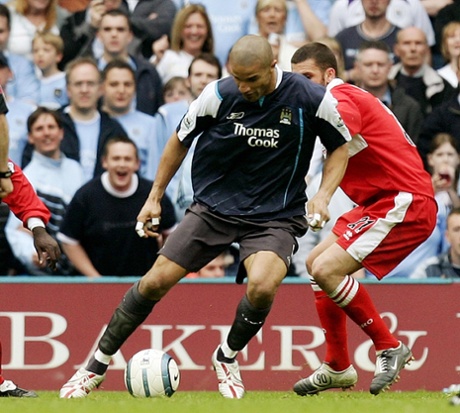
“I sat at home on Saturday night and thought to myself: ‘What shall I do if we’re drawing the game late on and need to hit it long?’” explained Pearce. “I’ve got a good striker in Jon Macken, who is really disappointed, but I wanted to unsettle them and in some ways it did. It unsettled everyone … them and us.” James played in attack for the final two minutes of the game, and five of bonus stoppage-time, in which City won – no thanks to him – a penalty, which Robbie Fowler missed, before the match ended in a 1-1 draw.
The Knowledge could dredge up a couple of comparable incidents, and one of them also involved Pearce. In 2009, now in charge of England’s Under-21s, Pearce saw so many players withdraw from his squad through injury that he could rustle together only four outfield substitutes for a home friendly against Azerbaijan. He merrily used them all up, bringing on Danny Rose, Richard Stearman, Andrew Taylor and Jack Rodwell inside 62 minutes, meaning that when Lee Cattermole hurt his leg with 15 minutes remaining he had little choice but to bring on Joe Lewis, then of Peterborough, as a makeshift striker. Despite the disruption England cantered to a 7-0 win.
“We were at a loss as what to do,” said Pearce. “We used all our outfield subs and Joe put himself forward to go up front. It was a forced sub. Whichever way we did it we didn’t want to be seen as disrespectful. That was the last thing I wanted.”
Finally we found brief mention of a Second Division (in old money) game between Sheffield United and Nottingham Forest in 1936 in which, according to the Mirror, the Blades played “with a goalkeeper on the wing and a back in goal” and still won 4-1. The Guardian reported that “United had their goalkeeper hurt, and another player also injured, but even so were victorious”. If you know any more details, we’d be delighted to hear them.
YELLOW FEVER
“Just noticed Sevilla vs Atletico produced 11 yellows (seven to Atletico) and this made me wonder how many yellows has a team got in a game without any red,” writes Ravid Alon.
We turned up an FA Challenge Cup encounter between Tongham Youth and Hawley Reserves in November 1969, which ended with the referee’s notebook bursting with the names of every single player from both sides – and one of the linesmen.
So unusual was it that a documentary about the game, Booked, has recently been completed. “It got into the Guinness Book of Records but then it just disappeared from history,” Booked’s director, John Bush, tells the Knowledge of the match, which Tongham eventually won 2-0. “There’s nothing on the internet anywhere, and neither club nor the relevant counties had records going back that far. But I managed to track down eight of the original players, and I found the referee, who didn’t want to be involved because he’s still sore after all these years.
“He was in his second year of refereeing, only 23 years old, and I think he had a bit of a problem getting his authority recognised. The general feeling was that he was being overzealous with the whistle, so some of the lads started getting a bit lippy. The rumour was that the linesman, who was also the Tongham manager, had gone onto the pitch uninvited to help an injured player, which is why the ref booked him.”
After the final whistle the referee went into both teams’ changing-rooms and retrospectively booked every player who hadn’t already been booked, for dissent. One player was in hospital at that stage, having sustained a nasty cut to his head, but he got booked as well. Another player couldn’t go to the game at all, so found someone else to play instead of him using his name. He was booked too, despite being at a wedding at the time.
However it only half counts, because at a meeting of the Aldershot FA a few weeks later all the bookings were overturned. And it doesn’t count at all, because one player was sent off. Still, it’s a good yarn.
POISONED CHALICE
“I have a question about a sequence of results,” writes Robin Clarke (him again). “In the First Round of this season’s FA Cup Coventry City lost to Worcester City. In the Second Round Worcester City lost to Scunthorpe United, eventually. In the Third Round Scunthorpe United lost to Chesterfield. In the Fourth Round Chesterfield lost to Derby County. In the Fifth Round Derby County lost to Reading. Has this ‘poisoned chalice’ path to the Cup Final ever concluded with the runners-up?
Really quite frequently, would be the rather disappointing answer. Given that everyone beats someone who won in the previous round, the chain can only really falter at the third round, if the losing side had only joined the competition at that stage. So for example last year’s chain stops with Leeds, losers to Rochdale in round three but not involved in round two (Rochdale then lost to Sheffield Wednesday, who lost to Charlton, who lost to Sheffield United, who lost to Hull who lost to Arsenal). In three of the last four seasons, though, the chain goes all the way through to round one, and sometimes some way further.
You only need to go back two years to find the best poisoned chalice run possible. In 2012-13 Causeway United lost to Continental Star in the extra preliminary round, and Continental Star lost to Stourpot Swifts in the preliminary round. The Swifts then lost in the first qualifying round to Stafford Rangers, who lost in the second qualifying round to Gresley, who slipped up in the third qualifying round to Ilkeston. In the fourth and final qualifying round Ilkeston lost to Fylde, who lost in the first round proper to Accrington Stanley, who lost in the second round to Oxford United, who lost in the third round to Sheffield United, who lost in round four to Reading, who lost in the fifth round to Manchester United. In their quarter-final United lost to Chelsea, who were in turn beaten by Manchester City in the semi-finals, who slipped up against Wigan in the final.
KNOWLEDGE ARCHIVE
“I vaguely recall hearing that Shay Given has a special bottle of water he puts in his goal before every match,” Damien Hensley vaguely recalled in 2007. “Is this really true?”
Well, Damien, according to the man himself, it is. Prior to every game he plays, the Republic of Ireland keeper places a vial of Lourdes holy water at the back of his goal as a lucky charm. “I carry it in my kit bag and it goes everywhere with me,” he told the Irish News of the World in 2002. Apparently, the water carries with it powers that many Roman Catholics ascribe to the Lourdes spring, where apparitions of the Virgin Mary first appeared in 1858. Given also takes a picture of his late mother wherever he goes. “He’s been doing it since he was small,” revealed his father Seamus. “I don’t know how much he remembers her because he was so young when she died, but he doesn’t want to forget about her.”
It won’t come as any real surprise that goalkeepers are as superstitious they come, and myths abound that Arsenal’s will never wear brand new shirts unless they have already been washed. Apparently, this dates back to the Gunners’ 1927 FA Cup final defeat to Cardiff, when Dan Lewis blamed a greasy new woollen top for the mistake that led to the only goal of the game.
Prior to this, the Woolwich Arsenal keeper Leigh Richmond Roose (cited by the Daily Mail in 1905 as one of the capital’s most eligible bachelors, no less) had a similar clothing ritual. Legend has it that Roose played every match with an unwashed ‘lucky’ black-and-green Aberystwyth top underneath his jersey. “Roose is one of the cleanest custodians we have, but he apparently is a trifle superstitious about his football garments, for he seldom seems to trouble the charwoman with them,” read one March 1904 account in Bolton’s Cricket and Football Field. “Considerable amusement was created at Stoke on Saturday and again at Liverpool on Monday, when it was noticed that Roose alone failed to turn out in spic and span garments. His pants, we should say, carried about them the marks of many a thrilling contest.”
CAN YOU HELP?
While reading a glib comment on an internet message board that Manchester City’s defeat to Liverpool had effectively meant that Chelsea won two trophies on one day, I had a thought … has that genuinely ever happened? Teams can obviously win a league if other results go their way and they could, theoretically, be playing a cup final in another competition on the same day. Does anyone know if this has ever happened?” wonders Eoin Byrne
“I am a Celtic supporter. This month we are playing Dundee United three times in a row in separate competitions (Scottish Cup, League Cup and Premiership),” writes Pat Jordan. “Have two teams ever played each other three times in a row in separate competitions before?”
“How big a psychological blow is it to concede right before half time? What percentage of teams have lost after conceding in the 40-45th minute?” asks Michael Hughes.
Send your questions and answers to knowledge@theguardian.com