We asked Guardian readers to share their experiences of football in India via GuardianWitness. From youth football to charity matches and recreational tournaments, five readers share insights about football - both male and female – in towns and cities across India.
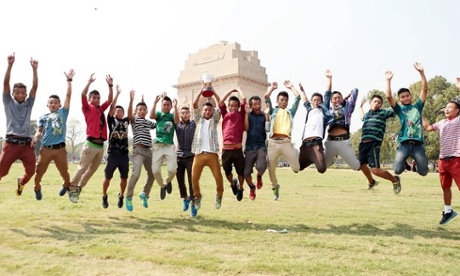
Anshuman Neil Mainkar tells the story of the Subroto Cup; a school-focused junior football tournament held annually in Delhi. It’s India’s largest football tournament at grassroots-level. Originally the brainchild of Air Marshal Subroto Mukerjee of the Indian Air Force back in 1958, the tournament started out with 50 school teams but now more than 20 000 schools nationwide take part. Schools from other countries are also invited to participate and teams from Ukraine, United Kingdom, Switzerland and Brazil have participated. Though the tournament has been running for more than 50 years, the first Girls Subroto Cup only started up in 2011. The successful girls teams are awarded the same amount of prize money as the boys, something that is not always offered at other sports tournaments. The inclusion of girls’ football teams at the Subroto Cup is a significant breakthrough in encouraging both girls and boys to participate in the game at an early age, which will hopefully mean more players continuing the game to a professional level.

An exciting moment in the Afghanistan - Maharashtra match: Subroto Cup
The worthy platform provided by the Subroto Cup, draws teams from all over the world, in the boys as well as the girls category. Although not commercially driven, it has been able to develop a cult following over the past 55 years, thanks to its noble ideal and its promise and potential for the future. OurDreamRun is proud to partner with the Subroto Cup to showcase its talent across the world - breaking barriers of age, race, sex or nationality.
There’s definitely growing interest in girls football in India. Steph Hays and Peter Woolcock are both heavily involved with the Reality Gives Girls Football Program in Dharavi, Mumbai. The organisation’s aim is to break down negative stereotypes about slums and raise funding and awareness for local development projects, such as the Girls Football Program. The Dharavi slum in the heart of Mumbai is one of the largest in Asia. Many girls take on a lot of domestic responsibilities from a young age. This restricts their opportunities to participate in other community based events, and when they do there is often a social stigma attached to them. Steph argues that the aim of the girls football program is to make it acceptable for girls to participate in sport within the community, giving them a chance to broaden their personal development in the process. Christina Sussman has taken this photo of four girls taking part in the program. Sharon, Vaishnavi, Fiona, and Hinduja (from left to right) represent all the separate age categories, from the U12 to the U16s. Hinduja has been part of the program for a number of years, recently taking on a leadership role assisting the coaching of the younger girls taking part.

Reality Gives' girls football program in Dharavi, Mumbai.
The Reality Gives' girl’s football program, supported by tours of Dharavi, aims to make it acceptable for girls to play sport within their community, to offer them escapism, fun, the opportunity to compete and the chance to broaden their own personal development
India’s lack of infrastructure remains one of the biggest challenges facing football participation in the country, and this is something Mark Seagraves highlights in his story. The Football FaktoryTM is a football school based in Delhi which aims to help India’s footballing youth develop their skills, and ensure limited infrastructure doesn’t hinder their potential. It was co-founded by Mark, who himself is both an ex-professional footballer and more recently a UEFA accredited coach. The football school has opened another centre in Dwarka, a city situated in the Western state of Gujarat. A new school has just opened in Goa, and the Football FaktoryTM’s intention is to create many more coaching centres across the country. With India being selected to host the FIFA U-17 World Cup in 2017, it’s important to build on both interest and expertise in the country’s youth football.

Football Coaching - The Professional Way
I have been in India for the past 17 months providing professional coaching to the grassroots of Indian Football. What amazes me is the interest among adults and children alike in the sport, with many children aspiring to be like their international football heroes backed by their parents equally wanting to take every step to fulfill their child's dreams and aspirations.
Despite the ever increasing football fan following in India, the sad truth remains that the lack of infrastructure impedes the country’s progress in realizing its true potential in the sport. Moreover, a majority of Indian children live under the stress of performing in academics and are often not allowed to take up any sport lest it come in the way of their books.
In light of such drawbacks, The Football FaktoryTM has been formed to develop the personal and technical skills of the Indian youth through high quality football coaching. We hope this initiative brings about the desired change in India’s outlook towards football as well as encourage like minded people to improve the quality of grassroots football in India.
Seeing the quality of some of the football pitches here in India, we have decided to start our centers through which we promise to continue striving for quality infrastructure and coaching in India
The Pushkar Camel Fair (locally known as Pushkar ka Mela) is an annual five day camel and livestock fair held in the town of Pushkar in the state of Rajasthan, north-west India. It is one of the world’s largest camel fairs, and has also become increasingly popular with tourists visiting the region. Neenad Arul took this photo of spectators watching the friendly charity football match organised every year by the Pushkar Mele Committee, between local people living in Pushkar and the visiting tourists. These charity matches are friendlies, where a love of the game is the only requisite for taking part. A small amount of money is donated for the welfare of the local people of Pushkar. There’s also an exhibition cricket match staged during the fair, reaffirming that sport plays an important role in people’s lives in this region of India. While Neenad admits he doesn’t follow any particular football team religiously, he likes to play the game with his friends and says football is becoming increasingly popular in several regions in India, second only to cricket.

Formation
Audience watches a Charity football match between Tourists and locals at Pushkar ,Rajasthan,India
Football is hugely popular in Mumbai although, as Nathan Watts explains, taking part in a football tournament during the Monsoon season doesn’t necessarily encourage a skilful passing game. When Nathan worked for a Mumbai advertising agency, he took part in a football tournament with his friends and co-workers. The team consisted of both creatives and account holders, and they were up against other local agencies. The tournament was held over one day at the Bombay Gymkhana; a historical members club during British colonial times located in the southern district of Mumbai. The venue hosts a number of sports events throughout the year, including rugby tournaments.

Monsoon Football
I lived in Mumbai between 2007-2010. This was our tournament team for the advertising industry annual event at the Bombay Gymkhana, held each August.
The rain was still heavy..monsoon water covered the pitch, revealing only smatterings of green where the uneven surface undulated upwards.
How were we going to play in these sodden conditions? Surely the game would be called off? Nonsense! What proceeded was something that more closely resembled water polo. I realised quickly that the locals are highly adapted to this style of football, which involved using your foot to scoop the ball upwards. I never quite got the hang of it!