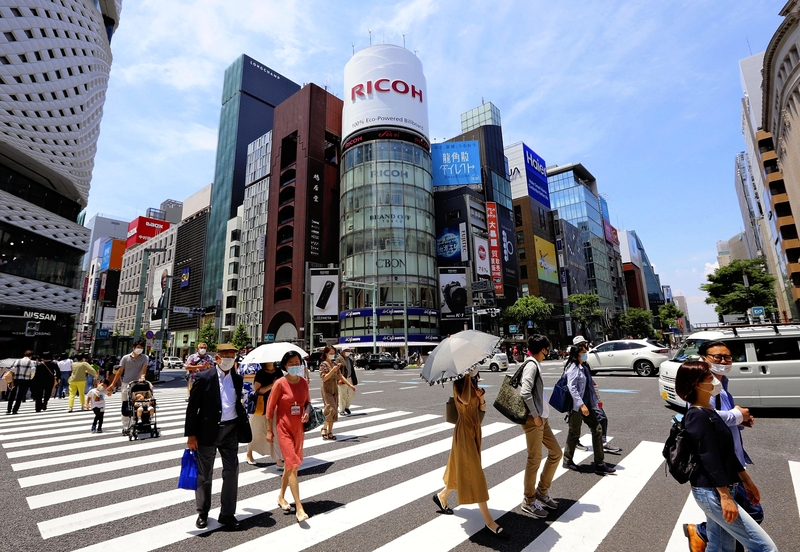
Since the lifting of the state of emergency on May 25, foot traffic in Japan's downtown areas has jumped 50% on weekday nights compared to the week prior to the lifting, it has been learned.
Analysis by Agoop Corp. shows that the number of people seen on weekdays at major stations in places such as Tokyo and Osaka Prefecture has started moving toward recovery.
An IT firm affiliated with SoftBank, Agoop analyzed data on the number of people within a 500-meter radius of major stations, utilizing location information obtained from a smartphone app, the company said.
Agoop compiled location data on people from 9 a.m. to 10 a.m. and from 7 p.m. to 8 p.m. for the five weekdays from May 25, the first week following the nationwide lifting of the state of emergency. These figures were then compared to the average figures for Feb. 3-7 -- the period before widespread infection -- and to those from May 18 to 22, a week before the declaration was lifted.
Compared to the May 18-22 figures from 9 a.m-10 a.m., the number of people during the five-day period after May 25 rose 17% at Shinagawa Station and 15% at Yurakucho Station, both in Tokyo. The data also showed an increase of 21% at Umeda Station and 14% at Namba Station, both in Osaka, while Sapporo Station saw an 8% increase.
The post-May 25 figures for Namba and Sapporo stations were about 60% of their levels in February, while Shinagawa and Yurakucho stations were at about 30% of their February levels.
The data also showed a remarkable increase in nighttime crowds in downtown areas compared to the figures during the day.
When compared with the May 18-22 data for the hour between 7 p.m. to 8 p.m., foot traffic after May 25 was up 31% in Ginza and 28% at Shimbashi Station, both in Tokyo. It rose 55% at Umeda Station and 35% at Namba Station. Hokkaido's Susukino Station saw an increase of 18%.
However, foot traffic during the five-day period after May 25 was only about 50% of the February level at Namba Station and about 40% at Umeda Station.
The firm also analyzed the number of people -- believed to be mainly commuters -- entering Tokyo and Osaka from outside their metropolitan areas between 9 a.m. and 10 a.m. The latest figures showed an increase of 9% in Tokyo and 11% in Osaka compared to the May 18-22 data.
However, Tokyo fell 49% compared to the February figures, while Osaka was down 33%.
Read more from The Japan News at https://japannews.yomiuri.co.jp/