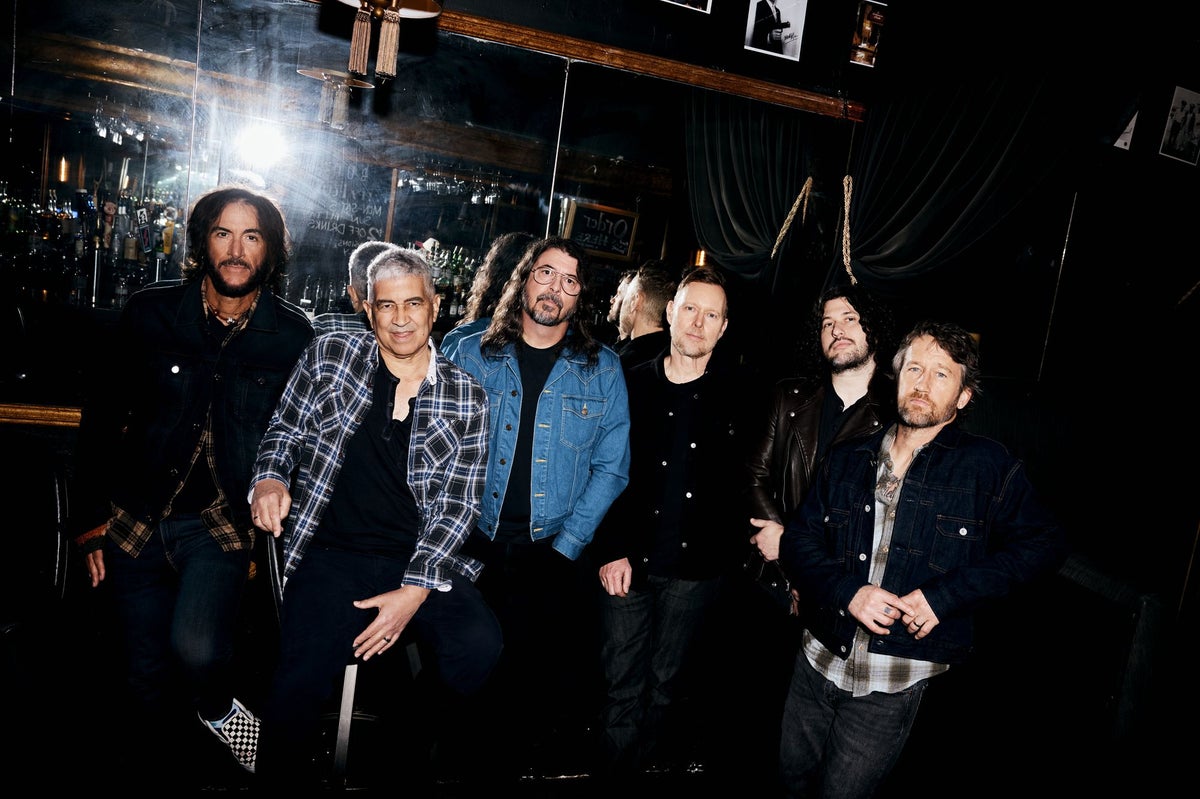
Foo Fighters were not a band known for drama. In fact, when they first started rehearsing in the mid-Nineties, frontman Dave Grohl apparently told bassist Nate Mendel he wanted the band to be “low-drama, and for it to be fun”.
The last few years, though, have been some of the most tumultuous of their career. Drummer Taylor Hawkins died in March 2022, while Grohl’s mother, Virginia, whom he described as his “entire world”, died four months later. In September 2024, Grohl – married to wife Jordyn Blum for 20 years – then made a public statement that he had fathered a baby daughter with another woman. He announced his intention to be a “loving and supportive parent” while doing everything to earn the “trust and forgiveness” of his wife and their three daughters.
Plenty of material ripe for songwriting, then, but other critics reviewing their 12th album Your Favorite Toy have claimed to find little insight into Grohl’s psyche. This is a surprise, as I found lyrics on the record to be among his most self-eviscerating in a long time, and certainly more revealing than he used to be – even the band’s most personal tunes, among them “Everlong” and “My Hero”, tended to be riddled with vagueness. After the numb grief of 2023’s But Here We Are, their first album in the wake of Hawkins’ death, Your Favorite Toy feels like a back-to-basics blast of fresh air, with Grohl using these songs to face up to himself. “Here comes the crash,” he yelps on fiery opener “Caught in the Echo”, “I move in two directions/ I move in complication/ Waiting for intersection.”
Many of these songs seem to take aim at Grohl’s ego – does he think he was caught in an echo chamber of praise, and it went to his head, perhaps? The title track is particularly brutal, from its mocking “nyah nyah nyah nyah” to the lines “Dead gardens from bad seeds/ But nice guys grow on trees” (Grohl is said to have disliked his “nicest guy in rock” moniker). “Get back,” he instructs over waspish guitar riffs, “Hear that, boy?/ Someone threw away your favorite toy.” It’s a particularly candid, and critical, look at the destructive side of fame.
Meanwhile, “Child Actor” confronts his need for validation and the realisation that, for all the fame and adulation, it’s a well that can never be filled. “Turn the cameras off,” he begs in a refrain that grows more and more desperate in the rousing outro. The brilliantly snarky “Spit Shine” unloads lines (“The grass is never greener/ Time ain’t no redeemer”) like a breathless therapy session. “Window” is superb, a slice of Seattle grunge redolent of Soundgarden or, dare we say it, Nirvana, with a scuzzy guitar hook so moody you can practically see those bruised rainclouds overhead.
Grohl does direct his ire beyond himself, too. The furious “Of All People” is inspired by an encounter with a drug dealer from the Nineties who, it transpired, was healthy and sober. Grohl, who has lost a number of loved ones to drugs, was clearly conflicted by this revelation: “And you live happily ever after?” he sings in disbelief, “How can you live happily ever after?” He alternates between reaching out for help or rejecting what sounds like a fake offer of friendship, on dramatic closer “Asking for a Friend” and “If Only You Knew”.
The latter, bristling with venom and with a star turn from new drummer Ilan Rubin, could be a riposte to the pearl-clutching over his personal life (stones in glass houses, etc), as Grohl sings: “Oh no, not you…” It’s a tremendous return, and all the more gratifying for its honesty.