
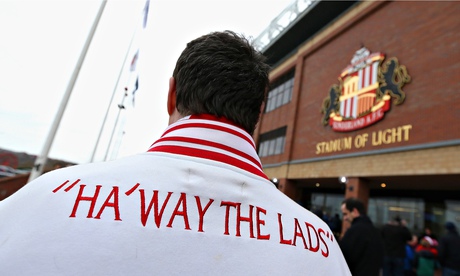
An image of Penshaw Monument is woven into the fabric of Sunderland’s club crest. Perched on a nearby hill, the 19th-century, 70ft folly is modelled on the Temple of Hephaestus in Athens and dominates Wearside’s skyline for miles around.
From a distance the eye-catchingly costly, ornamental structure looks mightily impressive but closer examination reveals that it was not built with anything as mundane as habitation in mind. A landmark so famous it is now preserved by the National Trust has never served any practical purpose.
As Southampton’s team coach heads to the Stadium of Light on Saturday Ronald Koeman and his players may, like legions of passing motorists before them, do a double take when it suddenly rears up on the horizon. Penshaw is perhaps not the only folly they will encounter before heading back to the airport.
At first glance there is much to admire about Sunderland AFC. Their 49,000-capacity stadium attracts the Premier League’s sixth-highest attendances – an average 43,000 – and the club’s training facilities at the Academy of Light are first-class.
Yet behind the magnificent melding of brick, stone, steel, glass, wood and marble something is missing.
Beyond the imposing facade there is a bit of the modern-day folly about Sunderland. Or in the north-east vernacular, a touch of “fur coat, no knickers”. Good people work within but they are not always in sync.
This, after all, is a club standing 18th in the table while paying, according to the most recent accounts, the Premier League’s eighth-highest wage bill. Dick Advocaat is the 10th manager – not including caretakers – in 13 years and there will not be a single product of the club’s academy in his starting XI on Saturday.
Such damaging disconnects are further highlighted by the arrival of Southampton, in so many ways England’s anti-Sunderland. Despite possessing merely the joint-14th costliest top-tier wage bill – £49m as against the Wearsiders’ £70m – Koeman’s team arrive in seventh place with their latest financial results revealing a healthy £29m profit as opposed to their hosts’ £17m loss.
Superficially, there are parallels between the pair with Southampton on their third manager in two years and far from immune to significant player turnover. The differences lie in conflicting implementation and interpretation of the director of football role, the contrasting fortunes of the respective academies and coherent – or otherwise – club philosophies.
Les Reed, a 62-year-old former FA technical director five years into his St Mary’s mission, oversees all football operations embracing the academy, scouting, recruitment and the medical department. In contrast his Wearside equivalent, Lee Congerton – a 41-year-old former Chelsea chief scout and Hamburg technical director – arrived with good ideas but appeared swiftly undermined by spending much of his first year engaged in an unwanted civil war regarding spheres of autonomy with Gus Poyet, the former manager.
With Poyet earlier involved in a power struggle with Kevin Ball, Sunderland’s former academy director, there seemed little hope of Congerton’s initial vision of Sunderland creating an identity rooted in Spanish technique bolstered by British heart taking hold. Let alone an academy which has not produced a first-teamer since Jack Colback suddenly churning out a procession of Gareth Bales and Luke Shaws.
Arguably Sunderland’s biggest problems – predating Poyet, Congerton and their ill-starred predecessors Paolo Di Canio and Roberto De Fanti – have been the lack of what Reed terms a “clear pathway” from academy “campus” to the first team and, crucially, recruitment. Despite an endless kaleidoscope of new faces – the Wearsiders have signed more players than anyone else in the Premier League over the past five years – the team aiming to atone for an 8-0 early-season defeat at Southampton will be ageing, lightweight and extremely slow.
Significantly one signing Congerton was responsible for, Patrick van Aanholt, is Sunderland’s paciest but, presumably in a desire to pacify Poyet, Ellis Short, Sunderland’s owner, and Margaret Byrne, the chief executive, permitted the Uruguayan to hire Liam Bridcutt, Will Buckley, Santiago Vergini, Ignacio Scocco, Ricardo Álvarez and Jermain Defoe.
All have had limited impact, with Álvarez, an expensive loan acquisition from Internazionale, spending most of the campaign injured. Tellingly, no one in Italy seems surprised. It is a similar story with the perenially unfit £8.7m De Fanti/Di Canio recruit Emmanuel Giaccherini.
At Southampton, Reed scrutinises medical reports before sanctioning buys. Meanwhile Southampton’s talent identification operation is so slick that not only were the managerial transitions of Nigel Adkins, Mauricio Pochettino and Koeman near seamless but the collective £88m loss of Dejan Lovren, Adam Lallana, Calum Chambers and Shaw has proved surprisingly painless. Koeman simply welcomed, among others, Dusan Tadic, Graziano Pellè and Fraser Forster for a collective £56m.
The irony is that Short, whose every bad move has been well intentioned, is desperate to mirror similar efficiency but instead contemplates a root-and-branch Championship overhaul.
The words “Consectatio Excellentiae” sit above Penshaw Monument on Sunderland’s badge. Unfortunately the club motto’s meaning – “in pursuit of excellence” – appears to have become lost in translation.
“I don’t really care whose fault it is,” says Advocaat, whose short-term contract ends next month. “It’s a big club a great organisation and I’ll be very disappointed if the worst happens. Hopefully we can stay up and I can help with the set-up here but, if we do go down, I’ll take responsibility.”
It is about time someone did.








.jpg?w=600)



