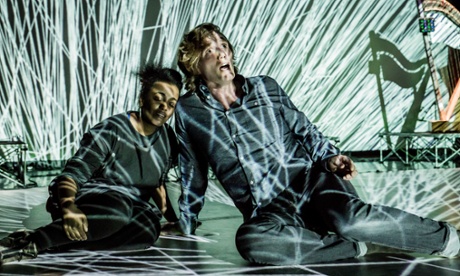
The phenomenon of folie à deux – whereby a psychotic disorder is shared by two people – is the subject of Emily Hall’s opera, which sets a libretto by the Icelandic writer (and regular Björk collaborator) Sjón.
An unnamed man believes that a pylon outside his home is communicating with him. Gradually, his belief begins to transfer itself to his lover, who has previously experienced difficulties in trying to connect with her partner. The result is a shared delusion or, as the synopsis puts it, “their madness takes hold”.
There is certainly potential in the subject, which the small-scale forces used – just soprano Sofia Jernberg as the female character, and tenor Finnur Bjarnason as her partner, plus two live instrumentalists, some beats, and sound design – could have accentuated; but neither the score nor the staging is strong enough to explore questions of sanity and madness other than at the most superficial level.
Part of the problem may be that, according to her librettist, Hall began with the idea of a concept album; the notion of an opera was secondary. Musically, the result feels almost entirely static, something to chill out to, perhaps, but fatally lacking in dramatic momentum.
Frederic Wake-Walker’s staging doesn’t help, using very little movement and sometimes none at all, and failing to develop any real sense of character or narrative.
Purely as sound, Hall’s use of an acoustic harp (played by Ruth Wall) and – imitating the hum of the pylon – a specially constructed electromagnetic harp (John-Paul Gandy), is attractive; so, too, are the voices of the two principals; but very few words make it through the aural haze, while as a drama it is a non-starter.