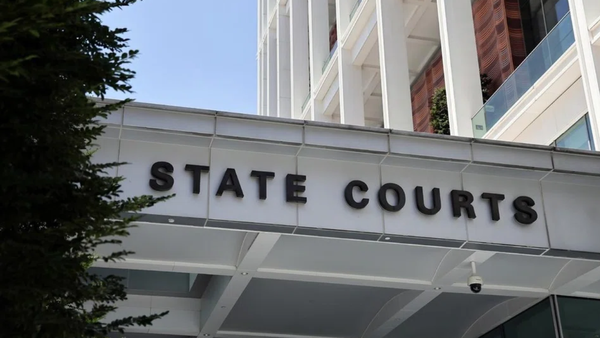

A $2.7 million government-funded shade structure in Darwin's CBD has cooled temperatures underneath it by less than 1 degree Celsius in the two years since it was built, documents obtained by the ABC reveal.
The 55-metre structure on Cavenagh Street was completed in late 2018 as part of the NT Government's plan to transform Darwin into "a cool, tropical, world-renowned destination", after a 2017 heat study revealed some surfaces in the city were hitting temperatures between 45C and 67C.
At the time, Chief Minister Michael Gunner described Cavenagh Street as "a river of fire" and said a reduction of between 2C and 4C was necessary to make Darwin "walkable and liveable".
But two years since the shade structure was built, the street continues to bake in the sun because of the failure of tropical vines to fully grow across the structure's wooden frame.

The lack of a shaded canopy has been blamed on everything from overzealous pruning to a plant disease.
It has also led the CLP Opposition to criticise the heat mitigation project as a farce.
"Anyone could stand under the shade structure, look up and tell you that it's not doing its job," Opposition Leader Lia Finocchario said in November.
Ms Finocchiaro's comments came after it emerged the Government had spent $80,000 on a climate study in Darwin by the University of NSW.
UNSW says $30,000 of that funding has been used to evaluate the shade structure's cooling performance.
The results of the evaluation have now been obtained by the ABC through a Freedom of Information request.

The study, by researchers at the University of NSW, examined temperature data collected at nine locations across the CBD every 30 minutes over separate five-month periods in 2019 and 2020.
The first period, from June to November 2019, showed the average temperature under the shade structure during the hottest part of the day — between 2pm and 4pm — was 30.5C, compared with 30.9C outside of it — a difference of 0.4C.
The second and more recent study period, from February to July 2020, showed the average temperature under the shade structure during the peak heat hours was 31.4C, compared with 32.1C outside of it — a difference of 0.7C, or around 2 per cent.

The study noted that the while relative humidity under the shade structure was higher, the effects of "evaporative cooling" were not being felt because the plants were yet to fully develop.
The researchers concluded that the data from the 2020 study period was insufficient to perform a detailed analysis.

Last week, the Infrastructure Minister reiterated her support for the trial project.
"I, like anybody, would have hoped that those vines grew very, very quickly.
"I would have done everything in my power to make sure they grew quickly but the reality is they will continue to grow."

In a statement, the Department of Infrastructure, Planning and Logistics said it had no current timeframe on when the vines were expected to fully cover the structure.
"The Cavenagh Street shade structure and landscaping was constructed as a trial project to contribute to reducing the ambient temperature in the Darwin CBD by up to 2 degrees and improving thermal comfort ['feels like' temperature] for pedestrians," it said.
Correspondence obtained through FOI shows the UNSW researchers requested a nine-month extension for their shade structure evaluation, adjusting the original deadline from March to December this year.
The NT Government approved the extension as it was agreed there would be no additional costs to the taxpayer.
UNSW has since said it intends to monitor the shade structure's performance for several more years.