
Headline-driven capital flight out of defense equities routinely engineers textbook fundamental mispricings.
When the framework for a Middle East peace agreement hit the newswires recently, algorithm-driven selling accelerated the rotation, triggering a sharp flight from defense and crude oil. The logic appears sound to a passive observer. Fewer active regional conflicts must equal reduced defense spending.
That surface-level assumption completely ignores the mechanical realities of the defense industrial base. The broader market selloff hit legacy contractors indiscriminately, dragging Lockheed Martin (NYSE: LMT) shares down toward below the $529 mark.
Wall Street exacerbated this slide by hyper-focusing on the first-quarter earnings report, in which Lockheed Martin reported earnings per share of $6.44, below consensus estimates of $6.79.
Markets incorrectly conflated this temporary margin compression with long-term demand destruction. The current valuation of Lockheed Martin reflects what may be an overreaction to geopolitical headlines, masking a structural backlog that is less directly tied to near-term peace developments than the stock’s move may imply.
Refueling Mid-Air: A $2.8 Billion Sustainment Win
Military spending operates on decades-long modernization cycles, not daily news cycles.
The United States military is executing a massive, structural upgrade of its air fleet regardless of temporary geopolitical truces. Right in the middle of the sector-wide drawdown, the Department of Defense awarded Lockheed Martin two contracts totaling $2.8 billion.
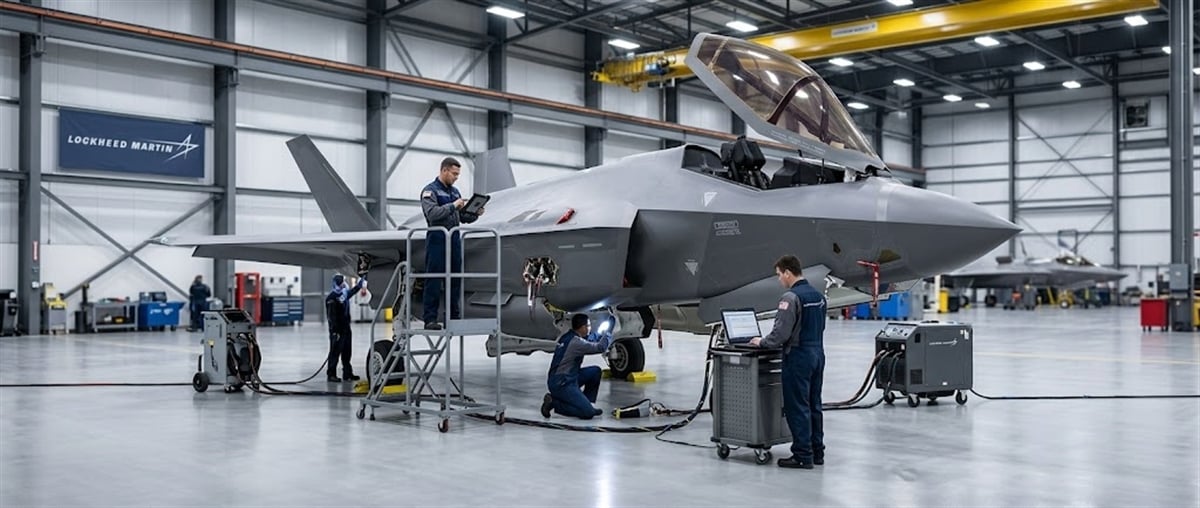
The primary agreement is a $2.29 billion cost-plus-incentive-fee contract for F-35 Lightning II sustainment. In the defense sector, procurement is only the first step in the revenue cycle. Sustainment covers site activation, fleet management, and ongoing reliability improvements. The Department of Defense operates on a recurring revenue model with major contractors. Selling the initial aircraft provides a baseline margin, but decades of required maintenance, software upgrades, and parts replacements drive true long-term profitability for Lockheed Martin.
This sustainment revenue is supported by a severe readiness deficit within the United States military. A recent Government Accountability Office report revealed that F-35 full mission capability rates dropped to a concerning 25%. To arrest this decline, the Pentagon submitted a funding request for an additional $13.7 billion through 2031 to address spare part shortages and maintenance backlogs. Aircraft readiness functions completely independently of active combat deployments.
The Department of Defense also awarded the Sikorsky Aircraft subsidiary of Lockheed Martin a secondary firm-fixed-price contract worth $525 million for the development and modernization of the CH-53K heavy-lift helicopter program. These logistical upgrades highlight exactly how structural spending acts as a financial moat against sector volatility.
Cruising Altitude: Lockheed Martin's $194 Billion Backlog
Understanding the severe disconnect between Lockheed Martin's current share price and its intrinsic value requires a close look at its underlying valuation metrics. Lockheed Martin trades at a forward price-to-earnings (P/E) ratio of nearly 18. The forward P/E ratio measures a company's current share price relative to its projected per-share earnings. Trading at an 18 multiple is highly attractive for a business generating $75.05 billion in annual sales and with a near-monopoly in fifth-generation fighter production.
A price-to-earnings-to-growth ratio of 0.98 signals that shares are priced at parity with projected growth rates. Finding a blue-chip industrial trading at a discount to its growth curve remains a rare anomaly in the current macroeconomic environment.
More importantly, Lockheed Martin has a $186 billion total backlog, which acts as a massive financial shock absorber. A backlog is a list of orders that have been received but not yet fulfilled. When Lockheed Martin's backlog exceeds its entire market capitalization of nearly $124 billion, the downside risk profile narrows significantly.
Current options chain dynamics support this technical floor, indicating a sharp contraction in implied volatility for near-term out-of-the-money puts. Institutional hedging reflects rigid support near the $525 to $530 range, effectively neutralizing downside risk for Lockheed Martin.
Safe Landings: Yield Support in a Turbulent Market
Capital rotating into Lockheed Martin during this drawdown receives immediate, tangible yield. Lockheed Martin approved a second-quarter dividend of $3.45 per share, payable on June 26, rewarding patient capital while the broader market digests the geopolitical headlines.
Institutional desks clearly see the value proposition and are aggressively accumulating shares of Lockheed Martin.
Korea Investment Corp increased its position in Lockheed Martin by 17.1% during the fourth quarter. Top-tier analysts diverge sharply from the broader market's cautious sentiment.
Although the broader analyst consensus remains Hold, with an average price target of about $620.68, Susquehanna maintains a massive $700 price target, and Morgan Stanley holds firm at $653.
These targets imply healthy upside and reflect deep institutional confidence in Lockheed Martin's underlying business fundamentals.
Short sellers hold an anemic 1.15% of the free float, confirming the total absence of genuine downward institutional pressure against Lockheed Martin.
The industrial base is actually expanding capacity to meet structural demand, even as the stock market sells the defense sector on peace news. General Motors (NYSE: GM) is currently in talks to manufacture commonly used weapons parts for Lockheed Martin, aiming to clear persistent munitions bottlenecks driven by recent global inventory depletion.
Final Approach: A Defense Modernization Play
The market fundamentally misprices legacy defense contractors by tying them solely to active regional conflicts. Predictable sustainment programs and structural modernization upgrades constitute a durable financial moat for Lockheed Martin. The recent $2.8 billion in targeted contract awards proves that baseline military infrastructure spending remains incredibly robust.
Investors watching the headline-driven capital flight might consider evaluating how Lockheed Martin's high-visibility Department of Defense cash flow and attractive forward multiple position it for resilient, long-term outperformance.
The article "Flying Under the Radar: Lockheed Martin's $2.8B Stealth Setup" first appeared on MarketBeat.