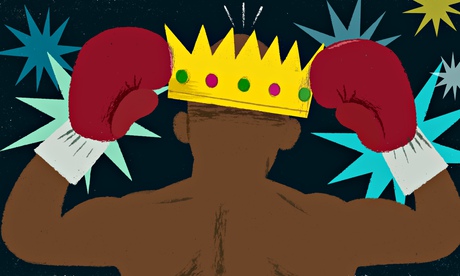
Shortly after victory number 48 was in the books, Floyd Mayweather was asked to assess his genius. “Muhammad Ali called himself the greatest,” he told reporters. “But in my era, I’m TBE.” The Best Ever.
Earlier in the week Mayweather had claimed that he was better than Ali and Sugar Ray Robinson, so this was a minor retreat. Even so, like US presidents in their final terms, there was no hiding his obsession with his legacy.
But while Mayweather’s unstitching of a faded – and possibly injured – Manny Pacquiao enhanced his bank balance by more than $100m [£66m], I am not convinced that it significantly enhanced his reputation.
Don’t get me wrong, Mayweather is a superb fighter. He could teach a trigonometry class a thing or two about angles. He is so good defensively he can leave opponents dazed without even throwing a punch. His unbeaten record includes 10 world titles in five weight categories. And he will almost certainly go down as the finest boxer of this era.
But when you talk about being the greatest ever, as Mayweather does, the goalposts shift. Breaking Rocky Marciano’s 49-0 record will not be enough; no one says the Brockton Blockbuster is the greatest heavyweight of all time, despite the fact he retired unbeaten.
No, the very greatest fighters stretch themselves, by either seeking out the most dangerous opponents in their prime, or moving up the divisions to cement their legacy.
Robinson, Ali and Sugar Ray Leonard were great not because they beat former champions – such as Archie Moore and Henry Armstrong – on the slide but because they never shied away from potential rivals.
By the time he was 25, Leonard had fought Roberto Durán twice, Tommy Hearns and Wilfried Benítez. Later he won titles from welterweight to light-heavyweight and, for good measure, beat Marvin Hagler in a fight for the ages.
Leonard, incidentally, reckoned Robinson was “the most complete prizefighter in history. He could attack. He could counter.” And Robinson also wasn’t afraid of over-reaching. In 1952, having amassed a record of 131 wins, two draws and two defeats, he took on Joey Maxim for the light-heavyweight title.
He weighed 157lb to Maxim’s 173lb and was winning despite facing a far heavier opponent in 103F heat. But then, in the words of AJ Liebling: “When he came out for the 13th he walked as if he had the gout in the both feet and dreaded putting them down, he had quite simply collapsed from exhaustion, like a marathon runner on a hot day.”
Has Mayweather sought out such trials by fire? Hardly. He waited six years so that he could face a much less supersonic version of the Pacquiao who tore through Ricky Hatton, Miguel Cotto and Antonio Margarito. Meanwhile, the Oscar De La Hoya that Mayweather defeated in 2007 had lost two of his previous four contests (and one of the wins, against Felix Sturm, was widely disputed). And Cotto and Shane Mosley were also past their peaks when – after years of trying – they finally stepped into the ring with Mayweather. He is a classy fighter, sure. But he is a clever matchmaker, too.
Admittedly, no one has made more money from boxing than Mayweather, which counts for something. One of the first rules of broadcasting is this: give your audience what they want. Mayweather, though, breaks this with impunity. Blood is rarely spilt. Knockdowns are rare. The action hums rather than cackles. And the sizeable numbers who hope to see him smashed to smithereens are left disappointed.
Against Pacquiao, as so often when Mayweather boxes, the crowd’s noise told you the story of the fight: the cheers of “Manny! Manny!” beforehand, the excitable spasms in the fourth as Pacquiao connected with force and fury, and then the emptying of hope as Mayweather took control.
It has happened so many times before. And yet they still hand over their $100 bills.
What is interesting is that most successful PPV fighters tend to be loved, feared or regarded as exciting – but Mayweather is none of these things. Nor is he overly popular, given the multiple cases of domestic violence against him. It cannot just be because he is a defensive genius. Pernell Whitaker – a four-weight world champion – was tricky yet he never quite flipped over into the mainstream.
It is not Mayweather’s fault that he has outclassed so many of his opponents. But there are still challenges out there; ones that would prove his place in the pantheon mattered as much as his bank balance. A fight with Gennady Golovkin, the unbeaten WBA middleweight champion, who boasts detonators in his fists, would do the trick. But it will never happen; Mayweather is too cautious.
So we are left with unanswerable questions. Is Mayweather really better than Robinson or Leonard were at welterweight? Or a Durán so rugged, indestructible and relentless at lightweight? Meanwhile, when Mayweather claims he has done as much in boxing as Ali did, it is hard not to contrast someone who took on many of the toughest heavyweights in history, as well as the US government, with a man who simultaneously always does enough yet always leaves you wanting more.
Yes, Mayweather will be recognised as the greatest fighter of this era. But the best ever? Not now. Not ever.
- This article was amended on 4 May to correct a reference to ‘Henry Robinson’. It was meant to say ‘Henry Armstrong’.