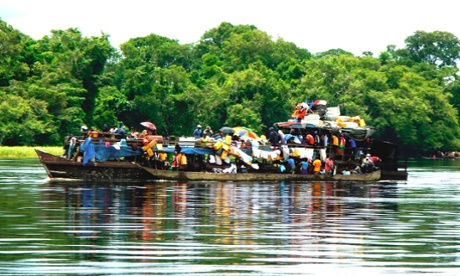
At the bustling port of Mbandaka, market vendors are selling everything from dried cassava and smoked fish to used clothing and shoes. The shouting of offerings drowns out everything but the loud hum of boat engines. There is an air of expectation as traders mill around the port, waiting for confirmation that there is a barge on the move.
Barges fill up quickly with goods: cassava, maize, groundnuts, live goats and chickens. The Democratic Republic of Congo (DRC) is one of Africa’s biggest countries, but has hardly any roads; those that do exist are unpaved and mostly impassable. River transport is the cheapest and most efficient way to transfer goods between Equateur and Kinshasa.
Smoked and salted fish and other food produce from the north make their way downstream to Kinshasa, DRC’s capital located in the west. In return, goods such as batteries, school books, soap and pharmaceutical products are sent up to northern remote rural communities.
The river crosses the equator, so humidity is high. Even at 9am the air weighs down heavily on cargo handlers hauling goods over rickety gangways. Every day boat operators launch vessels from Mbandaka 700km towards Kinshasa having negotiated fees with several traders.
For the boat operators, it isn’t always as simple. Unscrupulous officials and a multitude of taxes, both legal and illegal, push up costs and suffocate trade and investment.
“We face a lot of problems, especially with different government officials collecting taxes. Boat operators often don’t know which taxes they are supposed to pay and what is illegal,” explains Didier Mukoma, president of the Alliance of Congolese River Transporters.
Provincial authorities have long exploited ambiguous taxes to impose numerous and mostly illegal fees on traders and transporters operating along the river. Officials have been known to inflate the value of legal taxes five times over. Provincial governments have no legal authority to levy taxes and also routinely demand a fee for services invariably not delivered.
For this reason ÉLAN RDC, a programme funded by the UK’s Department for International Development (DFID), is supporting river transporters in their efforts to advocate for change. It has brought together many different associations of transporters to discuss the problems they face and form a plan of action. The efforts of the alliance have centred on ensuring government compliance with an inter-ministerial decree that abolished 38 illegal taxes in 2014.
The inter-ministerial ruling, which clearly distinguishes legal and illegal taxes, has had little impact because awareness is low. The DRC is a vast country and the decree has failed to reach more remote regions so provincial authorities continue to levy illegal taxes.
An alliance of river transport associations is now developing a national campaign to inform traders, transporters and provincial authorities about their rights. “If we can preserve our right to work along the river in fair terms, we can start to build up our business. If we can make more trips we can encourage traders and farmers to buy and sell more agricultural produce; it’s a chain that affects everyone in this region,” explains Didier.
The campaign has already seen changes take place in Kinshasa, where the provincial government has signed a mandate to create a one-stop shop for all transport tax payments in order to put end tax discrepancies outside of the city.
The associations are also helping their members with financial training to establish credit and get much-needed investment from banks to improve their barges to make more trips which will enable a faster flow of goods along the waterways that once formed the backbone of the Congolese economy.
Content on this page is paid for and provided by Adam Smith International, a sponsor of the Guardian Global Development Professionals Network.