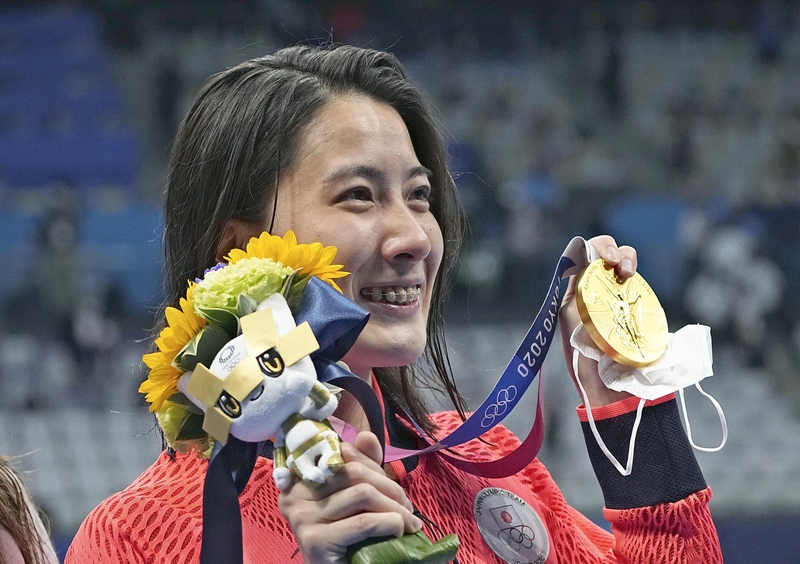
The victory bouquets being presented to medalists at the Tokyo Olympics are composed mainly of flowers grown in the three Tohoku prefectures worst hit by the Great East Japan Earthquake.
According to the Tokyo Organizing Committee of the Olympic and Paralympic Games, victory bouquets were not presented at the 2016 Rio Olympics and the 2018 Pyeongchang Winter Games because they had soon wilted in the past. But the practice has been revived this time through careful quality control. The flowers are meant to convey a message of welcome from the growers.
Eutomas from Fukushima Prefecture are among the flowers in the bouquets, as are sunflowers from Miyagi Prefecture and gentians from Iwate Prefecture.
After Tokyo won its bid for the 2020 Olympics, however, domestic growers pushed to revive the practice, spurred by a desire to honor medalists with high-quality Japanese flowers. They established a system to control the temperature at which flowers were shipped all the way from the production areas to the Olympic venues.
"I grew them with gratitude for the people all over the world who supported us when we were suffering after the earthquake," said a farmer in a quake-affected area. "I'm full of emotion to see the bouquets next to the player's smiles."
Heat-tolerant varieties are also being used to welcome athletes at competition venues.
At the 1964 Tokyo Games, which were held in October that year, producers studied to create flowers suitable for autumn, and the venues were decorated with modified chrysanthemums. As a result, autumn flowers became popular in the nation's horticulture market, which was previously dominated by spring flowers.
This time, a project team comprising the Tokyo metropolitan government and flower producers for the Games searched for heat-tolerant flowers, checking about 940 varieties and finding that 236 were suitable for summer. They were then planted in 28 metropolitan parks.
Salvia and petunia are blooming in blue and pink under the blazing sun near the Olympic cauldron set up in the Tokyo waterfront area, although people are being asked not to visit under the state of emergency.
"It's such a pity they can't be seen by many people amid the coronavirus pandemic, but I hope photos and videos convey their beauty," said Hideki Hayakashi, an official of a waterfront parks managing company that participated in the project team.
Read more from The Japan News at https://japannews.yomiuri.co.jp/