A bandleader from a Florida university faces a prison sentence of up to 22 years after his conviction on Friday for the manslaughter of a popular drum major who was beaten to death in a brutal hazing ritual.
Dante Martin, 27, was the ringleader of a group of musicians from Florida Agricultural and Mechanical University (Famu) who pounded Robert Champion, 26, with fists, drumsticks and mallets aboard a bus outside an Orlando hotel in November 2011.
He will be sentenced in January for his role in Champion’s death, an incident that fuelled a national debate about hazing and led to the university’s president and band director losing their jobs.
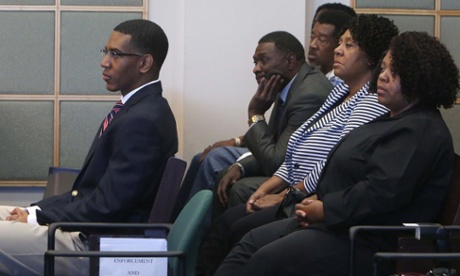
Champion’s parents, Robert and Pamela, who have become advocates for stronger anti-hazing laws since their son’s death, showed little reaction as the guilty verdicts against Martin, for manslaughter and felony hazing, were read.
Prosecutors told the jury of four women and two men during his week-long trial that Martin was the president of the Marching 100 band’s Bus C and decided which members were to be attacked on any given day.
Champion, from Atlanta, Georgia, was known to bandmates as “The Example” for his musical talent, work ethic and opposition to such hazing ceremonies, yet he decided to subject himself to the ritual known as “Crossing Bus C” to gain kudos from his colleagues, according to state attorney Jeff Ashton.
Champion and a number of others were required to run a gauntlet from the front of the bus to the back while under sustained assault.
“He died because his friends beat him to death. The fact that this is a tradition is not a defence to the people involved,” Ashton said.
Martin’s lawyers Dino Michaels and Richard Escobar accepted that Champion suffered a severe beating and that his death was due to “haemorrhagic shock” caused by massive internal bleeding, but argued that he was a willing participant in a what was effectively a competition of strength.
“Brutal as it was, foolish as it was, it was competitive,” Escobar told the jury.
Martin, who did not testify during the trial, was one of 15 band members ultimately charged after the investigation into Champion’s death. Nine have received probation or community service, one was cleared and another, Jessie Baskin, 22, received an 11-month prison sentence after pleading no contest to manslaughter in March.
Proceedings against the remaining three – Benjamin McNamee, Aaron Golson and Darryl Cearnell – who were due to stand trial at the same time as Martin, were postponed to a future date by circuit court judge Renee Roche.
Keon Hollis, Champion’s roommate on the band’s trip from Tallahassee to Orlando to play at the university’s football game in the city, testified that he had also collapsed after being beaten while passing through the bus, and that the ritual that he said probably took only seconds “seemed to last forever.”
An investigation by university authorities revealed that such hazing rituals were commonplace. Julian White, the band’s director, resigned after several months of trying to save his job and Dr James Ammons, the Famu president, stood down in July 2012 following criticism over his handling of the scandal.
The nationally acclaimed band, which had played at a Super Bowl and at Barack Obama’s 2009 inauguration, returned to competition last year after a 21-month suspension.
In closing arguments, Ashton had told the jury that attitudes towards hazing needed to change.
“The last decision [Champion] made in life is an example of peer pressure,” he said. “It is an example that even the best are subject to the desire to be accepted by their peers. It is an example of what happens when decades of indifference and decades of fantasy lead us to ignore the law.”
Champion’s parents have set up a foundation in their son’s name dedicated to eliminating hazing in universities, colleges and schools, and have also filed a wrongful death suit against the university, which they say allowed hazing to carry on unchecked.
Mrs Champion said the word “kind of puts a powder puff on things.”
“If you go out and beat a person to death, you beat them until they die, it’s murder,” she said. “But if you turn around and put the word hazing on top of it, then what is it? It becomes nothing. And that’s what is wrong.”