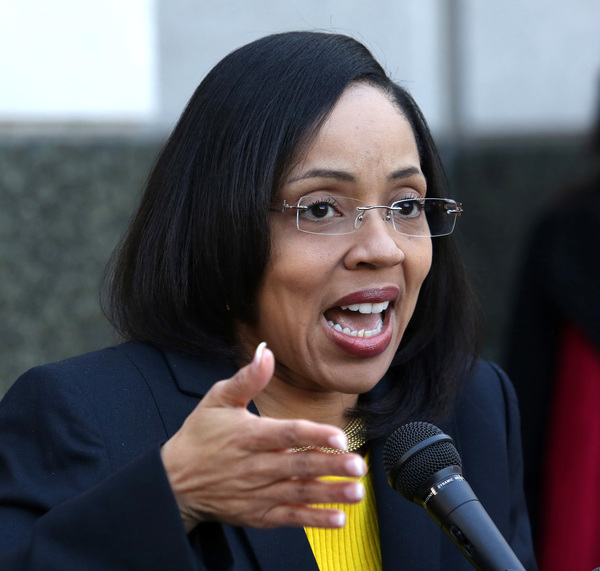
ORLANDO, Fla. _ The Florida Supreme Court ruled Thursday that Gov. Rick Scott has the authority to take death penalty cases away from Orange-Osceola State Attorney Aramis Ayala, who has said she won't seek capital punishment for anyone.
"Far from being unreasoned or arbitrary ... the reassignments are predicated upon 'good and sufficient reason,' namely Ayala's blanket refusal to pursue the death penalty in any case despite Florida law establishing the death penalty as an appropriate sentence under certain circumstances," Justice C. Alan Lawson wrote.
The court was split 5-2, with Justices Barbara Pariente and Peggy Quince dissenting.
"The Governor's decision in this case fundamentally undermines the constitutional role of duly elected State Attorneys," Quince wrote.
Scott called the decision a "great victory."
"Crimes like these are pure evil and deserve the absolute full consideration of punishment _ something that State Attorney Ayala completely ruled out," Scott said in a statement. "She unilaterally decided to not stand on the side of victims and their families, which is completely sickening. In Florida, we hold criminals fully accountable for the crimes they commit _ especially those that attack our law enforcement community and innocent children."
Ayala's spokeswoman and her lawyer did not immediately respond to requests seeking comment.
Ayala, who took office in January, announced March 16 that she will not seek the death penalty for anyone as the region's top prosecutor. She said research showed the death penalty was unevenly applied, put families through decadeslong ordeals, and did not deter serious crimes, among other reasons.
She did not publicly express any opinions about the death penalty during her campaign, in which she defeated incumbent State Attorney Jeff Ashton in an August 2016 primary open only to registered democrats. Ayala did not face real general election opposition in November.
Scott responded to her March announcement by signing executive orders taking death penalty cases away from her office and assigning them to State Attorney Brad King of Ocala, starting with the case of Markeith Loyd, accused of first-degree murder in the killings of his pregnant ex-girlfriend, Sade Dixon, and an Orlando police office, Lt. Debra Clayton.
Since March, Scott has reassigned 29 cases from Ayala to King. Two have gone to trial under King with the help of prosecutors from Ayala's office who had already been working on them: Juan Rosario of Orange County, who robbed 83-year-old Elena Ortega's home, beat her with a blunt object, and set fires in her house; and Larry Perry of St. Cloud, who killed his infant son Ayden when he would not stop crying.
Jurors found both men guilty of first-degree murder and unanimously recommended the death penalty for both. Neither has been formally sentenced.
Ayala filed two lawsuits in April, one with the Supreme Court of Florida and one in federal court. In the Supreme Court case, Ayala asked justices to determine whether Scott has the legal authority to reassign the cases. The federal case was on hold until the Florida court issued its decision.
Scott has used the state's in-house legal counsel to represent him in the suit. Ayala hired Roy Austin, a Washington, D.C.-based lawyer.
In oral arguments in June, Austin said that the governor was taking away Ayala's prosecutorial discretion. State attorneys should be able to decide how to pursue their cases independently and without political interference, he said.
Lawson, the Florida Supreme Court justice, addressed the argument in his written opinion Thursday.
"By effectively banning the death penalty in the Ninth Circuit _ as opposed to making case-specific determinations as to whether the facts of each death-penalty eligible case justify seeking the death penalty _ Ayala has exercised no discretion at all," Lawson wrote. "... Ayala's blanket refusal to seek the death penalty in any eligible case, including a case that 'absolutely deserve(s) (the) death penalty' does not reflect an exercise of prosecutorial discretion; it embodies, at best, a misunderstanding of Florida law."