WEST PALM BEACH, Fla. �� The hurricane season is over, but Florida power customers, consumer advocates and state legislators are still simmering over the effectiveness of the company's electric grid upgrades, and whether the utility can do more to prevent storm-driven power outages.
In September, Hurricane Irma was the first test of a 10-year upgrade of Florida Power & Light Co.'s grid. FPL called its nearly $3 billion in upgrades a success. Yet, Irma knocked out power for 90 percent of its customers.
"How did we do? Cut to the chase. Did we get our money's worth?" said state Sen. Aaron Bean, who chairs the state Senate Committee on Communications, Energy, and Public Utilities, during an Oct. 10 presentation by Florida's Public Service Commission, which regulates FPL and other utilities.
Jon Moyle, a lawyer who represents big power users in the Florida Industrial Power Users Group, said Bean asks a fair question. "I don't think anyone knows," he said.
J.R. Kelly, Florida's public counsel, who represents consumers, said no judgment can be made about the grid's reliability "until you get down to the core _ what failed and why did it fail and how did it fail?"
That judgment initially falls to the PSC. But the commission, which came down hard on FPL after rotted poles were found after Hurricane Wilma in 2005, has done little to follow up.
One reason is that the commission signed off on a 2016 settlement with FPL on its base rate request, as it has in two previous rate cases. No review of FPL's grid spending takes place unless the utility requests a rate increase. Because settlements were reached, there was no evidence or testimony submitted about the $2.78 billion FPL says it spent on upgrades.
"Expenses are only reviewed when the company files for a rate case, then all expenses are audited," said Cindy Muir, spokeswoman for the PSC. As a result of the 2016 settlement, "specific hardening expenses were not identified."
FPL also has not been asked to justify storm recovery charges to customers. That's because the 2016 settlement gave FPL the power to add up to a $4 a month surcharge to customer bills without giving the commission evidence to justify it.
Without the information, consumer and business advocates can't question FPL's recovery of certain costs.
While FPL says its grid held up well during Irma, the utility said it will ask the PSC for $1.3 billion in storm recovery costs. To increase its storm charge from $4 to $5.50 a month on a typical 1,000 kilowatt hour bill, FPL must ask the commission.
PSC Chairman Julie Brown has promised a review of utility restoration efforts after Irma, and is seeking customer feedback. But no date has been set for that review, a spokeswoman said.
FPL customers have filed comments with the PSC:
"I would like to know where $3 billion went in hardening the grid. Considering this $3 billion was spent to make the grid capable of withstanding 140 mph winds, (the grid) seemed to collapse with only tropical storm force winds and a few Cat 1 hurricane force winds," wrote Pompano Beach-area resident Eddie Eastwood.
Debra Dietz, also of Pompano Beach, asked the PSC not to approve more FPL storm charges: "Enough of the greed. They had 12 years to complete a better infrastructure with all the money they collected. ... Florida's Public Service Commission needs to stand up for its FPL customers. This increase is a hardship."
FPL has said a prime benefit of a hardened grid is that main power lines perform 40 percent better day-to-day than non-hardened power lines. "Hardened power lines also performed better during Hurricanes Irma and Matthew, helping to significantly speed our restoration efforts," FPL spokesman Christopher McGrath said.
As of year-end 2016, about 40 percent of FPL's main power lines have been hardened overhead or put underground, McGrath said.
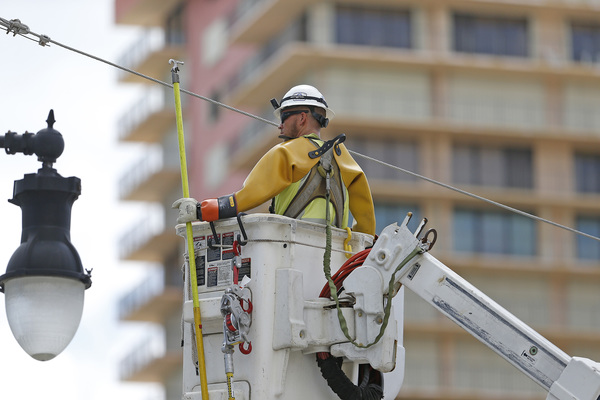
FPL says it spent $2.78 billion since 2006 to strengthen its network for critical infrastructure such as hospitals and community needs including gas stations and grocery stores; replacing wood poles with concrete and steel; installing flood mitigation equipment; stepping up inspections of poles and transmission structures, and trimming trees and vegetation around poles and lines.
Grid improvements lessened damage in Irma, FPL said. While downed trees felled poles, there were fewer than in the last big storm, Hurricane Wilma in 2005. No substations and no transmission structures were damaged.
In 2016, FPL made headway in replacing wooden poles. Only 12 percent remained to be replaced, according to FPL.
But FPL acknowledges that it fell short on goals to complete some hardening, finishing 91 percent of projects for main power lines serving critical infrastructure, and 97 percent of hardening projects of main power lines for community services. The company blamed delays and projects involving underground digging and conversions from overhead lines.
FPL says its 2018 goal is to harden 60 percent of system-wide electricity feeders �� either storm-hardening them or placing them underground. That would be up from the 40 percent hardened by 2016.
The effort to build a more resilient infrastructure began in 2006, after Hurricane Wilma and four other major storms in 2004. Florida's utilities have been required to inspect all poles every eight years and provide "reliability" reports on their grids each March, just before hurricane season. Beginning in 2007, the utilities were required to provide updates on hardening projects every three years.
Vegetation management is another issue. FPL attributed most Irma outages to fallen trees and overgrown vegetation. Reports to the commission show FPL's annual budget for trimming has fluctuated. It was as high as $63 million in 2013, but fell below $60 million in 2016. FPL says trimming is a "shared" responsibility with communities.
In the recent committee meeting, legislators asked how the PSC verifies that utilities are doing the work they say they did.
Cayce Hinton, PSC director of industry development, said the commission relies on utilities for "self reporting." "We don't have inspectors out there following behind them to make sure they're doing what they're saying," he told the committee.