Five more years of pay restraint will cut public sector wages relative to the private sector back to where they were in the late 1990s when hospitals and schools struggled to recruit staff, according to a leading thinktank.
A fall in real wages since 2010 across the public sector has already reduced a longstanding gap with the private sector, the Institute for Fiscal Studies (IFS) said in a report, adding that a continuation of this pay squeeze in the next parliament will send the position into reverse.
Private sector pay is predicted to rise as much as 4% in 2017 while public sector pay is scheduled to be kept to a maximum 1% increase under existing government budget forecasts that also show another 1m public sector posts disappearing by 2019. In the two years following the 2008 financial crash, public sector wages rose 4.5% on average compared to 1% in the private sector.
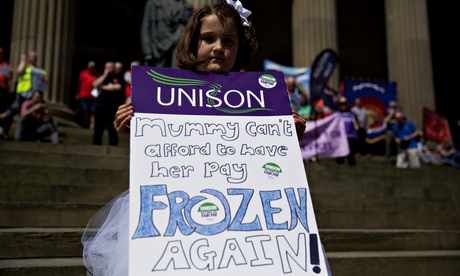
The report comes amid growing unrest in the public sector over the coalition government’s clampdown on public sector pay rises. Health workers are due to strike over pay on Monday for four hours while central government workers will hold a one-day strike on Wednesday.
The IFS, said: “While the public-private pay gap is now back at pre-crisis levels, forecasts from the Office for Budget Responsibility imply public sector pay will continue to grow less quickly than private sector pay over the next parliament. This has the potential to create problems in recruiting and retaining staff of appropriate quality.”
Almost 10,000 nurses quit the health service between 1997 and 1999 after the incoming Labour government agreed to stick with the previous administration’s pay squeeze. It took until 2003 and several billions of pounds training and recruiting nurses to recover the lost numbers.
The IFS and Office for National Statistics have consistently argued that crude comparisons between public and private sector wages are misleading. Public sector workers tend to have higher qualifications and work for longer periods for the same employer, accruing higher wage rates. The main factor separating the pay of public and private sector workers is the poor wages for women in the private sector, which are 7% lower on average than the public sector.
But the IFS said pension contributions should be included in the overall benefits package offered to staff, giving public sector workers a significant boost.
“Focusing on headline pay alone can lead to missing out an important part of remuneration. Without recent reforms, we estimate the value of employer contributions to public sector pensions would have risen from almost 25% of salary in 1997 to almost 35% in 2011, due to factors such as increased life expectancy and the increasing gap between retail prices (RPI) and consumer prices (CPI) measures of inflation,” the report said.
“Reforms introduced by the Labour and the coalition government which substantially reduced this, particularly the move to index current and future public service pensions to the CPI, meant average pension accrual in the public sector fell to 19% in 2011.”
Most public sector workers are members of final salary pension schemes, while the proportion of private sector workers in such schemes has fallen from 38% in 1997 to just 12% in 2012.
“This large difference in coverage of relatively generous schemes is one reason why, averaged across all employees, incorporating the value of employer provided pensions significantly increases the estimate of the public-private pay differential,” it said.
TUC general secretary Frances O’Grady said the IFS report highlighted how public sector workers had suffered a “deep and long pay squeeze”.
She said: “Already the NHS is having difficulty recruiting and retaining staff, and morale has hit rock bottom following the government’s rejection of its own pay review body’s recommendation.
“What is worse is that the pay squeeze looks set to go on and on, which will not only make public sector workers suffer further years of cuts in their living standards, but also hit the quality of the services that bind our society together.
“Public sector workers going on strike next week do not understand why they are not being allowed to share in the benefits of the recovery, when there is cash available for tax cuts for the rich.”