Hearing a child say they spent their school day playing with Lego may not go down well with parents. But these little bricks could become a fixture in maths lessons thanks to a new programme devised by the toy company.
Primary schools have long used Lego informally to teach. However, this month Lego Education is launching a new programme, MoreToMaths, a global scheme especially designed to help teachers tackle key stage 1 maths on the national curriculum using the toys.
The MoreToMaths kit, including lesson plans and teaching guides, costs £750 for a class of 30. While some may be sceptical about Lego’s move into education – and the price that may deter state schools – many teachers have already found cost-effective ways to use Lego in lessons.
We gathered these fun ideas from our teaching community.
Tell stories in Lego
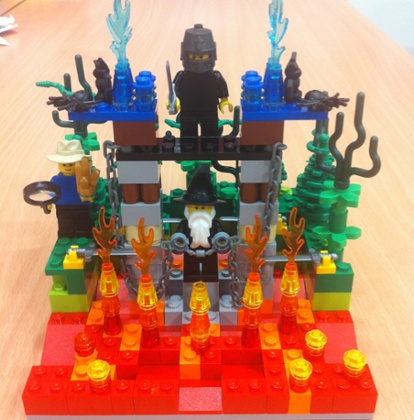
St Richard’s Roman Catholic primary school in Manchester has been using the Lego StoryStarter kit (a box containing more than 1,000 bricks) for more than a year. The resource lets students build stories using Lego characters in imaginative settings. “This helps pupils visualise their stories more clearly,” says Mathew Sullivan, a year 3 teacher at the school.
Sullivan says that the children write stories based on the models they make. The most important thing about using a resource such as this is ensuring that high expectations of work run alongside it, he says. “One of the most effective ways to use Lego in the classroom is to pair it with another exciting stimulus, such as a popular book or film,” Sullivan says.
Text analysis
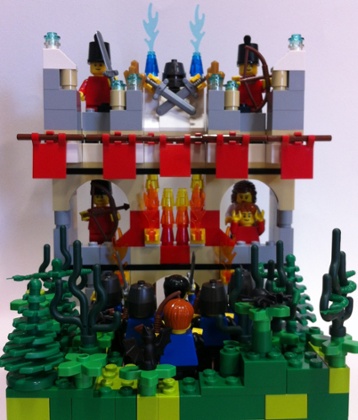
Rebecca Lagden, who teaches at Felsted school in Essex, used Lego in her year 13 English class to put texts into context and help students analyse them. “The individual bricks represent literary devices and the final model is the text,” she says.
“Many students start with the bricks and try to build an argument without understanding the meaning of the whole text. I get pupils to break apart the completed Lego model they’ve built to show the main message of the text and look at it’s component parts.”
We also enjoyed this tweet from Liz Connolly (@lizabold), a literacy co-ordinator and English teacher from Wirral, on using Lego to illustrate Robert Swindells’ novel Stone Code.
@GuardianTeach illustrating Robert Swindells' Stone Cold with Lego. pic.twitter.com/Yb8Ik9M9rs
— Liz Connolly (@lizaboid) January 13, 2015
Katy Mills, based in Ipswich, is another teacher who uses Lego to teach literature. She got her bottom set of year 9s to make a spaceship out of Lego and then created a Top Trump style card to describe it. For each section of their trump card they used a creative writing technique, such as a simile to explain how it flew, when describing the spaceships attributes.
Elements, compounds and mixtures
@GuardianTeach serious lego pic.twitter.com/ZJ42zOrDrL
— H Simpkin (@pipkinzoo) January 13, 2015
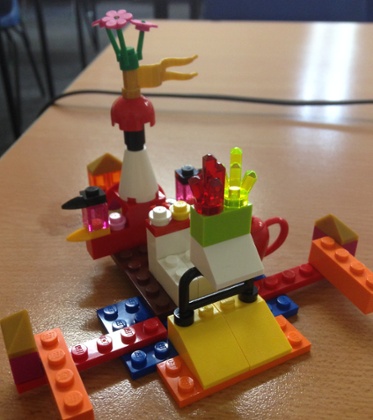
Teacher Hayley Simpkin (@pipkinzoo) uses Lego with her year 7 class as part of a topic exploring elements, compounds and mixtures. Each brick represents a different type of atom and therefore an element, she says. “If the bricks are all identical they are an element. They combine to make different compounds. I ask pupils to make, for example, a mixture of two elements, a mixture of an element and a compound, and so on.”
Simpkin says this is a nice way of showing an abstract concept and can be revisited and extended in later topics. “It also ties into the science Assessing Pupil’s Progress (APP) framework as they can discuss the strengths and weaknesses of using Lego as a model for these ideas. It’s not a perfect model but it does help students to visualise what’s going on.”
Computer coding
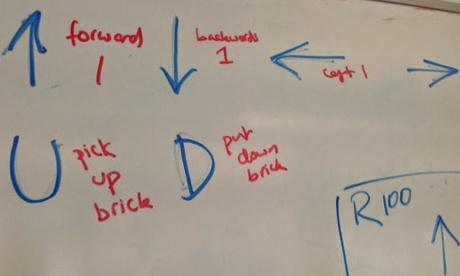
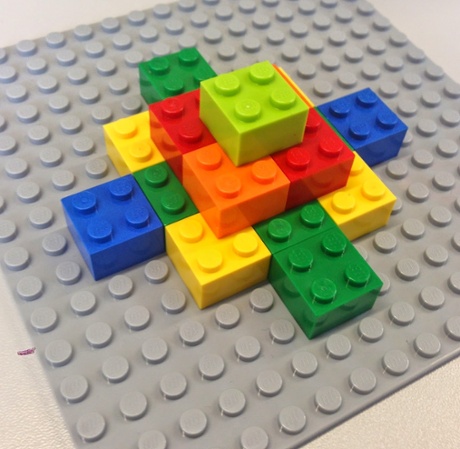
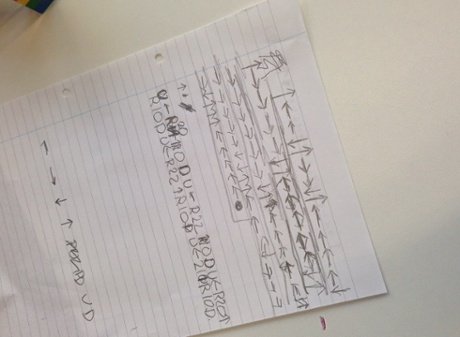
Lenny Dutton, design teacher and librarian, works in an iPad 1:1 school and has been teaching coding using iPads. She and English teacher Michelle Jones devised ways of using Lego in various topics, one of which is coding. “Students were thrilled when they arrived to my design class. I had set up base plates, with five bricks, papers and pens,” she writes on her blog.
The class, working in small groups, made an algorithm to get robots to stack Lego in a certain way. One student in each group played the role of robot. The robots went to the back of the class and followed code that programmers had written to build Lego models. “We decided on simple commands including a set of six arrows, four for direction, one for picking bricks up and one for putting them down,” she says.
Dewey decimal with Lego cards
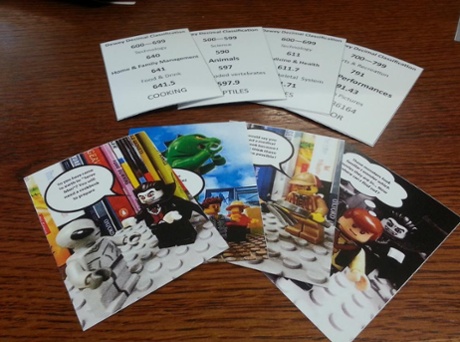
For something a bit different you could use Lego cards to teach the Dewey Decimal Classification System – as the librarian at Farringtons school, Matthew Imrie, has been doing. He designed a card game used from year 7 and up. Each card has been created with Lego mini-figures. Find out how to play the game here.