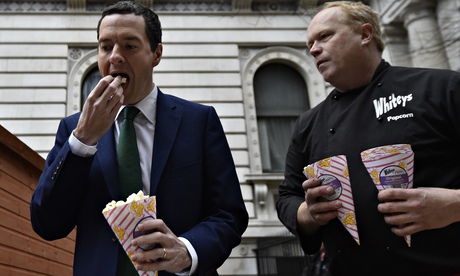
Once the initial excitement had died down over the chancellor’s rabbit-out-of-the-hat moment, making cuts to most homebuyers’ stamp duty, reality quickly set in. George Osborne triumphantly announced in his autumn statement on Wednesday that the deficit was on course to fall in every year, leaving a bumper surplus in the bank for rainy-day spending come 2019-20.
But, with an eye on the general election in just five months’ time, he failed to explain exactly how Britain is supposed to get on that path. The short answer is: with cuts. Even after years of austerity, most public-spending cuts are still to come and will shrink the state to its smallest size in 80 years.
We learned five big things this week about the nation’s finances. They were:
Growth is weak
Some of the cheerier news from the statement was on the UK’s economic performance. Britain is still on course to be the fastest-growing G7 economy this year. The Treasury’s independent forecaster, the Office for Budget Responsibility, revised its forecasts for growth in 2014 up to 3% from 2.7%, and for 2015 to 2.4% from 2.3%.
But after that it tails off. From 2016 onwards growth is now expected to be weaker than previously forecast, slowing the recovery. The OBR also revised its forecasts for every year from 2016 down, ending the period with a prediction of a 2.3% increase in gross domestic product in 2019. Government spending cuts and subdued demand for UK goods and services abroad are expected to weigh on UK growth.
Overseas trade is expected to be a drag on growth rather than a contributor throughout the forecast period, as imports outweigh exports. It is a clear sign that the government’s stated ambition to rebalance the economy away from its heavy reliance on financial services and debt-fuelled spending, towards exports and manufacturing, remains elusive. The chancellor has been pretty quiet in recent months about the target he set in 2012 of doubling UK exports to £1 trillion by 2020.
Elsewhere in the OBR’s forecasts there was good news on unemployment, now predicted to fall even faster, and real wages, which are expected to start rising again next year having fallen for most of the past six years. Inflation forecasts were revised down, with the annual rate expected to return to the Bank of England’s 2% target in 2017 – two years later than the OBR predicted in the March budget.
The deficit is going (slowly)
Borrowing is set to fall this year. It was a relief of sorts, because many commentators believed government borrowing would go up after rising in the first seven months of the fiscal year. There are still five months to go, so the outcome is unknown, but the OBR’s forecasts suggest the deficit will fall to £91.3bn in 2014-15, from £97.5bn last year.
But before considering what happens to the deficit further down the line, it is worth pointing out that £91.3bn is about £5bn more borrowing than the OBR was forecasting back in March. And when Osborne presented his emergency budget in June 2010, shortly after getting the keys to No 11, borrowing this year was expected to be £37bn. The deficit has been coming down but the chancellor has fallen far behind his original plans. Had he succeeded in meeting those targets, he would have been in much more comfortable position with greater scope for pre-election sweeteners.
The most dramatic element of the forecasts last week, however, was the prediction that Britain would swing sharply into the black with a £4bn surplus in 2018-19, rising to £23.1bn the following year. That would be an absolute gift for any chancellor delivering a budget just before the 2020 general election. It would also be the first time Britain has achieved a surplus since 2000-01, under the last Labour government.
We can expect lots more cuts
The chancellor trumpeted the return of Britain “back living within its means”. But he didn’t spell out how we are going to get there. As things stand it will not be through bigger tax receipts, which are now forecast to be £23bn lower by 2017-18 than previously thought. It will instead be delivered through, in the chancellor’s words, “very substantial savings in public spending” or, in the words of tax and spending experts at the Institute for Fiscal Studies, “colossal” cuts.
Welfare will be cut further and, according to the IFS, some government departments will be forced to lop an additional 41% off their budgets, which have already been heavily slashed over the course of the last parliament. A lot of the low-hanging fruit has gone already. Vince Cable, the Liberal Democrat business secretary, described the scale of the cuts that would be required as “implausible”. Many economists agreed. Those who took part in a survey conducted by the Centre for Macroeconomics said the scale of cuts required to reach the surplus was not credible.
The OBR, meanwhile, said that the scale of the cuts implied would reduce the state to its smallest size, relative to GDP, since before the second world war.
It was all very political
The autumn statement was hugely political. Given the scale of the fiscal challenge ahead, with a big deficit remaining and large-scale austerity planned during the next parliament, the shakeup of stamp duty – amounting to a tax cut of about £800m a year – was the big surprise at the end of the chancellor’s speech. A surprise increase in the personal allowance to £10,600 from April and the decision to make travellers under the age of 12 exempt from air passenger duty were other crowd-pleasers.
With just five months to go until the public votes for its next government on 7 May, the appearance of sweeteners was entirely understandable from a man who wants to still be in his job the day after.
Rob Wood, chief UK economist at Berenberg, said: “Putting it bluntly, he raided banks and foreigners to fund politically attractive cuts to stamp and air duty. Economically, the giveaways and takeaways were meaningless. He has an election to win and was probably aiming for stamp-duty changes to distract from the pain elsewhere.”
There’ll be budget tricks too
George Osborne has one crucial performance left before the nation goes to the polls next May, and that will be his 2015 budget. The chancellor has perfected the art of saving the big headline-grabbing measures for last, and it seems unimaginable that the last big number before the election will be any different.
Alan Clarke, economist at Scotiabank, said: “The chancellor’s tried-and-tested method is to pull something out of the bag at the last minute that no one expected. I’m sure there’ll be something. He’s exhausted housing, pensions and savings, so you’d think it would have to be something more mainstream.”
Income tax cuts, or a big move to scale down inheritance tax would both be seen as big crowd-pleasers, but of course, any costly measures would have to be paid for to keep those ambitious deficit reduction targets on track. More than likely, the true extent of the pain to come will not be revealed until the 2015 autumn statement and 2016 budget, when the next government is safely in place for another four or five years.