3-5-2 has potential
Let’s set aside the result of the Chile game for a moment. And, yes, that means setting aside attempts to calibrate the various equivalences necessary to get a true reading of two B teams going at each other in different stages of their domestic seasons. It also means setting aside the significance and subplots of the USA’s current losing streak — for a moment, anyway — and looking at the primary purpose of this particular friendly.
This was a chance for Jurgen Klinsmann to try and balance the strengths of the old and new guard, with at least the first half of the coming World Cup cycle in mind, by sending them out to play a road game against decent opposition in an experimental 3-5-2 formation. And while that also meant the traditional January camp looks, of varying relevance, at possible fringe players it also meant a chance to shore up the USA’s recent tendency to be overrun in midfield, while also giving them some potency in springing numbers into attack.
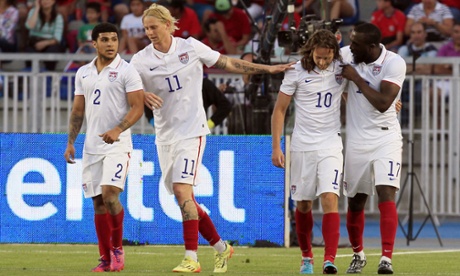
The opening 10 minutes were something of a crash course in the merits and drawbacks of this system. The sight of Brek Shea marauding at speed on the overlap to smash the opening goal was a firm mark in the credit column for the policy of asking him and DeAndre Yedlin to play the wide roles. But a few minutes later, with Yedlin unable to prevent the whipped cross from Mark Gonzalez at the other end, Matt Besler and Jermaine Jones were on totally different pages in the middle as Roberto Gutierrez got between them to glance a simple header home.
There’d be another positive development on the half hour, with Yedlin’s threaded pass from near the corner flag to set up Mix Diskerud’s assist on Jozy Altidore’s goal, but with Shea looking exhausted by the end of the game and clearly still feeling the effects of his long layoff, and with the US formation rendered indistinct, then ragged, with the switch to a 4-4-2 diamond in the second half, by the end of the game the 3-5-2 was almost an afterthought to a more familiar recent narrative of US second half collapses. It won’t be the last we see of it though...
Klinsmann is trying to thread a needle with Jermaine Jones
If that subheading’s an awkward one, well, it’s describing an awkward experiment. One of the more intriguing experiments of the post-World Cup period was the sight of Jones being moved to center back, with the honest, but by the end of the year exhausted Matt Besler deputized to provide the dutiful clearing up where Jones’ lack of natural feel for the position saw him caught out.
If it felt a little strange to see Jones, who’d hit a vein of form driving his new team New England forward to an MLS Cup appearance, playing in a position where his box-to-box willingness appeared to be muzzled, there were moments watching him throw his body around or playing out of the back where it made a kind of sense. Though what gave the experiment most legibility was the idea that Klinsmann might be considering how to extend Jones’s career with the national team through to the World Cup in 2018, when he will be 36.
Against Chile, the results, again, were mixed. Jones playing deeper allowed for the presence of the increasingly tenacious Diskerud in a position Jones might occasionally occupy, but it also invited Chile to whip ball after ball into the box, knowing that a three man defense unfamiliar with each other, and in Jones’s case, unfamiliar with the position, were always likely to allow opportunities.
And so it proved. Gutierrez was a menace all night, and scored one goal on a header he got the better of Jones on, and almost had another in similar circumstances, but for an offside flag. Even when Jones was moved into a more familiar position at the base of a midfield diamond, with Shea and Yedlin dropping back to help defend in a 4-4-2, he didn’t look much more comfortable — if anything he more resembled the player who’d earned a reputation as a reckless yellow card machine in the period leading up to his pre-World Cup renaissance, than the future defensive fulcrum for the coming World Cup cycle.
It could yet work — but it’s a lot to ask of Jones and of Klinsmann’s faith in his ability to sustain that role in the long term. Because if it’s not for the long term it’s currently hard to see what he’s doing there.
Mixed results for the debutants
As is customary with January team camps, the first competitive game saw a smattering of international debuts, and there were some intriguing cameos to look at — even if meaningful data was limited in some cases.
Steve Birnbaum had to endure the sight of a ball deflecting off his thigh and heading goalwards in the second half (a Nick Rimando catch on the line spared his blushes), but was otherwise very solid on his debut, after a rapid ascent with DC United last season.
Bobby Wood made his first start after five substitute appearances, but was entirely anonymous in the first half, other than arriving too late for a Yedlin ball across the face of the goal, and it was no surprise to see him back on the bench for the second half. His replacement, Lee Nguyen, has perhaps been unlucky to see his second chance with the national team coincide with a lull in their fortunes, but other than placing a shot just wide of the post found himself bypassed by Chile’s domination of the second half.
Likewise Wil Trapp, the promising young Columbus Crew midfielder, thrown into a testing period of rearguard action in his half hour on the field, looked indecisive as he tried to find the game.
Perhaps the most intriguing of the substitute cameos was Gyassi Zardes, whose national team debut may have come at just the right time. Zardes arrived in MLS with some of the raw flair and trickery of a Juan Agudelo, but hasn’t seen a national team debut until well after a sustained and necessary period of mentoring by his club mate Robbie Keane. Keane was distinctly unimpressed by Zardes’ penchant for embellishments and stepovers in his debut season, and played a significant part in Zardes’ evolution last season into a player who depends on movement and awareness of his team mates to do his best work.
And in the just over 20 minutes Zardes was on the field it was possible to see the value of some of those subtler virtues as he modestly passed and moved to keep the infrequent US attacks going. And if he might have done better with the shooting chance he got late on, Zardes did enough to suggest his international future might just offer a steady growth into his role rather than a flash in the pan.
New bad habits are starting to die hard
At some point the statistical sample size has to get large enough that even in the apparent phony war period after a World Cup the results do matter. Klinsmann might shrug at that notion, given that he continues to put together the toughest possible schedule for his players, even for these early season skirmishes, but the fact is that going back to the Ghana game that opened the World Cup campaign, the USA have now won just once in nine games, none in the last five, and have lost the last three games.
The most alarming part of the trend has been the second-half slumps that have characterized these games — in this five game winless streak the US have been outscored 9-0 after half-time, and continue to show a worrying penchant for giving up late goals.
And it’s not as if Klinsmann can point to his own need to try out substitutes as the sole reason the second-half has been so torrid of late. In particular the last two games against Ireland and now Chile were against teams in the same experimental boat — both the Ireland team that thrashed the US and the Chile team that eventually outran them on Wednesday were notionally B teams when considering their starting XI against their usual starting line ups.
Whatever the reasons, and whatever the merits of looking at the significance of what’s largely a run of friendlies in a new cycle, the USA’s tendency to run out of ideas in the second half, shortly before running out of defensive concentration or resolve, is not a habit Klinsmann can afford to let get too entrenched. The cumulative value of testing friendlies will ultimately come in acquiring a sustainable winning habit, rather than a reputation as useful but limited international sparring partners.
MLS has a player power headache
If this year’s USMNT January camp has highlighted one thing for MLS, it might be, “Be careful what you wish for”.
The arrival of Clint Dempsey back in the league in 2013 signaled the start of a trend that reached some kind of peak during the World Cup group stages, when seven MLS players started the game against Germany — as national team starters and fringe players alike were lured back to MLS. It was a move that inflated both their market value and wage demands, and inadvertently caused a further ascent in the reputation of one Landon Donovan from American exception to John the Baptist figure.
The fact that several of the returning players, including Donovan, didn’t make Klinsmann’s World Cup squad, didn’t diminish the significance of this latest development for MLS — if anything the recent naming of the MVP trophy after Donovan put down a symbolic marker of how important the return of the favored sons was to the league’s conception of its own future (underscored again on the day of the Chile game with the signing of Sacha Kljestan by New York Red Bulls). That’s if the sight, last fall, of Don Garber’s vigorous defense of the league from the cumulative perceived slights by Klinsmann, wasn’t enough indication of how significant the national team players are to the MLS picture.
Lost in the immediate pre-and-post-World-Cup fallout was another looming date of extreme significance — the expiry of the Collective Bargaining Agreement between MLS players and the league, which will now be the subject of intense focus in the coming weeks before the start of the season. As the league sits down to negotiate in discussions that are expected to focus on raising the salary cap and questions of free agency, they will find themselves facing a player pool boosted by the very domestic exports they’ve re-imported at a premium.
That means players like Toronto’s Michael Bradley, who in the midst of this most recent national team camp was asked if, for example, free agency was an issue worth a player’s strike:
“Absolutely.”
If Klinsmann had been listening in, he could have been forgiven a slight smile before passing Garber his headache tablets.