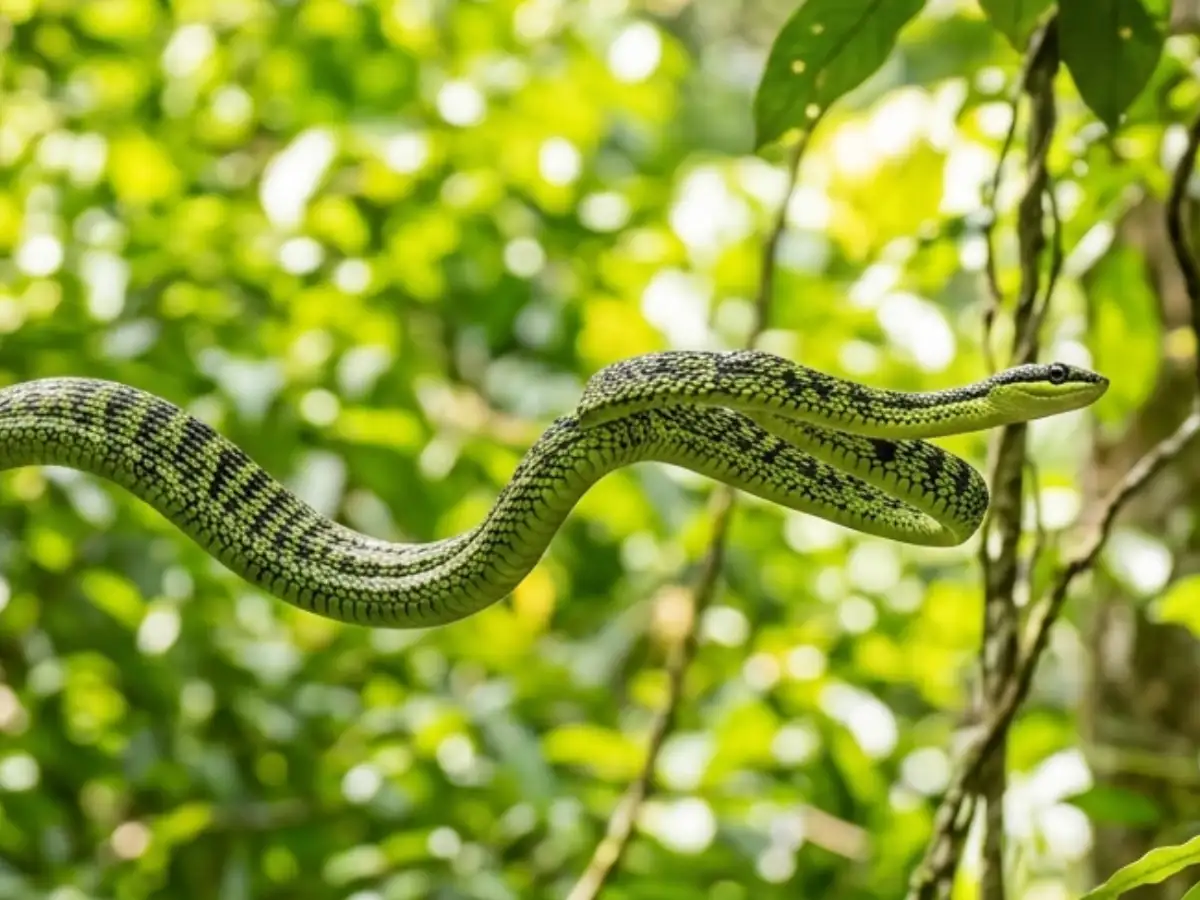
No wings, no feathers, no business in the air, but five species of snake in South-east Asia do just that. They launch off the tops of trees, flatten themselves in the air, and ride the wind between branches like living scaled ribbons. If this sounds like something out of a nature documentary you half-watch at 2 am, wait until you hear how they do it.
What is a flying snake anyway?
The five species, paradise, golden tree, twin-barred, ornate, and Moluccan flying snakes, are all members of the genus Chrysopelea and are found in forests from India to Indonesia. They obviously have no wings. What they do have, however, is an alien-like ability to reconfigure their bodies at will.
As soon as one of these snakes launches from a branch, its muscles flatten its torso from round to almost triangular, like squeezing a garden hose into a ribbon. The flying snake Chrysopelea paradisi generates a geometry that functions as a lifting surface in the absence of wings by spreading its ribs and flattening its body to create a triangular cross-section, according to research published in the Journal of Experimental Biology. That odd, almost UFO-like cross-section is what keeps them aloft, and surprisingly effective it is.
The wiggly secret behind a stable glide
Here is where it gets even weirder. When they glide, these snakes don’t just stretch out stiff and pray for the best. They undulate, sending rhythmic waves down their bodies the whole time. For years, scientists thought this was just a vestigial motor habit from slithering on the ground, something their muscles did automatically, but it’s a lot more intentional than that, actually.
A 2020 study published in Nature Physics found that flying snakes use both horizontal and vertical waves during aerial undulation while gliding. Without undulation, simulated glides were unsuccessful due to roll and pitch instabilities. The addition of undulation stabilized the rotational motion and greatly increased glide performance. In other words, the wiggling isn’t just for show; it’s the whole reason they don’t fall out of the sky.
Researchers at Virginia Tech have turned a four-story theatre into an indoor glide arena, using 23 high-speed cameras and motion-capture technology, and have found that aerial undulation not only prevents the snake from tipping over during glides but also increases both the horizontal and vertical distances traveled.
Why would a snake need to fly in the first place?
Good question. These snakes aren’t migrating or hunting for birds. A 3D kinematic analysis of gliding in Chrysopelea paradisi suggests that the snakes may be capable of using aerial locomotion to effectively travel between trees, pursue aerial prey, or evade predators. It is slow and dangerous to drop to the ground and climb back up in dense rainforest canopy. Gliding is really just a shortcut, and sometimes it saves their life.
The paradise tree snake is the most adept glider of the five species, capable of glide ratios up to 4.5 and displaying active turning in mid-air. To give you some context, a glide ratio of 4.5 means it moves 4.5 feet forward for every foot it drops. That puts it in the same category as flying squirrels.
Where to spot them (if you're brave enough)
These snakes are arboreal, meaning they live almost their entire lives in trees. Their range includes the mainland, Greater and Lesser Sundas, Maluku, and the Philippines, and extends to southern China, India, and Sri Lanka. Lowland tropical forests are the sweet spot, especially places with tall, dense canopies where it actually makes sense to glide from tree to tree. blogspot.com
If you’re the type of person who visits Borneo or Thailand with a wildlife checklist in hand, these snakes are on the harder end of the scale. They are small, fast, and most active in tree canopies far above eye level. Your best bet is in the early morning when they are warming on the tips of branches. Look up and maybe get a longer lens.
For most of us, the footage that researchers have gathered is more than enough. Watching a snake launch itself into the open air, flatten into a wing, and coast between trees is one of those moments that makes the natural world feel really, absurdly cool.