
At the beginning of this year, xAd’s marketing insights team called out five key mobile trends for the year. Following Mobile Marketer’s annual Mobile Research Summit in New York, we want to draw attention to some updates and a couple of new figures on mobile use and location-based advertising.
1. Mobile phone addiction reaches epidemic level
Consumers are more addicted to their phones than we thought. From the moment we wake up in the morning, we crave our phones – so much so that 79% of US adults aged 18-45 reach for their smartphones within 15 minutes of waking up, according to research from John Jackson and team at IDC.
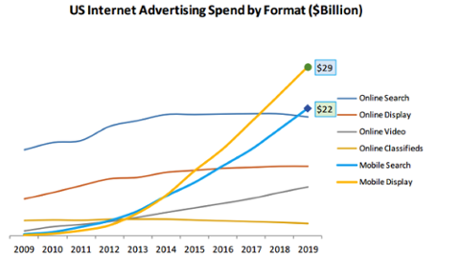
We also love apps – IDC forecasts that global app installs will exceed 150bn this year. With this kind of use, it’s no wonder Jackson is optimistic that mobile ad spend will outpace all other internet advertising formats, as the chart below indicates.
2. Location targeting drives big returns in media and advertising
Rick Ducey and the team at BIA/Kelsey shared some interesting stats on smartphone and mobile location use in the US. Smartphone penetration in the US is now 72%. 30% of all search volume comes from mobile, and of that mobile search volume, 50% is for local businesses or services. Marketers are responding: location-targeted advertising will make up 35% of mobile ads this year, and by 2019 it’s share will rise to 43% ($17.86bn). Additionally, BIA/Kelsey reports mobile targeting is proving popular among consumers. On average, hyper-geo targeted advertising has an 80% higher click-through rate than standard targeting on mobile.
3. Mobile’s role in the digital divide is defined
Deloitte Digital presented insights on navigating the divide that can exist between bricks-and-mortar and digital retail. Deloitte’s findings indicate physical stores maintaining a digital presence significantly increase revenue, and mobile turns out to be a critical component of this. For instance, this year 28% of all in-store purchases were influenced by mobile ($0.97tn), whereas three years ago this influence was estimated at just 5%.
Research from Deloitte also indicates mobile has a critical role in helping consumers spend more when they do purchase. One in three consumers spend more when they use their device in-store to research their purchases. This was attributed to the increased confidence of consumers who read product reviews and compare prices. Shoppers in store who use their phone to assist in making a purchase report spending 20% more than those who didn’t.
Mobile devices make shopping easier for most; Deloitte found that 45% of shoppers report increased shopping ease when they use their device while in-store.
4. Apps connect with apps
We are seeing a rise in the hyper-connected app, which connect to other applications on a device to cross-leverage individual app utilities. For instance, you can now hail an Uber ride from within the Google Maps app. Increasingly, application programme interfaces (API) and software development kits (SDK) are becoming readily available in the app world – developers are relying more on other companies to house data and handle consumer payments than they have in years past.
5. More of the same: Americans now using the same apps for longer
Nielsen shared trends in the US indicating smartphone adoption is beginning to plateau, while smartphone usage continues to rise. The increase is driving growth in overall media consumption.
Consumers are spending their additional mobile time in apps. Since 2012 app use has grown year on year at rate of at least 23%. Some are surprised to learn that this growth continues while the number of apps used per month remains largely unchanged. Today’s consumers are getting more use from the same apps than they have in years past.
Mobile use rates continue to grow in part because smartphones allow users to engage with devices while participating in other activities. In the US, consumers tend to use their smartphones while they are waiting for someone or shopping and running errands. The mobile utility of tablets is recognised while at home, the top activities done in conjunction with tablet use are watching TV and lying in bed.
Moving forward
Consumers are more mobile focused than ever. The need to adopt advertisement strategies to respond is more important than ever. To learn more about how to more effectively engage with consumers on mobile, visit our website.
For more on the conference, including full reports from the presenters, visit Mobile Marketer here. For additional insight on US and global mobile usage, check out xAd’s 2015 State of the Market report and our Location University Library.
John Duncan is research manager at xAd
This advertisement feature is brought to you by xAd, sponsors of the Guardian Media Network’s Future of advertising hub.