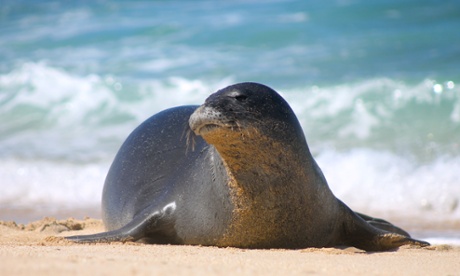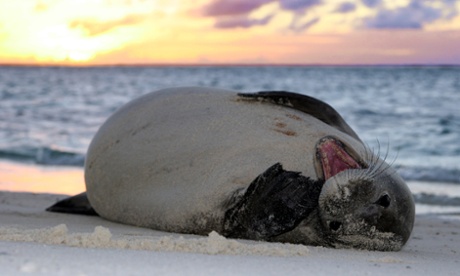
The Hawaiians call their monk seals ilio-holo-i-ka-uaua or “the dog that runs in rough water,” but when I see my first one, I think: whoa, that’s more like a bear. And indeed, a female Hawaiian monk seal weighs up to 240 kilograms – about the size of a Eurasian brown bear. Although the Hawaiian monk seals are clearly powerful, hefty animals – twice as heavy as an English mastiff – their wide, black, velvety eyes make them hard to resist. And I find myself quickly enamoured.
You may think I’m on a Hawaiian beach soaking up the sun when I see my first living, breathing monk seals, but I’m not. I’m thousands of miles away in the cold, landlocked Midwest at a press event a few days before the public debut of five female seals at the Minnesota Zoo. It’s a landmark debut: these are the first Hawaiian monk seals on public display outside of the Aloha State.
“We have been working for a long time to get more high quality zoos and aquariums to house monk seals,” said Charles Littnan, a lead scientist and monk seal expert with NOAA. “Most people in the U.S. don’t realise there is species of seal, an old and unique species, struggling against extinction in Hawaii. The Minnesota Zoo brings the seals’ plight to over a million people every year, people far removed from the tropical shores of Hawaii.”
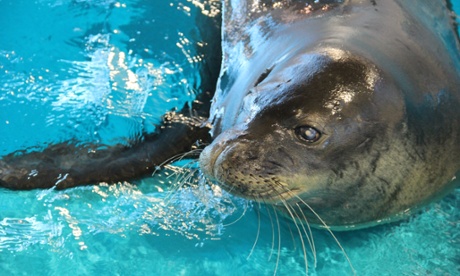
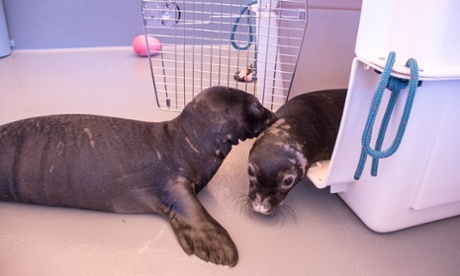
The five monk seals at the zoo – Nani, Paki, Koa, Ola and Opua – weren’t born in captivity, but had been brought into rehabilitation centres by conservationists. Unfortunately, all of these five females suffered from serious eye problems, which meant releasing them back into the wild would have been a death sentence. The decision was made, instead, to bring them to a first-class facility like the Minnesota Zoo where they can act as ambassadors for an endangered species that, despite conservationists’ best efforts, continues to decline.
“The seals in our care help to raise awareness of the conservation challenges Hawaiian monk seals face today,” said Melanie Oerter, a marine mammals zoologist at the Minnesota Zoo. “When our guests have the opportunity to connect with animals by seeing them personally, it can greatly raise awareness, compassion and concern for conservation.”
Only around 1,100 Hawaiian monk seals survive today and the population continues to fall more than 3 percent every year. Despite decades of conservation action, extinction remains a very real possibility. Indeed, the species’ closest living relative, the Caribbean monk seal, vanished forever in the 1950s after centuries of slaughter.
“[The Caribbean monk seal] demonstrates how vulnerable a critically endangered species can be and the reality that a species can become extinct within a person’s lifetime,” noted Oerter. “Without action...the Hawaiian monk seal could also face extinction in the not too distant future.”
And if we lose the Hawaiian monk seal, we lose an entire distinct lineage of ancient marine mammals.
The story goes like this. Around 14 million years ago, the first monk seals evolved. Eight million years later, the Old World monk seals (i.e., the Mediterranean monk seal) split from its New World relatives, which had made their homes in the Atlantic and western Pacific. Then the Panamanian isthmus rose, separating the now-extinct Caribbean monk seal from the Hawaiian about four million year ago.
This evolutionary tale, only put forward by scientists last year, means that the Hawaiian monk seal is the last survivor of a newly-created genus Neomonachus. And the Mediterranean monk seal is the only surviving representative of the genus Monachus. Both seals house a treasure-trove of evolutionary and genetic distinctness and have been described as ‘living fossils.’
“[This] raises the stakes involved in their conservation by making it even clearer how much unique evolutionary history of the seal family would be lost by the extinction of either of these critically endangered animals,” Kristofer Helgen told Mongabay last year.
In fact, the Mediterranean monk seal is in an even more dire position than the Hawaiian. Only 350-450 Mediterranean monk seals survive today in widely spaced, small populations. And these, like the Hawaiian, continue to decline.
Monk seals are so-called for their short hairs on their head that look like a monk’s. They hunt octopus, eels, fish, squid and lobster by picking them up off the sea floor. In turn, monk seals can also become prey to some of the bigger sharks and many bear the scars to prove.
Still, the largest threat to monk seals isn’t their natural predators, but a much more recent arrival: us.
On the Edge
While the Caribbean monk seal was wiped out by mass-killings, the Hawaiian monk seal faces a much less violent – but much more complicated – suite of problems. Overfishing, marine debris, conflict with people and disease all appear to play a role in the ongoing decline of the iconic species.
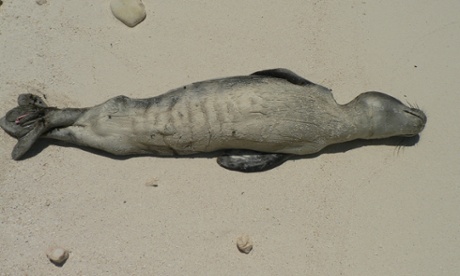
In the remote, northwestern Hawaiian Islands – where the vast majority of the animals live – young seals continually turn up emaciated. Many of them are starving before the age of three, according to Littnan. Essentially these juveniles are not finding enough food at the time in life when they must learn to fend for themselves.
“One of the reasons that food sources are limited around these islands is that the populations of fish were once over harvested,” said Oerter. “Commercial fishing is now restricted around these islands, but fish populations are slow to recover.”
But even with large-scale fish depletion, Littnan said researchers “aren’t entirely sure” why young seals are faring so poorly here.
“We definitely think that competition plays a big part,” he added. “The waters of the Northwestern Hawaiian Islands are renowned for being apex predator abundant. These large jacks and sharks have very similar diets to monk seals. Video footage has shown us that seals in the Northwestern Hawaiian Islands can be escorted by 1 to over 30 fish and sharks that wait for the seal to flip over a rock to expose the octopus or fish hiding underneath. At that time they swoop in and try to steal the prey.”
Littnan said that while an adult monk seals employ “size and cunning” to keep competitors at bay, young seals just aren’t big or experienced enough to stave off hungry competitors.
To better untangle these complex relationships, the scientists plan to fit a struggling population of seals with Crittercams, special cameras that give researchers an animal’s POV. But marine Crittercams aren’t cheap; the parts alone for a single camera can cost between £4,500 and £8,500. This is where the Minnesota Zoo comes in: the facility is currently fundraising to purchase Crittercams for the researchers to study the seal population of the Midway Islands, a remote and protected area near the northwestern end of the Hawaiian archipelago.
“The Crittercams will give NOAA scientists a glimpse into the seals underwater world which will provide insight into the challenges that the seals around Midway Island are facing,” explained Oerter. “This is part of a larger effort to study the biology, health and ecology of Midway monk seals, identify threats to the seals, and in turn inform new ways to help the seals so that the declining population trend may be reversed.”
On the plus side, the monk seal population is actually increasing in the main Hawaiian Islands – something that seemed impossible just a few decades ago.
“Animals are fatter and healthier and survival is much higher [on the main islands],” said Littnan, who noted that this may be due to the fact that fisheries here have largely wiped out the area’s big fish and sharks.
But the biggest threat to seal recovery on the main islands remains people, including deadly run-ins with fishing hooks and ghost nets, or even angry fishermen. Some fishermen have deliberately killed seals in recent years, viewing them as competition and resenting their protected status.
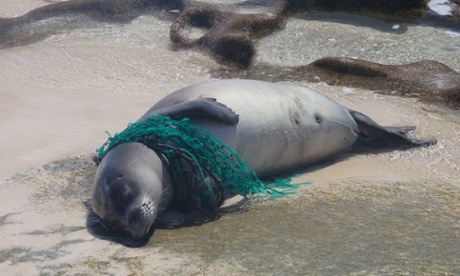
None of this is helped by a pernicious rumour that the monk seals are not native to Hawaii, but were brought to the islands as some kind of bizarre government conspiracy. This rumour is fuelled by the fact that seals are only beginning to recolonise many of the big, populated islands after centuries of slaughter. Of course, the truth is that monk seals swam these seas millions of years before the first Polynesian sailors arrived – and before humans even evolved in the savannahs of Africa. But such rumours help fuel misguided anger towards the protected species.
“We are working to create a better understanding of the seals and a culture of coexistence,” noted Littnan.
Conservation Helps
Although the Hawaiian monk seal population is still declining, conservation efforts have made a difference; a big one. A study last year, co-authored by Littnan, found that 32% of the seals alive today are the product of direct conservation interventions.
Since the early 1980s, conservationists and scientists have helped seals in a number of ways. They have pulled rogue hooks out of seals, cut trapped seals free from ghost nets, treated all variety of wounds, dewormed sick seals, transported seals to better habitats, reunited pups with their moms, saved juvenile seals from violent males, and even brought in emaciated seals for supplementary feeding. This is how the Minnesota Zoo’s five seals first came under human care.
Examining how these life-saving interventions impacted the current population, the researchers found that nearly a third of the seals alive today had either been helped by conservationists or were descendants of females that had been aided.
In other words: conservation actions, even unplanned ones, have made a sizeable difference to the current population. Without such interventions, the seal’s population would be significantly lower today and much closer to extinction.
“The benefits we describe, while considerable, do not capture the full breadth of activities or outcomes associated with monk seal conservation,” the researchers added in their paper, noting “a broad array of habitat protection measures have also been implemented, including designated fishery exclusion zones and limits on beach access in areas deemed sensitive for seals.”
So, here’s the million dollar question: why are Hawaiian monk seals still in decline? It seems the numerous threats still outweigh the many conservation actions. Or maybe – given slow breeding – it will just take time for new fishery regulations, new protected areas and other interventions to really allow the species to stage a comeback.
People, even tourists, can help, according to Oerter.
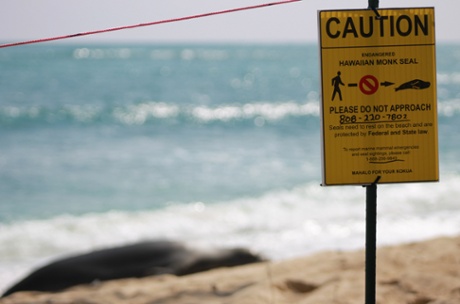
“One of the most important things people can do is simply keep their distance from the seals,” Oerter said, who visited Hawaii last year and spent time with researchers and volunteers. “Giving the seals their space allows them to rest and will prevent disturbing a mother that is nursing her pup. It seems simple, but respectfully sharing an animals environment and staying far enough away...is one of the most important things people can do for any wild animal.”
For those of us not visiting Hawaii anytime soon, we can help the seals by simply making better choices when eating seafood.
“Purchasing sustainable seafood can make help ensure healthy populations of fish remain into the future for all animals – including people,” noted Oerter.
For his part, Littnan, is optimistic that the seal ambassadors in Minnesota will help give the endangered mammals a bigger profile.
The zoo exhibit will “let millions of people know how they can help make a difference,” he said. “They give people a path forward to help seals, and other species, by encouraging them to change personal habitats, like use of plastics, or to contact their government officials to let them know they should care about monk seals.”
On my visit – just days before the seals would be unveiled before thousands of Minnesotans – I get to watch the five seals have a late breakfast. Once they hear the keeper with the bucket, they break free from the water and scramble, knowingly but awkwardly, onto the concrete. They are underwater acrobats, but on land they are often ungainly. They devour the fish whole one-after-another until they slide back into the deep pools, their new home, thousands of miles from their wild relatives.
It’s true these massive females have lost their shot at bearing and rearing pups – at propagating their genetic line. But it may be that in our human-dominated world, these five, near-blind monk seals have an even more important role to play. They act as living, breathing messages to the two-legged Homo sapiens who will decide the fate of all their kind.
“They are reaching an audience we could only dream of connecting with,” said Littnan.
Let’s hope the message is received.