
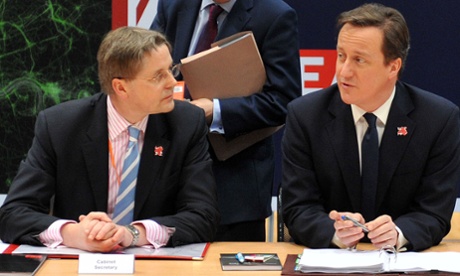
- Sir Jeremy Heywood consolidated his power
For a while, Sir Bob Kerslake and Sir Jeremy Heywood tried to make their odd duumvirate at the top of Whitehall work. But by the middle of 2013, the cracks were beginning to show and this July Kerslake finally resigned as head of the civil service.
Heywood, recently described as having the prime minister “by the balls”, has thus consolidated his power, taking on the role of head of the civil service as well as being cabinet secretary. His decision to bring in former businessman John Manzoni as chief executive of the civil service, rather than someone from inside government, indicates a determination to make the civil service more businesslike. While changes to the way permanent secretaries are appointed, to give ministers more say, have tightened the political grip on the civil service.
Meanwhile Kerslake, who has now also stepped down as permanent secretary at the Department for Communities and Local Government, is making himself useful in other ways. He led a scathing review of Birmingham city council and has recently been appointed as chair of Kings College Hospital Foundation Trust.
2. Local government scented power – but where’s the money?
For local government, the immediate aftermath of the Scottish referendum was a powerful resurgence of demands for greater devolution to English regions, culminating in November’s announcement of £1bn in devolved funds for Greater Manchester and a directly-elected mayor. Other regions may follow suit.
But greater powers could prove a hollow victory as funding continues to be scythed away. Announcing the local government financial settlement for 2015-16, communities minister Kris Hopkins said no council would see cuts of more than 6.4%. But Solace, which represents local government chief executives, said the cuts would be closer to 8.8%, or about £2.6bn, and would push many councils close to breaking point.
3. Outsourcing swept across previously uncharted territory
Once, probation and the NHS would have been considered a step too far by even the most hardened advocate of privatisation. But in 2014, the controversial plans by justice secretary Chris Grayling to privatise probation services saw the light of day, with 70% of services, worth £450m, put out to tender to private and voluntary sector providers. Meanwhile, new NHS boss Simon Stevens defended privatisation of health services after figures showed that non-NHS providers of health services received more than £10bn of the almost-£100bn NHS budget last year.
Government ministers, including Cabinet Office minister Francis Maude, love to emphasise the potential role of employee-owned mutuals and voluntary bodies in running former public services. But two companies, Sodexo and Interserve, are the preferred bidders in more than half the probation services being privatised. And the fiasco of delayed pensions payments at MyCSP, the government joint venture that delivers civil service pensions, took the shine off the biggest single mutual to spin out of central government so far.
4. Government became more digital, but is it enough?
Digital-by-default isn’t a bad idea for government and the much-lauded Government Digital Service, headed by ex-Guardianista Mike Bracken, has certainly shaken up government IT and brought pace and scale to many projects. At the same time many parts of government have, finally, got the bit between their teeth. This year the UK hosted D5, the first summit for leading digital governments.
However, government will miss its own deadline to redesign 25 significant public services, which it had planned to get online by March 2015. GDS now expects 20 of the 25 to be live or in public beta by that date.
5. Many public services staff reached the end of their tether
Few people work in public services for the money, whatever the Taxpayers’ Alliance says. Of course they’re not just a bunch of altruistic souls, either. But the combination in 2014 of attacks on public servants’ jobs, pensions and services has left many demoralised and fearful for the future.
There are now 5.4 million people - the lowest number since 1999 - who are still directly employed by the UK public sector. If the government’s further cuts of £60bn go ahead there will be fewer still by 2020.
Attacks on pensions were the final straw that brought firefighters out on strike during 2014. In central and local government, staff are now wearily resigned to being under attack from their own politicians. This year, as well as struggling with increased workloads, many civil servants also felt the impact of hugely unpopular performance management ranking systems.
Sign up for your free weekly Guardian Public Leaders newsletter with news and analysis sent direct to you every Thursday. Follow us on Twitter via@Guardianpublic













