
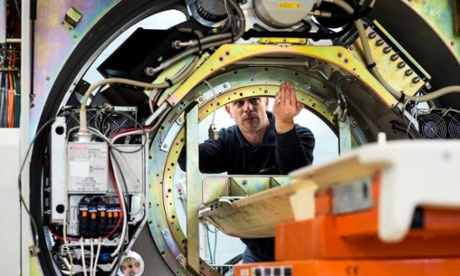
How can manufacturers build resource resilience into their supply chains in a way that not only reduces raw material input costs, but delivers added value to the customer? One smart solution is to sell the performance of a product whilst retaining ownership of the component parts within it. Earlier this month, to coincide with the official opening of its refurbished systems factory for healthcare imaging equipment in Best, the Netherlands, Philips hosted a panel discussion to examine how emerging product-service models built around circular economy principles of ‘pay per use’, renting/sharing and lease ownership could be scaled up.
The discussion involved the following panelists: Frans van Houten, CEO of Royal Philips; Dame Ellen MacArthur, founder of the Ellen MacArthur Foundation; Jens Teichelmann, managing director of IBM Global Asset Recovery Services Europe and Mark Boelhouwer, CEO of RICOH Netherlands.
Five key leading thoughts came out of the discussion:
1. Cracking the mindset conundrum
“Why are not more companies moving to circular models?” Mark Boelhouwer questioned. The panel felt that institutionalised ways of working and thinking, particularly within business, were hard to break down – this can make cultural buy-in for innovative leasing and lifecycle service propositions a tough nut to crack. Not just with internal staff, but with customers too. Reflecting on the solutions that RICOH sells, Boelhouwer said: “We still have to convince a board of directors to move to this model, they still want to buy something.” Echoing this, Frans van Houten said that public sector procurement was a significant barrier. “Tendering rules don’t allow for [municipalities] to buy for lighting as a service … to truly get to a circular model we need to change a lot of stuff in how people behave.”
2. Designing for longevity
Shifting towards service-based models will see greater durability built into products as companies seek to maximise product lifecycles. Ellen MacArthur highlighted a washing machine as an example. “When you shift to a more circular model, that machine is not bought by you – you pay per wash, you pay for its use. The manufacturer is then incentivised to build a better machine; they don’t want it to break because they are providing a service.” Frans van Houten added: “If we sell light as a service then we continue to own it. It’s in my favour to design for longevity because I can rent it out for twice as long.” For products requiring regular upgrades, such as IT equipment, companies like IBM are focusing on modularity for easier remanufacture and refurbishment of replacement parts. “We design all of our products so that they are upgradable, usually over two generations of technology,” Jens Teichelmann said.
3. Servicing the economics
Cost benefits for customers can be substantial with ‘pay per use’ given that the supplier of the service takes care of the technology risk and the investment in return for a long-running lease agreement. Using the washing machine example again, Ellen MacArthur said users could half the cost of each wash cycle by buying into the performance of the machine rather than owning it outright. It’s a model already paying dividends in the printing industry. “The way we have been doing business for the past 20 years is on pay per scan,” Mark Boelhouwer said. Other sectors however are slow to take up such models due to balance sheet constraints. “Many municipalities…don’t upgrade to energy efficient lighting because it would have to come out of a CAPEX (capital) budget instead of an OPEX (operating) one,” Frans van Houten reflected.
4. Technology as an enabler
The rise of digital and global connectivity opens up a huge opportunity for asset tracking – the ability to follow products through their lifecycles and remotely monitor their performance. IBM servers, for example, come equipped with a ‘call home’ feature so the company is notified of their health and status once they are installed on a customer’s premises, enabling preventative maintenance. Ellen MacArthur floated the idea of ‘product passports’ – information about products and components, their repairability and upgradability, as well as, ultimately their material composition. “We need to be able to create material flows. One of the pioneering conversations going on at the moment is, how are we able to track those materials? How do we know what sits within that product?”. Frans van Houten said businesses needed to view asset tracking as an opportunity, rather than an obligation. “When we look at our new IT landscape, our wish list is to track material consumption all the way.”
5. The value proposition
In building service-based propositions, companies must start redefining their pricing models so they become relationship-based, rather than transaction-based. The panel acknowledged this was a big learning curve for business. “The challenge we have is in bringing up our sales and marketing organisations to make sure you get [the message] across,” Mark Boelhouwer said. Calling value-based pricing “the only way to go”, Frans van Houten said the philosophy needed to be embedded at every level across the business. “Do your KPIs (key performance indicators) and incentive schemes allow for it? Does the CEO allow it on the balance sheet?” he questioned. Ellen MacArthur added: “What really helps to accelerate this economic model are companies who deliver more value – for not just the company itself, but for those people who use the products.”
Click here for more info about Philips’ new imaging systems refurbishment facility.
More from the Philips partner zone:
- Hospital innovation partnership set to deliver high quality, sustainable patient care
- Tapping into the potential of 3D printing to reduce plastic waste
- Recycling: ‘the loop of last resort’ within a circular economy
Content on this page is paid for and produced to a brief agreed with Philips, sponsor of the circular economy hub









.jpg?w=600)



