The Manchester Guardian argued fiercely against Britain’s involvement in the first world war with its editor, CP Scott, urging the country to stay neutral in the conflict. However, once war was declared on 4 August 1914, the paper swung firmly behind the decision.
The pages of the Guardian were soon full of news about events in Europe, not to mention pictures of war damage, graphics and long comment pieces. As a result, regular features such as the long-running country diary were dropped.
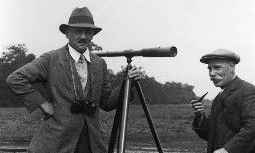
When war erupted, the column had just celebrated its 10th anniversary. It first appeared in the paper as A Country Lover’s Diary on 21 March 1904, becoming simply A Country Diary a couple of years later. For most of its first decade, Thomas Coward (bylined T.A.C.), a retired textile bleacher from Cheshire, was the sole diarist. He had taught himself to become Britain’s leading authority on birds, publishing a number of books including the respected three-volume The Birds of the British Isles and their eggs (1920–1925).
Though Coward wrote about many other rural matters as well as birds (and regularly included notes and queries from his readers), Scott was keen to introduce a variety of voices to the column. After a number of years resisting any such change, he finally agreed to share the column. In the autumn of 1913 Arthur Nicholson (under the byline N.), a farmer and businessman from Cheshire, began contributing three days a week.
Where Coward’s tightly written columns included conservation issues and ornithological detail, Nicholson’s were of a more general nature, written from the potentially conflicting agricultural view. More often than not, his dispatches would start with a few words about the weather before going on to give a glimpse into the daily life of an Edwardian farmer. Subjects included foxhunting, a poor wheat harvest and the worrying exodus of farmers to the colonies.
Nicholson also made the first comments in the country diary about a world transformed by the assassination of Archduke Franz Ferdinand in Sarajevo. On the day war was declared, Coward’s short piece included the poignant line, ‘the disturbed spirit of the day’.
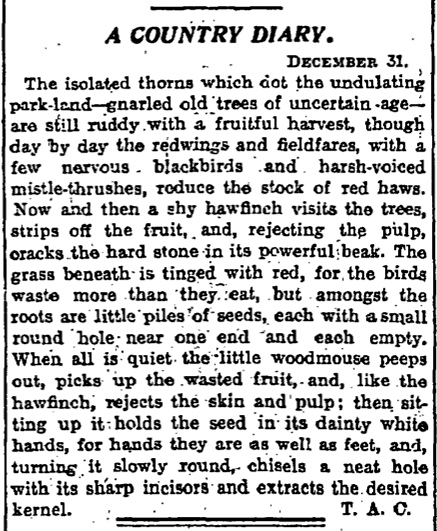
After a five-month hiatus, Scott decided to reinstate the column, no doubt to provide a small bit of relief from the conflict. Thus on 1 January 1915, the diary was once again to be found in its back-page berth, beneath the weather and the Lamp-time for cyclists. Coward’s column about a shy hawfinch didn’t mention the war but the following day Nicholson’s noted the absence of farm workers as all of military age had gone off to fight.
Shortly afterwards the literary critic Basil de Selincourt (bylined as S., later B de S) started writing from Oxfordshire and the three diarists were soon joined by journalist and suffragette Helena Swanwick and former labour correspondent, RC Spencer.
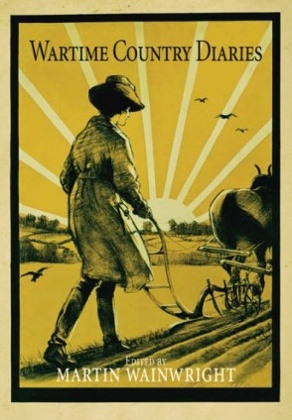
A much more detailed history of the country diary during the first world war (including many fine examples of the daily dispatches) can be found in Martin Wainwright’s Wartime Country Diaries (2007).