The first British government flight back from earthquake-hit Nepal has arrived in London, bringing 120 Britons home to emotional reunions with family and friends.
Among those on board the Department for International Development (DfID) chartered Boeing 767 – which flew aid out to Nepal on Sunday – were children, older people and those chosen as a priority because of health conditions.
After touching down at Stansted airport shortly after 3am on Thursday, the aircraft taxied to a private hangar where some spoke of their experiences and their fears for local people.
The rescue flight came amid criticism of the Foreign Office’s efforts to rescue a number of Britons stuck in Nepal’s devastated Langtang Valley. They had been left behind as, it is claimed, citizens of Estonia, France, Germany, Israel and Japan were rescued.
The foreign secretary, Philip Hammond, on Wednesday confirmed the first British death in the disaster, while officials were “urgently investigating” reports that another Briton had been killed at Mt Everest base camp. At the same time, more British aid was arriving in Nepal, including a team of Gurkha engineers and tonnes of aid supplies.
At Stansted, Holly Jobes, from Sunderland, was delighted to be reunited with her husband, Grahame. “I’ve been worried sick – he described running down the streets and buildings falling on people around him,” said Jobes, who is seven months’ pregnant.
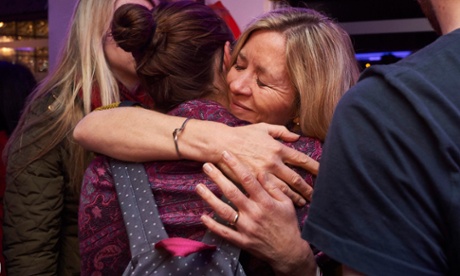
“He’s got three children at home and another one on the way and we were just desperate to get him home.”
Grahame Jobes said: “It was worse for her sitting at home worrying than it was for me. We’ve been well looked after and we can’t fault the aid effort and hospitality of the Nepalese people. But I’m looking forward to some family time now.”
About 300 British citizens have been housed in the embassy in the capital of Kathmandu since the 7.8-magnitude earthquake struck on Saturday, killing more than 5,000 people.
The youngest passenger to return on Thursday’s flight was a four-month-old baby while the oldest were thought to have been in their 60s.
Among the first off the plane was Roger Strachan, 19, from York, who had been in Nepal working as a voluntary teacher. “I was in a restaurant in Kathmandu when the quake hit. We hid under a table while the building was shaking very violently and cracking and we were very lucky to escape.”
He said that he now hoped to raise money for the communities where he taught. “We must remember there are thousands of Nepalese people living in very squalid shelters even at this moment and in a much more threatened position than we were in.”
Kate Penty, 18, from Cambridge, who was met off the plane by her parents, described running to find shelter as the quake hit. “It lasted about 30 seconds and was terrifying. We stayed in a hotel the day afterwards but it was falling down with us inside.
“We got to know several families in Nepal and their houses have been destroyed and they’re living in tents. A lot of us are coming home determined to do whatever we can to help.”
Ingrid Chiene, from Stroud, Gloucestershire, was greeted by her sons Harry, 12, and Ethan, 10. Harry smiled as he and Ethan hugged their mother. “We thought she might not be able to come home so it’s brilliant to see her,” he said.
Harry Quinn, 26, from Brighton, said he would have been in one of the worst-hit parts of Kathmandu but for his sleepy friends. “We’d been out the night before and had a few drinks but I was up early and ready to head out to see the sights. The others slept in and it’s a good job they did because we would have been right at the centre of it.
“A hotel two doors down, which had turned us away because it was full, completely collapsed with 80 people inside. We followed the locals to open ground on a football field and then went to the embassy.”
A DfID spokesman said there were thought to be 500 to 1,000 Britons in Nepal. Most were safe but some had been unable to make contact with loved ones because of the collapse of communications infrastructure.
Hammond said earlier that hundreds of Britons had now been accounted for but the situation remained “extremely challenging” because of infrastructure damage caused by the earthquake, landslides and avalanches.
Many Britons were stuck in Langtang Valley, a popular trekking spot, where trails out were blocked and people were running out of supplies, relatives said on Wednesday. Some relatives have criticised the Foreign Office for not organising evacuation fast enough, with their family members having to watch as other countries organised helicopters to airlift their citizens from danger.
Hammond said search and rescue teams, medics and armed services from the UK were on the ground helping those in need.
About £19m had been donated to the Disasters Emergency Committee (DEC) Nepal Earthquake Appeal just a day after it was launched, while Britain was preparing to send RAF Chinook helicopters to Nepal to help with the relief effort.
Hundreds of shelter kits and solar lanterns are among 18 tonnes of supplies carried on the RAF C-17 aircraft which took Gurkha engineers to the devastated region on Thursday, the international development secretary, Justine Greening, said.
The death toll currently stands at about 5,000, but Nepal’s prime minister, Sushil Koirala, said the death toll could eventually rise to more than 10,000.
Eight million people have been affected by the disaster, which has wiped out entire villages, according to the United Nations.