Good morning,
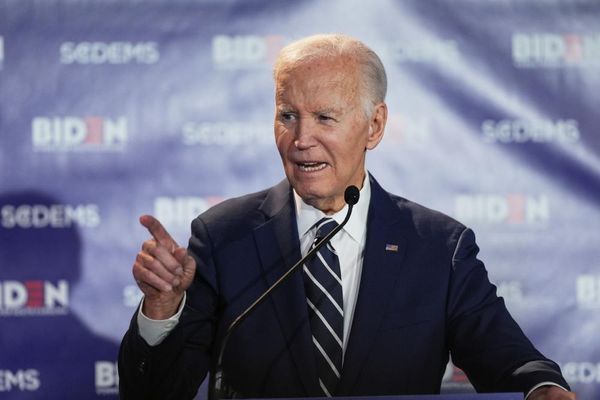
Joe Biden has said US troops may remain in Afghanistan beyond the 31 August deadline, as he pledged to “stay until we get all [American citizens] out”.
In his first on-camera interview since the Taliban took Kabul, the president denied there was “a way to have gotten out without chaos ensuing” – contradicting remarks he made weeks ago when he played down the idea of a complete Taliban takeover as being “highly unlikely”.
The US has evacuated nearly 6,000 people since Saturday, but thousands of Americans and tens of thousands of Afghans who want to leave remain.
It follows fears in the UK that US forces may leave Kabul airport within days, Whitehall and security sources told the Guardian.
The Taliban have ruled out any semblance of democracy, with their spokesperson Waheedullah Hashimi saying “there will be no democratic system at all because it does not have any base in our country”.
‘I stood with you … now, I need to be taken care of,’ says one Afghan interpreter who worked with New Zealand and is now hiding in fear for his life.
Vaccinated adults infected with Delta ‘can match virus levels of unvaccinated’

Fully vaccinated adults infected with the Delta variant can harbour virus levels as high as unvaccinated people, an extensive analysis of UK data has found, diminishing the possibility of achieving herd immunity.
Vaccines offer significant protection against becoming infected with the virus, including Delta, and even higher protection against becoming seriously ill and dying. However, the study shows that if a vaccinated person is infected, their virus levels can match an unvaccinated person’s.
What does this mean for transmission? The implications remain unclear, lead researcher Sarah Walker said, but it suggests that unvaccinated people “may not be as protected from the Delta variant as we hoped”.
It echoes findings that led CDC to recommend indoor mask-wearing in some settings, even for vaccinated people, last month.
US judge throws out Trump-era approvals for Alaska oil project

A federal judge has vacated Trump-era permits, which were defended by the Biden administration, for an oil project on Alaska’s North Slope, saying the review was flawed.
Last October, the US interior secretary signed off a government permit allowing ConocoPhillips to establish three drill sites, as well as processing facilities, roads and pipelines on the North Slope. Two more drill sites could have been considered later.
Why were the approvals thrown out?
The US Bureau of Land Management (BLM) excluded foreign greenhouse gas emissions in its environment review, the judge Sharon Gleason said – a move she branded “arbitrary and capricious”.
BLM acted unlawfully in developing its “alternatives analysis” based on the view that ConocoPhillips “has the right to extract all possible oil and gas on its leases”.
A lack mitigation measures for polar bears resulted in the US Fish and Wildlife Service report being voided.
In other news …

Myanmar’s security forces have killed more than 1,000 civilians since the armed forces seized power in a coup in February, an activist group verifying deaths under the regime has said. The figure reached 1,006 on Wednesday, according to the Assistance Association for Political Prisoners.
The US plans to offer Covid-19 vaccine booster shots from 20 September in an effort to stem the tide of Delta cases by boosting immune responses. A third Pfizer or Moderna jab will be made available to all Americans who had their first vaccine at least eight months ago.
The Chinese president, Xi Jinping, has promised to ‘adjust excessive incomes’ in a warning to China’s super-rich that the state plans to tackle growing inequality. It comes amid a drive to rein in the country’s biggest private firms.
Stat of the day: steel production accounts for 8% of CO2 emissions

Swedish manufacturer Hybrit has developed a type of “green steel” manufactured without using coal, and has just shipped its first batch to Volvo. With coal-based steel production accounting for 8% of greenhouse gas emissions, the company aims to replace the use of coking coal in steel manufacturing with hydrogen and renewable electricity.
Don’t miss this: what I learned from an unlikely friendship with an anti-masker

For the anthropology professor Anand Pandian, getting vaccinated was a no-brainer: it offered “freedom from worry, a way to avoid endangering myself and everyone I encountered”. His friend Frank, a restaurateur he met conducting fieldwork in US conservative circles, could not feel more differently. However, faced with threats ranging from the climate crisis to the future of democracy, Pandian writes that “our very survival depends on nurturing a sense of common fate”.
Climate check: saving ozone layer gave humans a chance in climate crisis

A rare bit of good climate news: curbing the ozone-depleting chemicals once commonly used in refrigerators gave the world a fighting chance of limiting global heating to 1.5C, research has found. The UN’s 1987 Montreal protocol resulted in limiting ultraviolet exposure and protecting the ability of plants to absorb CO2. If chlorofluorocarbons (CFCs) were still in use, the Earth could have been facing 3.5C of warming.
Want more environmental stories delivered to your inbox? Sign up to our Green Light newsletter to get the good, bad and essential news on the climate every week
Last Thing: one airport, 1,300 snakes

Photograph: Tobias Nolan/ZUMA Wire/REX/Shutterstock
Snakes on a plane? Not quite, but close enough. Across a highway from San Francisco airport lies a 180-acre, airport-owned piece of land that is home to roughly 1,300 garter snakes. Pushed out of their habitats by rapid urbanization, the animals are highly threatened – but now researchers have found the area holds more of them than anywhere else. “It is really hopeful,” said Brian Halstead, a research wildlife biologist with the US Geological Survey.
Sign up
First Thing is delivered to thousands of inboxes every weekday. If you’re not already signed up, subscribe now.
Get in Touch
If you have any questions or comments about any of our newsletters please email newsletters@theguardian.com