Good morning,
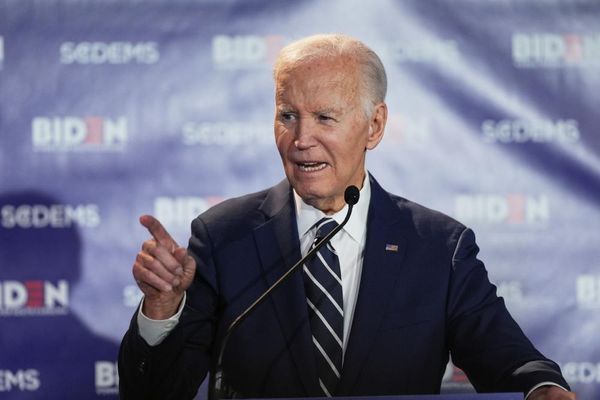
Thirty years after his first bid, Joe Biden formally accepted the Democratic nomination for presidential candidate on Thursday , at the culmination of this year’s party convention, months of primaries and a decades-long quest for Biden.
In his acceptance speech, which won praise from across the political spectrum, Biden pledged to be an “an ally of the light” and “end this season of darkness in America”. Without mentioning Donald Trump by name, Biden accused the president of failing “in his most basic duty to the nation”, and described his handling of the coronavirus pandemic as “unforgivable” in the light of figures that show the US as having a quarter of the world’s cases of the virus and almost 175,000 dead.
The speech was reminiscent of an “ageing heavyweight boxer who got himself in shape, climbed back into the ring, and landed a knockout punch,” writes David Smith. However, the Democratic national convention also drew criticism from climate activists including Greta Thunberg, who said the party had not taken a strong enough line on the climate crisis, while allies of Biden insisted he is committed to tackling it.
The number of people applying for unemployment benefits climbed back over 1 million last week as coronavirus continued to ravage the US labor market.
Steve Bannon appears in court after arrest on fraud charges

Trump’s former campaign manager Steve Bannon has pleaded not guilty after being arrested for allegedly siphoning money off a fundraising campaign for the president’s infamous border wall with Mexico.
Federal prosecutors in New York claim that Bannon received more than $1m (£760,000) from a non-profit organisation he controlled and used “at least” some of this to cover hundreds of thousands of dollars in personal expenses. After the confirmation of his bail conditions, a $5m bond which prevents him from travelling on private planes, boats or yachts, a sunburnt Bannon told reporters that the “entire fiasco is to stop people who want to build the wall”.
Trump’s last-ditch attempt to block the release of his tax returns was rejected by a federal judge, clearing the way for Manhattan’s district attorney to access the records.
Who is Steve Bannon and what is the alleged scheme? Your questions answered.
California grapples with growing wildfire crisis

Wildfires continue to strain emergency services in California, with one group of fires doubling in size overnight to reach 131,000 acres by Thursday. At least two people have died fighting the fires, which have destroyed 175 structures and threaten 50,000 more, with Big Basin Redwoods state park, California’s oldest state park, sustaining “extensive damage”.
Santa Cruz county has asked that all tourists leave their hotels immediately to make space for wildfire evacuees, as local shelters near capacity.
Humanity’s ecological footprint reduced by 9.3% compared with the same period last year as a result of the coronavirus pandemic, researchers said. However, to keep consuming ecological resources at the existing rate, we would need the equivalent of 1.6 Earths.
Opposition activist prevented from leaving Russia after ‘poisoning’

Doctors treating Russian opposition activist Alexei Navalny, after a suspected poisoning which left him in coma, are refusing to let him be transported abroad for treatment, in a move Navalny’s aides claim is an “attempt on his life”. The medics announced their decision just an hour before a plane was due to arrive to take the opposition activist to a hospital in Germany, saying Nalvany was too unwell to be moved.
The activist collapsed during a flight after drinking tea his press secretary said was laced with poison, forcing the pilot to make an emergency landing before he was hospitalised on a stretcher.
Who is Alexei Navalny and why may he have been targeted? Read Moscow correspondent Andrew Roth’s profile of an opposition leader known for “blockbuster investigations”.
A history: Luke Harding looks back at Moscow’s apparent poisonings of political opponents, from 1959 to today.
In other news…

North Korean ruler, Kim Jong Un, has ceded some authority to his younger sister, who now holds responsibility for relations with South Korea and the US, Seoul’s spy agency has said.
Prosecutors in Belarus have opened a criminal case against protesters, claiming that they are trying to seize power, as demonstrations against the 26-year regime of Alexander Lukashenko continue.
Mexico has been rocked by serious allegations of corruption involving three former presidents and senior lawmakers and aids, after a deposition from the former head of Mexican state oil, himself facing corruption charges, was leaked.
Selective abortion in India could lead to 6.8m fewer female births by 2030, researchers estimate. The country is estimated to have 63 million fewer women since sex determination tests were popularised in the 1970s.
Great reads

How Trump plans to allow fuel exploration in America’s last intact ecosystem
The Trump administration this week finalised it’s plan to allow oil and gas exploration in Alaska, the last fully intact ecosystem in the US. Oliver Milman speaks to conservationists and the native tribe which lives there about this rare slice of the natural world and the threats it faces.
Back to the future: rediscovering Great Depression unemployment murals
During the Great Depression, New York’s federal government launched a public works art programme designed to employ artists, which culminated in 1,200 murals being painted in the state’s post offices. As America plunges deeper into economic hardship today, this photo essay provides a fascinating trip into an American history that eerily echoes its present.
Opinion
Timothy Garton Ash looks back at the historical precedent of the pro-democracy demonstrations in Belarus, both inside the country and around the world, and argues that the protests offer a powerful reminder of the value of freedom.
To try to guess how this will end is a fool’s errand. In such moments, nobody knows what is going to happen this afternoon, let alone tomorrow. But it is not too soon to spell out one clear message from the streets of Belarus.
Last Thing: the German university offering money for doing nothing

A German university has launched a series of “idleness grants”, available to applicants who can prove they are committed to total inactivity. Hopefuls will have to persuade a jury that their area of “active inactivity” is uniquely impressive, as part of the project which the University of Fine Arts in Hamburg insists is a serious examination of societal values.
Sign up
First Thing is delivered to thousands of inboxes every weekday. If you’re not already signed up, subscribe now.