At the start of The Long Good Friday, Harold Shand flew in on Concorde. Shand was old-school: a London ganglord played by Bob Hoskins, back home after a New York business trip to find his empire being gutted.
Now, to revisit Harold’s world, I’m listening to the driverless hum of the Docklands Light Railway (DLR), gently jolting through east London above the endless juliet balconies of new-build flats. Neither the DLR nor the flats were here in June 1979, when Hoskins and director John Mackenzie started work on a modestly scaled British crime thriller that would become one of the most darkly momentous films that Britain ever made. So, on another sunlit early summer day, I wanted to see how the London of the film had changed; to splice then with now.
Walk from the scuffed bustle of Shadwell into Wapping, and you come to a large baroque church of white stone. This is St George in the East, where Harold had his first intimation that something was going terribly wrong. As his mother took holy communion, her chauffeured Rolls was the victim of a car bomb, along with the chauffeur. Now, I pick my way in to the church through prams; part of the building is used by a Montessori nursery school. In the vestibule, there are cheerful notices of church curry evenings, details of “pray-as-you-go” MP3s – an oddly tranquil place to have starred in such a bloody film.
But Wapping is nothing if not strange. Leaving the church, you cross The Highway, a historical magnet for vice and murder. Behind you is Cable Street, where the blackshirts threw bricks at my grandfather. To your right is the site of “Fortress Wapping”, the hive of offices from where, until recently, Rupert Murdoch ran News International. Now it’s been sold and knocked down for redevelopment, like so much of London’s gap-toothed landscape.
The reputation of The Long Good Friday rests on two things. The first is that it is a glorious thriller. But, as the years passed, it also became clear it had uncanny foresight. On screen, Harold declared the 80s would be a new era for London, his vision of unbridled commerce built around a revived Docklands. Off camera, others agreed. The timing was remarkable. A month before the cameras rolled, Margaret Thatcher became prime minister. Before she was done, Docklands would be a lustrous appendage of the City, and London would have hitched itself to global finance. When we stare around today and ask where this all began, we can look to Thatcher or The Long Good Friday. They were thinking the same thing.
St George in the East was only the exterior location for Harold’s mum’s near miss. Shots of worship were filmed instead at St Patrick’s, a sturdy Catholic church off Wapping High Street. When I get there, mourners are arriving for a funeral, laying wreaths on the steps. There is muted small talk, a complaint about the A13. Attracting looks with my notebook, I press on into Scandrett Street. At its end, the crew built a fake pub called the Lion and Unicorn, the next of Harold’s effects to be blown up. (During filming, locals had to be stopped from coming in for a drink).
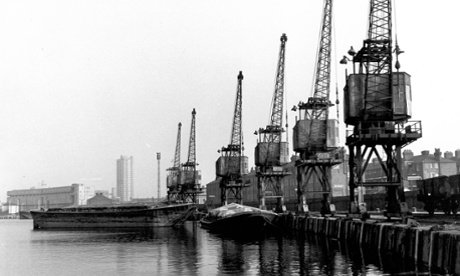
In 1979, the docks had been closed for 10 years. Cranes rusted on the skyline. You can see how threadbare the place was in one of the film’s most famous scenes, when a security guard has answers Harold wants. He’s found in an old wharf. The other side have got to him first: he has been crucified horizontally. The scene was shot in Wapping High Street using one of the countless derelict warehouses, a mossy husk of crumbling brick.
Now, the same building, opposite Dundee Street, is spruce and handsome. The ground floor has a yolk-yellow sign outside: it’s a branch of the estate agency Savills. Residential apartments make up the rest of the building. The place where you might once have been nailed to the floor is now a luxury flat.
Beyond the decay, there were still dockers and their families in Wapping, in tracts of council housing. But the government demanded a new broom. In 1981, a quango, the London Docklands Development Corporation, was set up to shape its future. Locally, the hope was that new industry could bring jobs. Instead, the LDCC struck deals with developers, handed out planning permissions and remade the place.
It wasn’t the only one to see the potential. Further down Wapping High Street you come to Pier Head, two terraces of grand Georgian townhouses abutting the Thames. The most gorgeous of all is owned by Helen Mirren, who bought it after coming here to play Harold’s wife, Victoria. A discreet sign is mounted on the railings of the central gardens: this is a private road, with no public access to the river, and is monitored by CCTV.
From here, it’s nothing but towering wharfs, most revamped in the 80s goldrush. These are homes with extras: underground car parks, gyms, concierges, private cinemas, hydro-pools. Occasionally, there’s an estate agency, useful for keeping track. At Tower View, prices start at £1.65m; the penthouse in Cinnabar Wharf is on at £5.75m. I see absolutely no one for several minutes. I start to feel illicit, as if I’m in someone’s house after they have gone to work.
And then I reach St Katharine Docks. If The Long Good Friday had a spiritual centre, this was it. It was here that Harold moored his yacht, here he killed a man with his bare hands. In the film, there were already flats, but it was still mostly a bleak array of lock-ups.
Under the LDDC, money poured in. A place in history opened up: in 1985, Ernie Wise made Britain’s first mobile phone call here, obliquely dressed as a Victorian coachman. Now, another small sign points out that you are in a private estate and a conservation area: hence the red phonebox and a three-storey theme pub, the Dickens Inn. Yachts are everywhere, gleaming bruisers (Gran Turismo, Optimum) and smaller fry (Lady Kate, Marjorie). Amid the chain restaurants, a gallery sells oil paintings of riverscapes, while a shop called Nauticalia offers brass telescopes and postcards of the royal family.
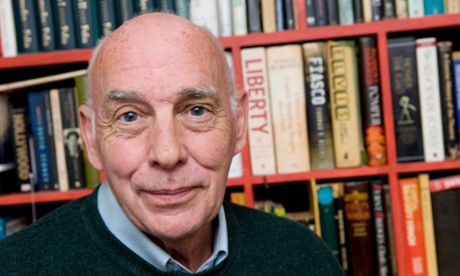
I find Barrie Keeffe outside a restaurant called Medieval Banquet. Keeffe, an acclaimed playwright, wrote The Long Good Friday. Now, he looks aghast. He says he hasn’t been here since the 80s. “I’m stunned,” he says. “Look at it.” Behind us, tourists take selfies with a suit of armour.
We end up next door, eating overpriced tapas. At 69, discussing the film is bittersweet for Keeffe, one of its last principals left: John Mackenzie died in 2011, Hoskins last year. Keeffe grew up down the road in East Ham; his writing career began when he was 18, as a reporter on the Stratford Express. His relationship with the old London was close enough to have brushed up against the Krays – “the twinnies” – and to have borrowed the crucifixion scene from life: “It was the punishment for heisting a lorry on someone else’s territory. You told the police it was a DIY accident.”
Talking to him, it becomes obvious that the film wasn’t prophetic by accident; it came from his years as a local journalist. By the late 70s, there had already been all manner of schemes. “My impression is a lot of money changed hands in town halls,” he says. While he wrote the script, he and producer Barry Hanson kept digging. “We got headed paper done up and said we were a company wanting to invest in Docklands. Suddenly all this stuff appeared in the post.”
This was 1977. “It was secretive. You could sense something enormous was about to happen.”
But nothing, perhaps, on the scale of what did. If change was already in motion by 1979, the Thatcher years gave it a feral intensity. Keeffe says people ended up scattered. “They went to Harlow, to Essex. Some of them were happy. But it wasn’t London. It was a purge, really.”
When we leave, I look up. Above us loom the Gherkin, the Shard, the Walkie-Talkie. I feel as if we’re in the scale model of the new Docklands that Harold keeps on his yacht, peered over by the coppers and councillors.
But the film captured more of London than Wapping. Two key scenes take place in Harringay. Fagan’s, the Belfast pub where Harold’s lieutenant Colin makes an ill-fated pickup, was actually The Salisbury, a giant, and occasionally notorious, boozer on Green Lanes. Just up the road is a 24-hour Sainsbury’s; the site was once Harringay Stadium, where Harold confronts his nemesis during a night of stock-car racing.
In Brixton, the home of the hapless “Errol the ponce” was 33 Villa Road, an address with a past. In the 70s, almost the whole street was squatted, home to Marxists, Maoists and primal screamers. Now, Brixton is in the throes of gentrification forceful enough to have brought local protests. On Villa Road, number 33 still looks lived-in. Yet many of its neighbours already have front doors done out in Farrow and Ball colours with plantation shutters at the windows. Half a dozen more are in mid-renovation, stripped and empty, front yards filled with bags of cement. “Used to be a nice place,” Harold scowled from his Jag. Now, Villa Road looks like a street between worlds.
Then there’s Lewisham: Ladywell leisure centre on the high street was the scene of Colin’s murder by a smooth-faced Pierce Brosnan. But that’s gone too. Closed in the summer of 2013, it was quickly demolished. There were hopes the site would be taken on by the upmarket cinema chain Curzon. Instead, it will be “Ladywell Pop Up Village”– 24 factory-made units in which Lewisham council plan to house up to 96 people. The scheme is to be rendered in “vibrant and uplifting” colours (think of a packet of Refreshers). Boris Johnson’s mayoral High Street Fund is chipping in for an “enterprise hub”. For now, empty space sits behind hoardings. As I peer in, a middle-aged woman taps my arm: “I learned to swim there,” she says.
And so back to the river and the Isle of Dogs, the misfit peninsula three-quarters cut off from the city. In the film, when Harold is hunting down old rivals, he visited a smoke-fugged pub here called The Governor General. In reality, it was The Waterman’s Arms, owned in the 60s by TV presenter Daniel Farson, who coaxed a visit from Judy Garland. Now it’s called The Great Eastern. I arrive to find its detached bulk facing the Thames in fresh cream paintwork. Inside, a barman in an Evil Dead T-shirt lists a range of craft beers. Apart from me, the only customers are insanely young, silently checking their phones. The rooms upstairs, it transpires, are used as a hostel for backpackers.
The Island had a part in the crucifixion scene too: Burrells Wharf on Westferry Road was also used for exteriors. Round here now, nothing looks older than 1986. In Millwall park, a woman watches a plane descend over London City airport; in the film, that was still the Royal Albert Dock, where Harold talked of bringing the Olympics to east London. The view is bizarre. All you see is Canary Wharf, soaring up over the grass as if ineptly Photoshopped.
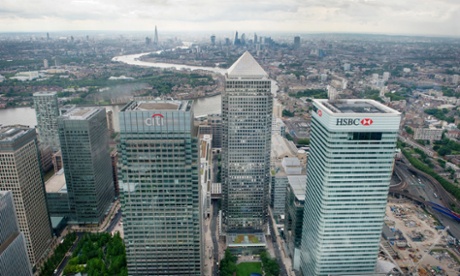
Of all the locations in The Long Good Friday, none has quite the resonance of Canary Wharf, and it wasn’t even in the film. On-screen, we see Harold’s yacht cruising through West India Docks; still to hear about his Mum, it’s his happiest moment in the movie. It would take a little longer than the rest of Docklands’ transformation, but eventually that stretch of water would be engulfed by One Canada Square and the rest of London’s corporate citadel.
When I get there, the sunset is winking off the glass towers of HSBC, Credit Suisse, Citigroup and Barclays. Late workers head home around me. Next to the offices of Morgan Stanley, another vast site has been freshly cleared. What Harold saw coming is never-ending.
In honour of the final scene, I stop outside the Savoy on my way home. I watch the cabs pull in and out, listening back to Keeffe. “Harold would be 80 now, wouldn’t he? He’d wish he could be part of what London is, but he couldn’t keep up. He’d ask himself the same thing I do. Who owns it all now anyway?”
• The Long Good Friday is re-released in the UK on 19 June.