After 14 months of repairs, Cern engineers have got the Large Hadron Collider to smash particles together far sooner than anyone dared hope.
For the time being the collisions are low energy, around 450 billion electronvolts per beam, which is around half the energy of what remains, for now, the world's most powerful particle collider: the Tevatron at Fermilab on the outskirts of Chicago.
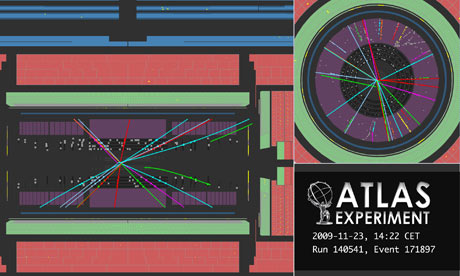
This is the first event spotted by LHC's Atlas detector, picked up yesterday afternoon when the two counter-rotating beams of protons were steered into a head-on collision.
The lefthand image shows the detector from the side on, while the circular image on the right shows the collision as seen down the beampipe axis of the detector. The coloured streaks coming out from the centre of the image are mostly caused by pairs of quarks called pions. In each colliding proton there are three quarks.
Scientists on Atlas say the detector is working beautifully. For all of the researchers at the lab, this is the beginning of a wonderful new journey. Fingers crossed they'll find something that the current theory of particles and forces, aka the Standard Model, can't explain.