The new coronavirus is set to be the biggest crisis for the global economy in history. How will companies and industries survive in the face of the unpredictable impact the virus is having on business performance and employment?
"Human movement has ground to a halt around the world," said Marubeni Corp. President and CEO Masumi Kakinoki in a livestreamed press conference on Thursday. His company recorded an unprecedented loss of 197.4 billion yen for the business year ending in March 2020.
"The world economy has entered its worst crisis since the end of World War II."
To Kakinoki, a V-shaped recovery of the world economy appears unlikely. He sees a more gradual L-shaped restoration.
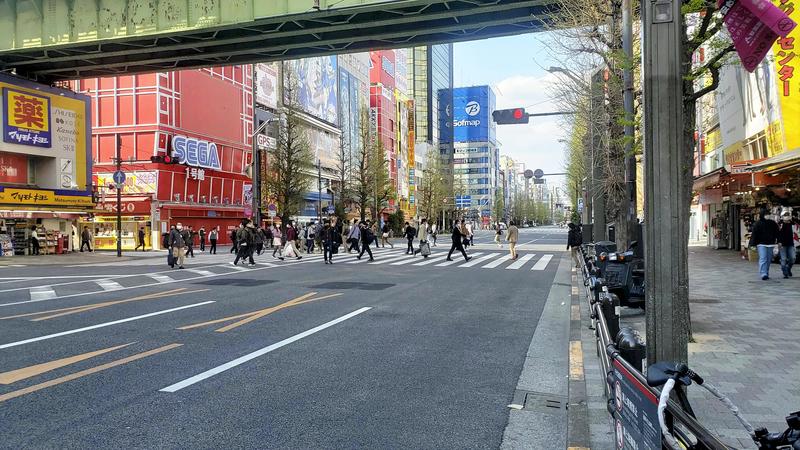
In cities and towns, stores and shops remain closed as part of the social distancing measures aimed at containing the spread of the virus. With no customers, restaurants and small retailers has seen sales evaporate.
World Co., a major apparel maker known for its Takeo Kikuchi and Untitled brands, expects to see net sales from its existing stores drop 97% in May, and a drop into the red overall for the business year ending March 2021.
That will stem from 90% of its 2,400 stores nationwide being unable to operate after department stores and other commercial facilities, of which many are tenants, closed.
The aggregate net sales of 1.3 million companies nationwide, including small- and mid-sized businesses, totaled 1.52 quadrillion yen in 2018. Nobuyasu Atago, chief economist at Okasan Securities, estimates that losses in just one month while the national state of emergency is in effect will amount to just under 50 trillion yen.
There is a sudden contraction of demand the likes of which was not seen even during other economic crises such as the bursting of the bubble economy in the 1980s and the collapse of Lehman Brothers in 2008. Of the 32 companies announcing their business results on Thursday, only nine offered an earnings forecast for the next business year.
What can the manufacturing industry do to help contain the virus' spread?
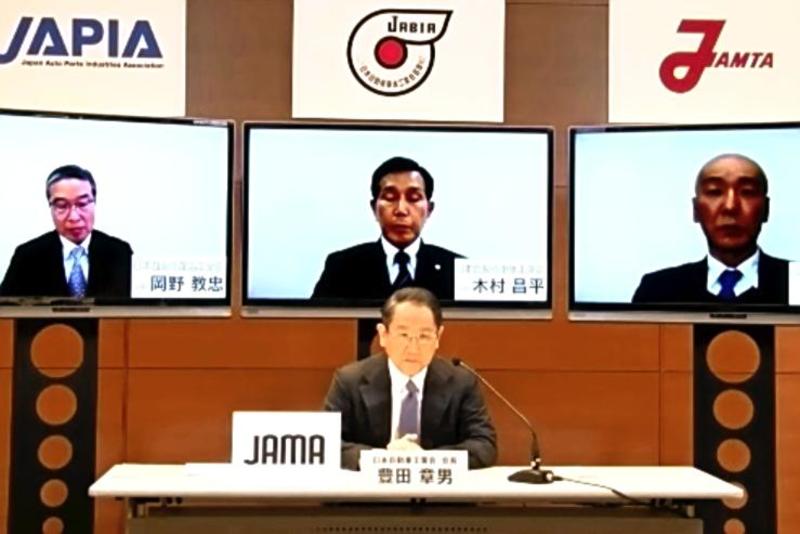
Toyota Motor Corp. President Akio Toyoda, who is chair of the Japan Automobile Manufacturers Association, suddenly arranged a press conference broadcast on the internet last month.
"Tenacity in our industry's DNA will allow us to survive," he said.
Toyoda, 64, told the story of how, at the end of World War II in 1945 with its employees and factory lost, Toyota began manufacturing pots and frying pans, and they grew potatoes and wheat on lands around the factory.
This time, Toyota is making face shields for medical workers and has been producing 40,000 per month since starting in late April. The company has also shared its "Toyota Production System" with medical equipment makers to help increase efficiency in the manufacturing of ventilators.
Facing a drop in demand for its mainstay liquid-crystal display panels, electronics giant Sharp Corp. is also doing its part in using its plants and personnel for mask production. It aims to eventually churn out 500,000 per day at its factory in Mie Prefecture, which is equipped with rooms that keep out microscopic dust and germs.
When its masks were first put on sale in late April, the company was inundated with orders for 4.7 million.
"In our 107-year history, it's our biggest seller," the company declared on its official Twitter account.
A simulation on bankruptcies carried out by research and analysis firm Teikoku Databank in late April produced shocking results. In the simulation, companies would steadily see a drop in sales by half, and if they do not receive financial support from the government, more than 600,000 will be in danger of going bankrupt in 11 months.
The unemployment rate will continue to rise as well. An additional 2 million-plus workers will lose their jobs, and the unemployment rate will quickly spiral upward from 2.5% in March to 5.6% before the end of the year, according to one calculation.
Economic growth for the April-June quarter is expected to approach the minus-30% range, which would be the worst seen in the postwar period.
"The number of deaths of those infected may be reduced, but if the number of economic-related deaths goes up beyond that, we will have lost the fight against the coronavirus," said Taro Saito of the NLI Research Institute.
The Japan Business Federation (Keidanren) has also made moves. On the morning of March 24, ahead of the declaration of a state of emergency, Director General Masakazu Kubota called a dozen or so senior executives into an office and implored, "At any rate, use whatever resources you can come up with to tackle this."
Putting together a recommendation to the government normally takes months. This time it was done in a week and submitted to the government, pressing for a financial stimulus package exceeding that of the Lehman crisis as an emergency request.
Keidanren Chairman Hiroaki Nakanishi personally implored member companies to "put priority on saving jobs," reflecting the severity of the situation.
In the past, crises such as pandemics or wars have been a catalyst for innovation; the plague of the 1340s, which claimed 75 million lives in Europe, led to the loss of the church's authority to prevent the disease, and led to the Renaissance. The Spanish flu, which was prevalent a century ago, also contributed to the advancement of medicine.
In Japan, many Keidanren member companies have switched to telecommuting now, though their reform of different work styles had not made much progress.
In response to outcries from workers who had to return to offices just to affix seals onto documents, Nakanishi indicated it was time to reexamine this, saying, The seals "are nonsense. They have no place in the digital age."
At this point, it is hard to envision what forms the economy and society will take when the pandemic is over. However, it is certain there will be changes to how we work and live. The Japan industrial world is standing at a crossroads in history.
Read more from The Japan News at https://japannews.yomiuri.co.jp/