This is the fourth installment of a series that looks at people seeking and developing new business opportunities to survive the coronavirus crisis.
If you enter an 8.2-meter-long blue truck in a Tokyo parking lot, you will find that the vehicle is actually an eyeglass shop.
The eight-ton truck is equipped with state-of-the-art vision-measuring equipment and lens processing machines. Its crew is able to craft the perfect glasses for customers based on their eyesight and their style preference for eyeglass frames. This is a mobile glass shop that Visionary Holdings Co. introduced in January last year.
The coronavirus pandemic began soon after the Tokyo-based operator of the Megane Super eyeglass shops introduced such mobile shops. They are now becoming popular, especially among elderly customers who do not want to spend time in crowded stores.
"We had this idea for about six years," said Naohiko Hoshizaki, 54, president of the company.
In 2013, an investment fund entrusted Hoshizaki with the restructuring of Megane Super, which had fallen into insolvency. At that time, only one in four visitors to the stores actually bought their products. However, whenever employees made a sales visit to a customer on request because there was no eyeglass store near the customer's home, a purchase was virtually guaranteed. Furthermore, such customers tended to spend 10% to 20% more per person than customers who came to stores.
Hoshizaki encouraged employees, saying, "If customers don't come to our stores, we'd better go outside to find customers."
The president even instructed employees to close the stores to visit customers when asked for a sales visit.
Despite strong resistance within the company, Hoshizaki persisted, in the belief that "it's the principle of business to make sure of making profits."
Initially, employees were confused about such a policy, but they came to realize the effectiveness of sales visits to customers. One of them said, "When we make visits, glasses sell and customers even thank us."
The company prepared 20 vans equipped with simple vision-measuring equipment and began full-scale sales visiting customers. Sales gradually increased and the business became profitable in 2016. Determined to make mobile sales a pillar of the business, the company decided to introduce trucks as well as vans.
The coronavirus pandemic highlighted the strengths of mobile sales. While the number of visitors to the stores has decreased as people refrain from going out, the number of requests for sales visits has increased dramatically since July last year, rising by 26% from the same month in the previous year in November.
The company closed about 60 out of nearly 400 stores, mainly unprofitable ones.
Instead, the company plans to add more trucks and vans to increase the total number of vehicles for mobile sales to 110 by the end of 2023. The company also plans to make sales visits more often to facilities for the elderly and in depopulated areas.
"A business model that's effective even during the coronavirus pandemic is a real business model," Hoshizaki said.
--Demand for masks made in Japan
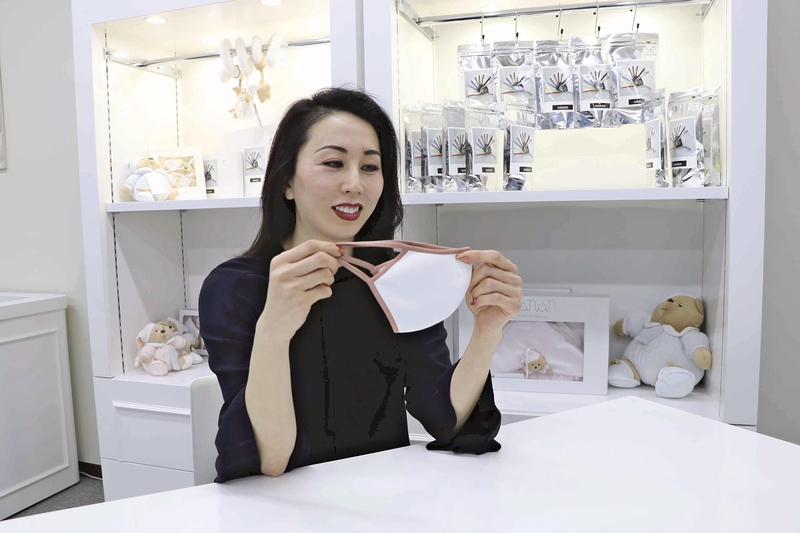
In early December last year, bundles of fabric masks were stacked up and the shipping process was proceeding smoothly at a warehouse in Koto Ward, Tokyo. This was partly because Nanan World Co. had begun selling fabric masks abroad through a cross-border e-commerce website in late November last year.
The company in Chuo Ward, Tokyo, began selling the masks within Japan in May last year. The company got so many responses that Haruka Kawada, 38-year-old president of the company, described it as "so unexpected that employees on the ground were confused."
The situation prompted Kawada to sell her products abroad. So far, the company has received inquiries from more than 10 countries and regions, including the United States, Hong Kong and Taiwan.
Kawada has been importing and selling Italian brand baby products since 2014, when she quit working as a nurse. She decided to start selling masks when she was asked to do so by a company in Italy. At that time, the number of people infected with the coronavirus was rapidly increasing in that country and Kawada was asked for masks "made in Japan, where people have a habit of wearing masks."
She found a sewing factory through a friend. Through her connections from her time working as a nurse, Kawada asked medical workers to try the masks out and sought their feedback. After sending the masks to Italy at her own expense, Kawada embarked on sales efforts for the masks. Now the sales from the masks are about three times higher than those of baby products, whose sales fell as people refrained from going out shopping.
Masks made in China, which dominate the global market, are not highly trusted in terms of quality. Therefore, Kawada thought, "We could do well if we emphasize [that our masks are] made in Japan."
--118 countries, regions
Beenos Inc., a Tokyo-based provider of cross-border e-commerce systems, is receiving an increasing number of inquiries, mainly from small and medium-sized companies. The company offers such services as "Buyee," a service that enables customers abroad to buy products from Japanese e-commerce websites by offering translation, payment processing and overseas delivery.
Shota Naoi, 40, president of the company, traveled around Asia as a backpacker when he was a student. What motivated him to launch this business was a memory from those days: Locals he befriended would ask him to bring things from Japan when he visited the countries again.
After working as a consultant for small and medium-sized companies, he launched a cross-border e-commerce website.
With delivery routes to 118 countries and regions around the world, companies can start selling their products overseas simply by linking up with this website.
In the fiscal year that ended in September 2020, total sales generated by distribution of items and services via the Buyee website increased by 22.3% from the previous year, reaching a new high.
"The number of Japanese companies that want to sell their products overseas has increased, as they expect the coronavirus pandemic last a long time," said the president.
"We want to create an environment where people can do business around the world without feeling any barriers."
Read more from The Japan News at https://japannews.yomiuri.co.jp/