There have been a number of large-scale fires at apartments and facilities where many elderly people and livelihood assistance recipients lived.
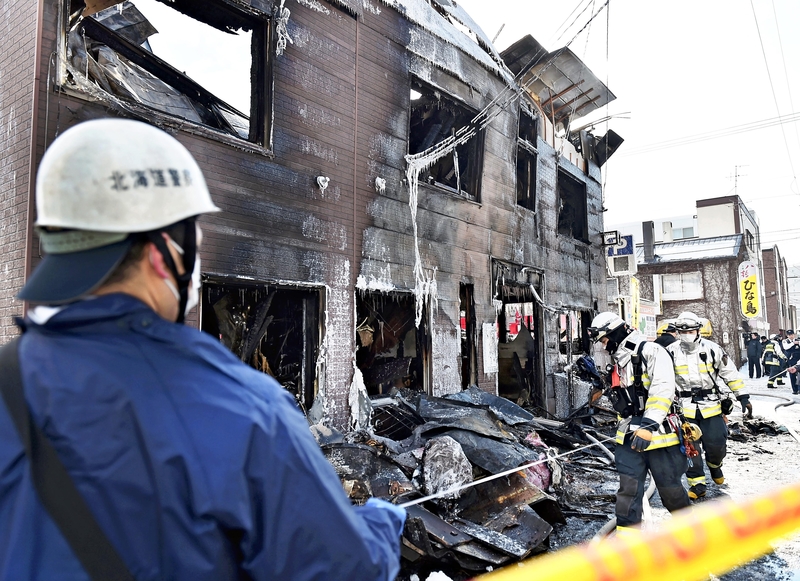
Late Wednesday, a fire occurred at a residential facility for financially disadvantaged people in Sapporo, resulting in the death of 11 people.
The Health, Labor and Welfare Ministry is calling on local governments to make efforts to grasp their respective situations regarding unregistered facilities and strengthen administrative direction toward them.
However, sufficient measures have not yet been taken, and the difficulty in dealing with these unregistered facilities has come to light.
Actual situation unknown
"I feel desperately sorry," Noriyoshi Fujimoto, the 68-year-old head of Nanmosa Support, which operates the fire-hit Soshiaru Haimu facility, said to reporters on Thursday.
According to Hokkaido prefectural police, the residential facility accommodated 16 people, including elderly residents. The operator told reporters the facility could be called an "elderly support facility."
However, it did not submit notification to the relevant authorities that it was a paid nursing home or other type of facility.
In response to a survey by the welfare ministry, the Sapporo municipal government reported in 2015 that the residential facility in question was suspected of being an unregistered facility providing free or low-priced accommodation and support to financially disadvantaged people and others.
Additionally, for reasons including the fact it offered meals to residents, the facility is suspected of being an unregistered paid nursing home.
Free or low-priced accommodations are stipulated under the Social Welfare Law, and paid nursing homes under the law on social welfare for the elderly. However, the details are vague, with no clear definition of "financially disadvantaged people," for example. The decision on whether a facility needs to submit notification is left at the discretion of the relevant municipality.
The Sapporo municipal government plans to conduct a hearing on the operating entity again, saying the residential facility could fall under the category of paid nursing home, although it cannot determine this at the moment.
Recent blaze far from first
In the past, there have been large-scale fires at facilities where many livelihood assistance recipients and others have lived. Every time someone became a victim, insufficient firefighting equipment or a slow response by relevant governments was pointed out.
For example, 10 residents were killed in a fire at an unregistered nursing home for elderly people in Shibukawa, Gunma Prefecture, in March 2009. The former head of an entity that operated the facility was found guilty for reasons including no fire alarms having been installed.
In February 2013, five residents died in a fire at a group home for dementia patients in Nagasaki. On Thursday, the Nagasaki District Court handed down a guilty sentence to the former president of a company operating the group home. The ruling strongly criticized the company's sloppy management of the group home because it failed to install sprinklers or assume a fire could happen.
Demand for facilities rising
However, these unregistered facilities are the last resort for low-income elderly people with nowhere else to go.
Low-income elderly people can enter special elderly nursing homes that are funded through taxpayers' money. However, even if people want to move into special elderly nursing homes, there are no vacancies in many cases. About 360,000 people were waiting for places as of April 2016.
Registered paid nursing homes have good care systems, but their residential fees are often expensive. As for ordinary apartments, many owners hesitate to rent rooms to such elderly people due to risks such as unattended deaths.
More than a few elderly people move into unregistered facilities for these reasons. They are introduced to the facilities by hospitals looking for places for their patients after being discharged, care managers who make nursing plans for elderly people, municipalities, and others.
A care manager working in the Tokyo metropolitan area said, "I have no choice but to introduce these cheaper facilities, even though I know they are unregistered."
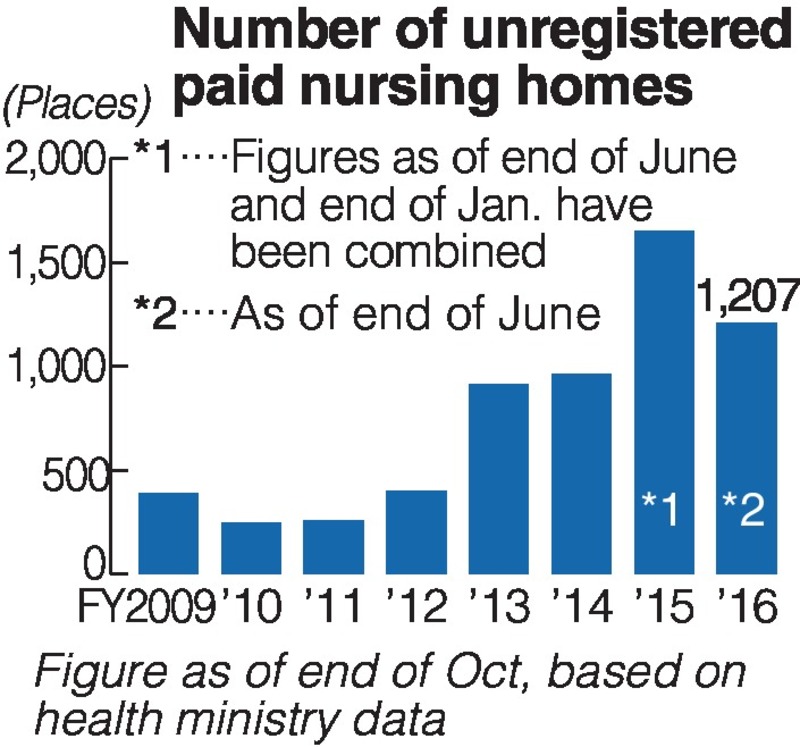
According to the first survey of its kind conducted by the ministry, there were 389 unregistered paid nursing homes in 2009. However, the number rose to 1,207 in 2016. As of 2015, there were 1,236 facilities suspected of being unregistered providers of free or low-priced accommodations.
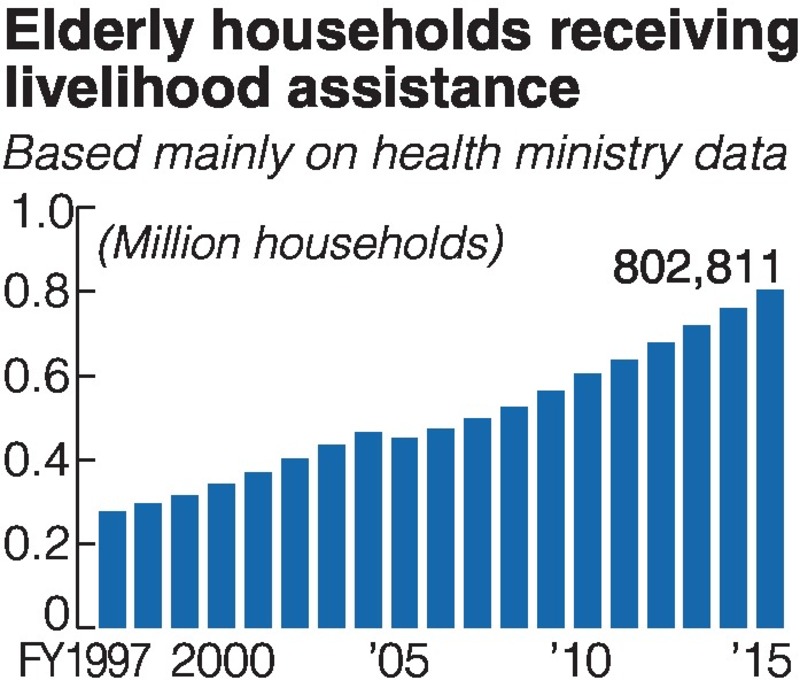
The number of elderly households receiving livelihood assistance rose to about 800,000 in fiscal 2015 from about 280,000 in fiscal 1997.
Tsuyoshi Inaba, a specially appointed associate professor at Rikkyo University who is familiar with poverty issues, said, "So far, civil groups and others have offered accommodation for financially disadvantaged people out of good will. But they often rent old wooden properties, which have a higher risk of fire. Housing support from the public sector will be necessary."
Read more from The Japan News at https://japannews.yomiuri.co.jp/