A fire burned down a Bronze Age settlement near modern-day Villena in Spain 3,500 years ago and preserved a rarely documented archaeological artefact – a wooden loom.
Wooden artefacts, given their compostable nature, are rarely preserved. Hence, very little is known about ancient looms made of wood.
The Villena loom is one of only a few known specimens from Mediterranean Europe. It enables archaeologists to study the working of an ancient loom in great detail, offering insights into the commonly used as well as the social organisation of work at the time.
The artefact was found at the archaeological site of Cabezo Redondo, which in its heyday was a regional hub spread over about an hectare. Excavations at the site began in the 1960s.
The dwellings at the ancient settlement, built on a series of terraces on the slope of the hill, had workbenches, fireplaces, silos, and receptacles for storage.
The village grew in size with continued occupation and the construction of monumental structures.
It played a key political and economic role in the southeastern Iberian Peninsula during the second millennium BC, researchers said.
However, around 1450BC, a fire erupted and razed the dwellings and the workshops to the ground.
Recent excavations unearthed a wooden loom preserved within a sealed space formed by the collapse of a ceiling.
“The collapse of the ceiling was crucial, resulting in a sealed space, enabling its preservation,” explained Gabriel García Atiénzar, an author of the study published in the journal Antiquity.
“The preservation of the organic elements was due to the fire that charred the remains and to the fact that these remains were practically unaltered later. Paradoxically, the fire both destroyed and preserved the site,” Yolanda Carrión, another author of the study, said.
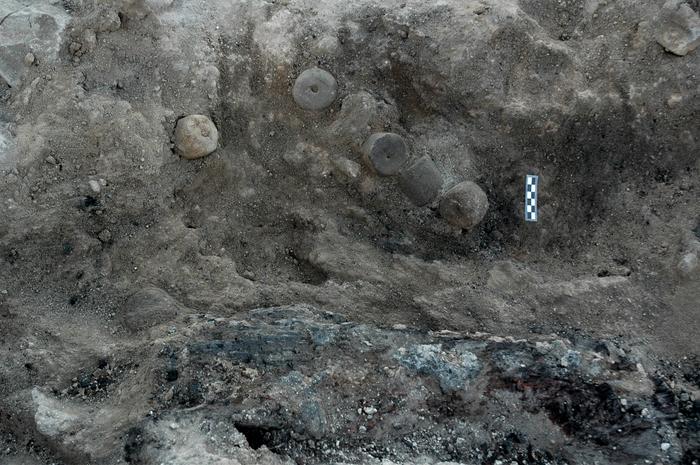
Researchers found the loom along with charred timbers, clay weights and esparto ropes, all trapped beneath the remains of the collapsed ceiling.
“Though the loom was recovered from a collapsed area and some pieces were missing, the compact set of 44 cylindrical weights with a central perforation, most of them nearly 200 grams in weight, is characteristic of a vertical warp-weighted loom,” study co-author Ricardo Basso Rial said.
From all these components, scientists could accurately determine how the loom worked.
Researchers found that the loom was made from Aleppo pine, widely found in the surrounding area.
Growth rings on the timbers suggested they came from mature trees, indicating that loom materials were carefully selected.
“The arrangement of wooden components of various sizes, assembled with each other and resting on a wall and the presence of the weights allow us to develop a robust hypothesis about the loom’s morphology,” Dr Carrión said.
Archaeologists said the loom was likely made during a period of “textile revolution” in the European Bronze Age.
“The textile revolution was the result of a combination of processes, including the expansion of livestock breeding for wool production, technical innovations in looms and spinning and weaving tools, and social changes that led to more intensive and diversified textile production,” Dr Rial said.
In this period, different household groups likely collaborated in activities such as spinning, weaving and milling, with women playing a “central role”, scientists said.
China factory activity rebounds in March as Iran war looms over growth
First human case of H9N2 bird flu recorded in Europe. Here’s what we know
Spain says it has closed its airspace to US planes involved in the Iran war
Ukrainians chide German defense boss for jibes about 'Lego' drones made by 'housewives'
Newly found letter reveals joy at ‘Tutankhamun curse’ creator’s death
New study upends theory about how humans got to the Americas