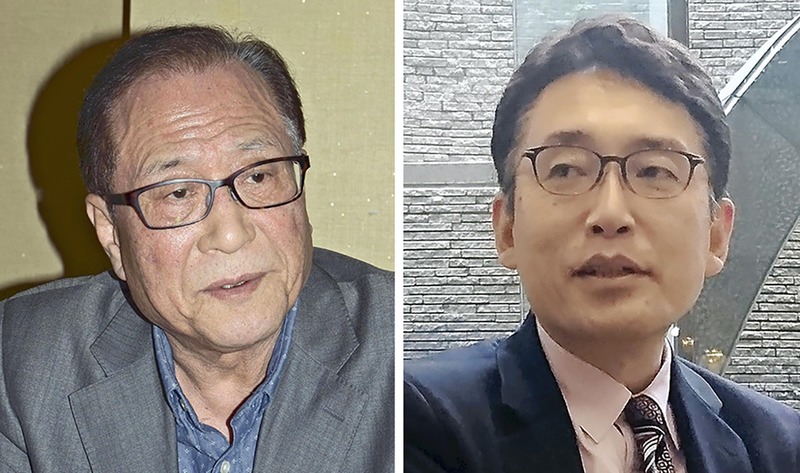
North Korea has informed a South Korean special delegation of its willingness for denuclearization and dialogue with the United States, a move that brings the Korean Peninsula situation to a crucial juncture. After several previous failures, can a path toward the denuclearization of North Korea be found this time? The Yomiuri Shimbun asked experts from Japan and South Korea about the prospects for dialogue between Washington and Pyongyang. The following are excerpts from the interviews.
(From The Yomiuri Shimbun, March 8, 2018)
===
Prepare for a lengthy struggle
Jeong Se Hyun / Former South Korean Unification Minister
North Korea's long-running nuclear and missile development has made it impossible to improve Seoul-Pyongyang relations unless there is progress on North Korea's denuclearization.
North Korean leader Kim Jong Un, chairman of the Workers' Party of Korea, sent his sister, Kim Yo Jong, to the opening of the Pyeongchang Winter Olympic Games in South Korea. When Kim Yo Jong sounded out South Korean President Moon Jae In about visiting North Korea, Moon commented that "a suitable envi-ronment should be prepared" for such a meeting. Moon was referring to making progress on the denuclearization issue.
In that respect, getting Kim Jong Un to mention "denuclearization" and also to indicate his willingness to hold dialogue with the United States during the latest round of talks between South Korea and North Korea was a breakthrough and a significant result.
Kim's comment has overturned his own stated desire to make North Korea a "strong nuclear power." For decades, North Korea has pushed ahead with its nuclear development to protect itself from external threats. However, a wide range of sanctions imposed by the international community has battered North Korea's economy, so Kim probably calculated that allowing these conditions to continue could trigger an internal crisis. Justifying denuclearization by claiming it was the dying wish of his grandfather, Kim Il Sung, and father, Kim Jong Il, was an excuse to convince the North Korean public to support this change of heart.
Of course, many people will be skeptical about whether North Korea will really give up its nuclear weapons. However, just doubting the sincerity of the other side will do nothing to resolve the problem. Effort will be important to translate Kim Jong Un's latest remark into action -- and eventually an accomplished fact.
At the same time, we must not forget that North Korea's denuclearization will be a long process.
During talks expected to be held between Washington and Pyongyang, North Korea should refrain from making any unreasonable demands right from the get-go. If North Korea insists the United States withdraw its military forces from South Korea in exchange for ending its nuclear program, it is clear the United States would quickly walk away from the table. The United States will also be well aware that the "complete, verifiable and irreversible denuclearization" that it is demanding will take a considerable length of time. As a first step, both sides should build a relationship of trust and, over several rounds of dialogue, try to draw up a road map toward denuclearization.
The Moon administration's plan to make a direct explanation of the results from the latest bilateral talks to not only the United States but also to Japan, China and Russia, was possibly made with a future resumption of the six-party talks in mind. Involving related countries in monitoring efforts by the United States and North Korea will be essential in the denuclearization process over a lengthy period. There are expectations Japan will have a major role to play if some progress on denuclearization is made and providing economic assistance to North Korea comes up for discussion.
It also is worth noting that while South Korea has decided to dispatch National Security Office chief Chung Eui Yong to the United States, China and Russia to brief officials, National Intelligence Service head Suh Hoon is sent to Japan for this task. Sending its preeminent North Korea expert to Japan is proof of the importance South Korea places on Japan and is aimed at precisely conveying North Korea's intentions. The Japanese government should also start seriously thinking about its involvement in any dialogue that could shift into high gear.
(This interview was conducted by Yomiuri Shimbun Seoul Correspondent Yujiro Okabe.)
---Jeong Se Hyun
Long engaged in South Korean policy toward North Korea, assuming such posts as vice minister of the Unification Ministry and special adviser to the head of the National Intelligence Service. He also served as unification minister from 2002 to 2004 in the last days of the administration of President Kim Dae Jung, which was conciliatory toward North Korea and the early days of Roh Moo Hyun's administration. He is 72.
===
Pyongyang looking for loopholes
Shunji Hiraiwa / Professor at Nanzan University
It is said that North Korea indicated there was no need to keep a nuclear program as long as there was no military threat against it and the safety of its regime was secured, and declared its willingness to relinquish its nuclear program. But as things stand, it cannot be said that North Korea's stance has changed significantly. It is not disavowing its position as a nuclear power.
Until now, North Korea has used the United States' hostile policy toward it as the reason for possessing a nuclear arsenal.
However, neither Pyongyang nor Washington has ruled out talks per se. The United States has demanded North Korea abandon its nuclear program; North Korea has demanded the United States recognize it as a nuclear power. Recently, South Korea turned North Korea's conventional assertion on its head in a bid to realize talks between Washington and Pyongyang. In a nutshell, Seoul attempted to find connections between them by switching the argument to say, "The United States should change its hostile policy to create conditions in which North Korea would not need to possess nu-clear weapons."
The United States could save face by being able to declare that constantly applying pressure on North Korea had prompted that nation to change its posture toward dialogue.
If Washington and Pyongyang hold direct talks, I expect North Korea will call for replacing the armistice agreement that ended the 1950-53 Korean War with a peace treaty before it will give up its nuclear program. In the future, the withdrawal of U.S. forces from South Korea and a reduction of U.S. nuclear missiles targeting North Korea will also be raised.
The United States will undoubtedly insist that North Korea's denuclearization should come first. The further the dialogue proceeds, the more difficult it will inevitably become.
Three main objectives lie behind North Korea's allusion to a moratorium on nuclear and ballistic missile tests.
First, to determine who is leading North Korean policy in the administration of U.S. President Donald Trump, Pyongyang presented conditions that are easily acceptable to the U.S. State Department, where dialogue advocates are based.
Second, it will become difficult for the United States to conduct military actions against North Korea while dialogue is continuing. North Korea declared in November that it had completed national nuclear forces, but some problems remain about this. It aimed to buy time to advance technological development.
And third, North Korea will try to receive aid from South Korea while making South Korea urge Japan and the United States to ease their sanctions. If South Korea and North Korea go ahead with a summit meeting at the end of April, the North would try to make the South reconfirm the agreement on economic cooperation and other issues reached during the October 2007 meeting between then North Korean leader Kim Jong Il and then South Korean President Roh Moo Hyun. In the end, this agreement came to nothing due to a change in the South Korean government.
Japan and the United States are certain to oppose any reconfirmation of this agreement. South Korea also cannot easily accept North Korea's demands. However, North Korea has spotted that South Korean President Moon Jae In was a senior official in the Roh administration and has an attachment to that agreement. North Korea will likely nudge South Korea to convince Tokyo and Washington to get behind the deal.
The most important thing for North Korea is improving ties with the United States. As a first step, it is seeking to develop closer relations with South Korea and, at the very least, curb any U.S. military action. At a time when there are growing calls in the international community for continued pressure on North Korea, Pyongyang's real aims are to foster an atmosphere in which dialogue is perceived as being necessary and to sniff out any loopholes in the sanctions it faces.
(This interview was conducted by Yomiuri Shimbun Staff Writer Takeo Miyazaki.)
---Shunji Hiraiwa
Specializes in the politics and diplomacy of South and North Korea. He assumed his current post after serving as special investigator at the Japanese Embassy in China, professor at Kwansei Gakuin University and other posts. His published books include "Kitachosen wa Nani o Kangaete Irunoka" (What is North Korea thinking?). He is 57.
Read more from The Japan News at https://japannews.yomiuri.co.jp/