Reports and presenters:
Hugh Muir
Participants:
CNC Clár Ní Chonghaile
GR Gideon Rabinowitz
AR Andrew Rogerson
RS Rupert Simons
AD Amy Dodd
BS Bianca Sheed
TJ Tim Jones
PC Paddy Carter
JLS Jean Letitia Saldanha
KS Kary Stewart
NA Natasha Adams
“Why do we give aid money? Is it about redistributing wealth around the world; is it about addressing past wrongs? And if we answer that question, that can help us work out who are the people who should be contributing.”
“There was a kind of historical responsibility. Aid is something we promised to do over half a century ago.”
“A lot of the Addis Ababa accord is about broadening financial flows to include the south and to include private flows, and we need to make sure that transparency is also applied to those flows.”
“There is a stat that is that three times more is lost to tax havens than is received in global aid flows by poor countries; it’s a huge, huge, huge amount of money.”
“We’re moving from an MDG agenda, which is what the north does to the south, to a universal agenda, which is everyone in the world collaboratively moving to a better future. We’re not currently on track for that sort of outcome in Addis.”
“I would like to be optimistic but if I sit in every day in the negotiations my heart is sinking deeper and deeper.”
HM Hello and welcome to the Global development podcast. My name’s Hugh Muir. This July in Addis Ababa in Ethiopia, they’ll host the UN’s third international conference on Financing for Development. Member states will decide on how the sustainable development goals, the blueprint for development priorities over the next 15 years will be financed. Global development’s Clár Ní Chonghaile went to a panel discussion called Financing the Future at the Overseas Development Institute and asked participants what they hoped the Addis meeting would deliver.
CNC This July in Ethiopia the UN will hold its third international conference on financing for development. This is ahead of September’s summit to ratify the sustainable development goals. The challenge facing member states in Addis Ababa will be deciding how to pay for this ambitious set of goals that will drive development priorities over the next 15 years.
The issues are complex and cover everything from aid and taxes through to the role of the private sector and trade, but success is crucial if the SDGs are to be achieved by 2030.
GR My name’s is Gideon Rabinowitz, I’m a research officer here at the Overseas Development Institute. I think the best possible outcomes are that we get commitments that allow for momentum on aid and international public finance to continue into the future. So we currently have in the proposed text for the agreement that developed countries will deliver 0.7% of their national income as ODA by 2020. That really gives campaigners and advocates a hook to really push their governments to deliver and scale up their aid in the coming years, which is great. So we need to keep that language there.
AR I’m Andrew Rogerson. I’m from ODI. Maintain their promises – that’s on the volume of ODA – but also on its composition. They need to spend a lot more on the poorer countries proportionally.
CNC The UN’s 0.7% target has, so far, proved elusive. That is why campaigners want Addis to spell out a clear re-commitment to the 45-year-old target. Rupert Simons, chief executive of Publish What You Fund, says member states must be ambitious if the SDGs are to leave no one behind.
RS I think it’s critical to get a good outcome at Addis but it’s not just about getting an outcome – anyone can get an outcome and sign on the dotted line. The key is that the outcome be ambitious and, above all, be universal. So where I see Addis coming in is that we’re moving from an MDG agenda, which is what the north does to the south, to a universal agenda, which is everyone in the world collaboratively moving to a better future. We’re not currently on track for that sort of outcome in Addis.
CNC One of the problems will be balancing the needs and responsibilities of all the member states, from emerging economies to fragile states to richer, traditional donors.
GR The major powers are looking for ways to opt out of some of the commitments. There’s an agenda at the moment that unless the emerging economies put something on the table, that the developed countries won’t come along and make additional commitments. Well that, to me, isn’t sufficient justification for not making a commitment. The emerging economies have only recently come to prominence in the global economy. It’s the developed countries that need to be showing the way and they shouldn’t be using the emerging economies as an excuse not to deliver on their commitments.
AR Some of them who are still classified as developing countries but are very emerging power houses can also do an awful lot, not necessarily in the form of gifts but in the form of loans, in the form of trade and so on. So they need to be part of a more responsible global system.
CNC Another talking point at Addis will be how to harness alternative streams of financing to supplement traditional aid flows. Some governments want to use the private sector to help kick-start development; but others are concerned about whether such projects will have enough of a focus on improving the lives of the poorest.
AD I’m Amy Dodd from the UK Aid Network. I think it’s not unreasonable to say that we need to be looking at other forms of financing and what developing countries, particularly the Brics, for example, can be doing. But realistically it feels to me that there was a kind of historic responsibility. Aid is something we promised to do over half a century ago, it feels like something we need to deliver. And so I can see a certain unwillingness, particularly from southern partners, that actually, you know, we just haven’t lived up to those commitments.
BS My name’s Bianca Sheed and I’m from SAB Miller. I think there’s a great deal of interest from the private sector in Addis, and what the expectation will be. And what the expectations of financing are as far as the private sector is concerned.
CNC A positive outcome at Addis will be welcomed, and will set the stage for the September meeting and also a critical summit on climate change this December. From there, the next step will be ensuring that financial pledges can be reliably tracked and monitored.
RS The most important commitment for us at Publish What You Fund is that all financial flows, whether they are north-south, south-south or private investment, be transparent and accountable. We don’t have that currently. We have made some progress towards it in the world of aid transparency, but a lot of the Addis Ababa accord, if that’s what we can call it, is about broadening financial flows to include the south and to include private flows, and we need to make sure that transparency is also applied to those flows. If it’s not, then we will leave the power in the hands of those who have the information; and that is overwhelmingly rich countries and investors, and we’re, once again, cutting out the poor and the supposed beneficiaries of those financial flows.
HM Global development’s Clár Ní Chonghaile. And joining me live in the Guardian studios here in London to discuss these issues are Tim Jones, policy officer at the Jubilee Debt Campaign; Paddy Carter, one of the lead authors of the ODI’s report on how international public finance can help eradicate poverty; and on the phone is Jean Letitia Saldanha, senior policy advisor from CIDSE, or International Cooperation for Development and Solidarity. Welcome to all of you.
So you heard in the report there a wish list of outcomes from the summit in Addis Ababa. Let’s start with the proposal that member states deliver 0.7% of their national income as official development assistance by 2020. Only five member states reached that target last year, so how likely do you think it is that we’ll get a firm commitment. Let me start with you, Tim. Do you expect the meeting in Addis to light a fire under those states. That’s most countries that haven’t met the commitment so far, do you think that that will improve?
TJ The evidence isn’t that great at the moment. But of course the aid part of it is only one part of the negotiations, so there are many ways of generating finance and aid is an important part of that. But also the other ways of finding finance through countries being able to keep their own resources through tackling tax avoidance, capital flight – those are going to be just as important in negotiations as well.
HM Paddy Carter, your report for the ODI said, and I’ll quote you here: “If we stick to business as usual, we’ll fall far short of our development goals in 2030.” And I think you listed five recommendations to make sure that member states at Addis actually find a way to meet those goals. Just very quickly take us through those.
PC Some of our recommendations were of a quite technical nature to do with how we think the delivery of international public finance could change to deliver the sustainable development goals. So, for example, one of the problems we identified is that in the lowest income countries in the world at the moment, there’s basically no social protection programmes, or at least it’s very fragmented and small scale. So we have been suggesting the creation of a new multi-lateral financing facility to accelerate the introduction and expansion of social protection in the world’s poorest countries. And really without such action, the ambition of leaving no one behind will really just be empty words.
HM Jean, you heard that. Do you think that’s a good way forward?
JLS Absolutely. I mean I think that the proposals that ODA makes in their report are absolutely plausible. The question is the reality on the ground in the negotiations. I’m here in New York following these negotiations, and why we would like all this to happen on the ground. And in fact it has to happen, as ODI forecasted – if it does not we’re going to still have extreme poverty, etc. But here in New York we’re seeing that reality is far from delivering what we all want, and there is a whole lot of bargaining at the moment, even to have any kind of commitment in the outcome of Addis. On the one side the northern countries want the southern countries to commit. And on the other side southern countries want the northern countries to commit.
HM Now we heard there just a bit earlier that phrase “leave no-one behind” – that’s the mantra for the sustainable development goals. Tim, in your view, how much pressure is there on the donor countries? And could the aims of the SDG prove just to be too much of a financial burden for at least some of them?
TJ I don’t think it could be too much for most donor countries because ultimately the amounts of public finance being talked about are still very small for them. And although we’ve had this financial crisis we’ve been going through, the reality is there are still huge amounts of money in northern countries, and that governments maybe aren’t accessing it through getting the money in through tax, but it’s certainly there. The deeper challenge is to… why do we give aid money? Is it about redistributing wealth around the world; is it about addressing past wrongs? And if we answer that question that can help us work out who are the people who should be contributing, whether it is those who have caused problems for countries in the past through colonialism or through their policies imposed on countries in the 80s and 90s. If it’s about redistribution we can look at the countries that have the most wealth in the world and work out how they should redistribute it. There’s, as I said, there’s also the fact that, for example, sub-Saharan Africa actually gives more money to the rest of the world than it receives. So we’ve also got to tackle that side of the equation as well as just the donor giving money in the first place.
HM Jean Letitia Saldanha in New York what are your views on this? Are we expecting too much, particularly from the southern countries?
JLS I completely agree with Tim that northern countries have a particular responsibility. Southern countries are, in fact, net creditors. Donor countries made commitments based on an acknowledgement of a particular responsibility, historical or otherwise, way back 40 years ago. So I think that southern countries in their circumstances at certain times may be able to contribute overall to sustainable development. And I do believe that every country has to make efforts, but northern countries have a very specific responsibility in this regard.
HM So everyone has to do their bit. Paddy, what about the emerging economies, how much should we be expecting from them?
PC Well they’re already doing a lot. From memory I think that if you think about financial flows which resemble foreign aid – although the emerging economies don’t like to think of themselves as aid donors – that type of financial flow is already up to about 12% of global aid flows. And they have a lot more to offer besides money. So, for instance, China is well known to know a thing or two about infrastructure investment; and Brazil, returning to my earlier point about social protection, economies like Brazil are famous for having implemented large-scale social protection programmes; so they can bring a lot in terms of technical assistance.
However, the sort of emerging economy view on development assistance is that it’s more like a private act between consenting governments than it is something which international agreements, such as what we’re going to be seeing at Addis, have much to do with. So I think that they’re going to be a bit resistant to coming up with some of the things that some of the rich countries might want them to commit to. And instead we’ll see them contribute just because they perceive it to be in their interest.
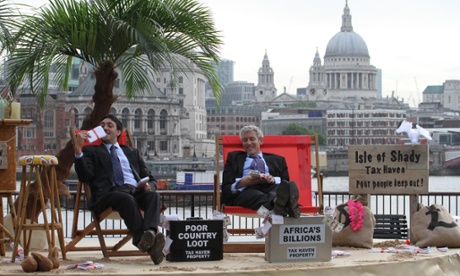
HM So let’s just change tack a little bit because I want to focus, for a moment, on tax. How much is tax avoidance by multinationals an issue? And could this really be a major source of funding for the SDGs? To answer that question we sent our producer, Kary Stewart, on to the streets of London on a treasure hunt.
“That’s right. So who here enjoys paying tax?”
KS No one really likes to pay tax but without it much of the infrastructure that we take for granted would not be possible. Multinationals, however, are routinely exploiting loopholes which allow them to avoid paying taxes, often by using tax havens. The result is that developing countries are estimated to lose tax revenues that are worth almost three times what they get from developed countries in aid.
So how are corporates implicated? We went out on a treasure hunt on the streets of London to find out.
NA My name is Natasha Adams and I’m the activism officer at ActionAid. I came to do a piece of research looking at where a lot of the headquarters of the corporates that ActionAid has exposed for tax dodging in developing countries were – they’re actually in quite a small area of London, around Mayfair. And so it made sense to put this tour together. It was actually Tom’s idea. He’s the guy who runs the tour with me.
Tom Indeed. So welcome one and all to Mayfair. It’s nice around here, isn’t it? What do you guys think? Do you think it’s nice around here?
NA A piece of research that ActionAid did actually showed that 98 of the FTSE 100 companies are using tax havens just routinely. So it’s not really a question of who is the worst offender, we’re rather trying to highlight something that it is endemic.
KS A report by the UN Conference on Trade and Development estimated that profit-shifting by multinational companies costs developing countries $100bn a year in lost corporate income tax. Another report, by IMF researchers, estimated that developing countries may be losing as much as $213bn a year to tax avoidance.
“So if you hear people complaining about international aid, we really need to keep this in perspective. The money that poor countries lose to tax dodging is so much more than total global aid flows. It could be a really good source of sustainable funding for development…”
KS So why are funds raised by taxation so central to development? Taxes give states resources to invest in essentials such as education, roads and healthcare. As countries become wealthier, taxes fund social welfare and pensions, reducing poverty and inequality and evening out aggregate demand.
“Really lovely window displays. Every time we’ve stopped here which will be perfect for your tax haven island…”
KS Over the last decade the Organisation for Economic Cooperation and Development, the OECD, has been working to encourage countries to agree to higher standards of transparency, and also to an exchange of information in tax matters. These efforts have gained global endorsement from the G20 and the UN. However, many argue that poorer countries are often left out of the discussions altogether.
AD One of the biggest problems in terms of how the global tax system is designed is that poorer countries don’t have a fair say in deciding on how the global tax rules are set up. So most of those decisions are made at an OECD level which means that the poorest countries, they just have no say.
KS In fact lower income countries are in a trap where lack of funding results in below-par administrative structures which make it difficult to collect taxes. A June report published by the Independent Commission for the Reform of International Corporate Taxation calls for the abolition of the separate entity principle. The establishment of an international tax system could be one of the most effective ways for donor countries to help developing countries mobilise their own resources.
“We don’t know exactly how big the tax bill should be because of the kind of secrecy element we discussed earlier, but I’m pretty sure it will be a lot more than 10 million...”
KS Unlocking tax, and creating transparent global tax system are at the heart of discussions about how to fund development and end inequality. That’s why these will be the hot button topics when UN members meet up in Addis next month.
“It’s very, very clear that using tax havens to avoid paying tax in countries where some of the poorest people in the world are…”
HM So what we see there is I suppose what we knew – multinationals are clever at avoiding tax. Tim, if these loopholes were tackled in Addis, to what extent would that contribute to financing for the SDGs?
TJ It could be huge. It’s been estimated that the amount of tax avoided in developing countries is three times the current level of aid. And ultimately what everybody wants to move towards is a system where there is no need for aid, that countries are able to collect all the tax revenue they need to meet all their basic services. So this is a big issue and needs to be very high up on the agenda of the negotiations.
HM Paddy, tax will only take us so far though, won’t it? I think in your report you said that even if developing countries raise taxes and use the existing aid there, there will still be a shortfall of about $73bn in terms of the amounts needed to eradicate poverty?
PC That’s right. And we were only focusing really on a very small piece of the jigsaw, which is health, social protection and education. So there’s a fundamental problem of a huge shortfall of the resources available to countries in the developing world. And regarding taxation, whilst it makes sense to focus on things that have international solutions, in an international conference such as Addis Ababa it should be remembered that really there’s an awful lot of domestic problems with tax avoidance. And whilst a lot of focus rightly goes on multinational corporations, a lot of the big problems are things like tax exemptions offered by governments in the developing world. It isn’t a matter of tax avoidance or evasion, it’s simply government policy.
HM Jean, you talked up the idea of inter-governmental tax bodies in developing countries. Would that be a good idea, would that be the answer?
JLS Let me first respond to the previous comment: I do think indeed that there is an issue with the tax policies of countries. And that’s very much related to tax competition. We right now see a race to the bottom in terms of countries basically putting their corporate taxes down to zero or even in the negative to attract investment, particularly foreign investment. Now the only way we’ve seen a way out of this is for greater cooperation, first of all. So we do believe that there is a reason for international tax cooperation to be discussed in a conference like in Addis Ababa, because we assume that recognising that multilateralism isn’t the only way to respond to this problem, there will be an agreement on greater international cooperation.
Now we see that the OECD has not yet been able to broker this kind of international cooperation. In fact we’ve heard, time and again, we have evidence, that the current international tax regime is not working particularly for developing countries. Now it is an issue of cooperating on tax rates, but it is also an issue of who sets the standards and norms. And that is why we say that we need a new space, a more open and democratic space – in the UN preferably – where we can have a more, I suppose, democratic discussion on how standards are set, how to negotiate the terms of international cooperation. And that’s what the reasoning and the arguments behind the need for a new international tax body are.
HM Tim, what do you think – is that the answer, or even part of an answer?
TJ Yes, a UN tax body is definitely part of the answer that there needs to be something created that actually deals with the particular problem of developing countries to tackle issues like companies reporting on their tax payments by country – automatically exchanging that information. And Paddy said, and he’s entirely right, that there’s a major problem of tax exemptions in countries but this all comes from a philosophy for the last 30 years of whatever private sector money you can get is good. And it’s just a nonsense. Private sector investment can mean many things. It can mean buying up assets which already exist. It can be structuring loans in a way in which to avoid tax. It can be actually creating far higher burdens for governments than they would have had if they’d invested themselves.
So, unfortunately, in this conference, the western countries like the EU and US are really pushing the private sector as a crucial part of the solution. But that is not being examined as to what actually that means. And there needs to be far more subtlety around what the private sector is and isn’t, and a lot more questions saying these are the government policies that are needed to make development happen rather than just an asset-stripping that is too often the case at the moment.
HM And of course the private sector needs to turn a buck, so is that really the answer in developing countries where they won’t have such a return on their investment? What do you think, Paddy?
PC Well, I mean, people tend to throw around the word “private sector” but as Tim has said it can mean an awful lot of different things from just the pure provision of money to entrepreneurs building businesses and employing people. And when it comes to certain priorities I’ve been involved a little bit with Uneca, the UN African Commission for Economics. All they want to talk about is growth, structural transformation, infrastructure, manufacturing and that is all … well it’s not all about the private sector but evidently private sector is a huge part of that. And I don’t think we should think that the emphasis on the private sector is an entirely northern imposition.
HM Jean, in New York, what other innovative financing methods do you think could be used and should be on the table in Addis to maybe give the SDG agenda some teeth?
JLS If you ask me what my wish was I would think that innovative mechanisms we have been discussing for ages – which would be a double whammy and would not only raise revenues which could be channelled to sustainable development but also have systemic impacts – would be the innovative finance mechanisms on the table. So for a long time we’ve had the Robin Hood Tax, the financial transaction tax that civil society has been calling for implementation. This tax would not only raise billions if it would be a full tax-based FTT. But it would also address very volatile financial flows.
Unfortunately what we are seeing in the current negotiations is that these kind of mechanisms are totally off the table, and right now the focus is very much talking about innovation in the kind of financing instruments whereby public money would be used to leverage private finance. I think we can have a debate on leveraging and blending. I do not think there is anything innovative about that. But what we are saying is that we have to tread very cautiously before we rush into considering that. Private investment with a little bit of public money to protect it or to guarantee it will be the only response to the huge financing gaps that we face to reach the SDGs.
HM Tim Jones from the Jubilee Debt Campaign, you’ve been to a lot of these conferences and I suppose they’re not a byword for innovative thinking. But were there to be some blue-sky thinking in Addis, what would you like to see in terms of financing?
TJ Yes, I mean, just one other innovative financing thing would be the idea of quantitative easing for development. We’ve seen, over recent years, western countries creating money as a response to crisis. That is actually something that could be done globally, and done to deal with the fact that all finance at the moment is cyclical; in the good times there’s more of it around, in the bad times there’s less and so in the bad times to do that.
But I think another thing that needs to be part of the debate is the mechanisms to deal with the problems that are created when finance goes wrong. So one of the big things that happened over the previous last period of the MDGs was debt cancellation for 36 countries, which has rapidly cut their debt payments and freed up more resources. The danger is in ten years’ time many of those countries could be back in debt crisis because of the current amount of lending that’s been given and also things like public-private partnerships which hide dangerous amounts of debt for countries. So what we’d like to see is mechanisms to prevent those crises being created – debt resolution mechanisms to deal with debt problems when they arise. And also to tell the private sector they’ll no longer be bailed out if they help cause debt problems.
HM Paddy, I think you’ll be going, won’t you? So when they call on you, as I am sure they will, and say suggest something to us that we haven’t thought of in terms of financing, something innovative, what would you say?
PC Well, you’re asking me a tough one there – there aren’t that many new ideas under the sun. I’m going to be going there and we will be just making the fact that both in terms of the magnitude and the allocation of international public finance it’s just utterly inconsistent with this stated ambition of no one left behind. Particularly, we show in our report, the very poorest countries, under $500 a year per capita – these countries get the least amount of aid per capita than the slightly richer ones. So the reality on the ground is completely inconsistent with the words in all these agreements.
HM So, you’d basically just be asking them to match words with deeds?
PC That’s a good way of putting it.
HM OK. It’s coming towards the end now, but let’s talk about sustainable development because obviously that can’t be separated from efforts to deal with climate change. They’ll be a separate UN summit in Paris in December to do with climate change, but how do you think that this financing conference in Addis will affect that conference, if at all, or how would you like it to? Tim?
TJ Well one of the, if not the crucial issue, in the climate change negotiations has always been the countries that are most responsible for causing climate change historically providing the money to enable countries that will suffer the most from climate change, the poorest countries, to be able to deal with the consequences. And to provide the money to enable countries to grow in a low-carbon way. And so whether or not the Addis conference shows a political willingness to find the mechanisms to raise that money will be crucial for whether the Paris climate conference can actually deliver on signing up to goals that will keep us within safe limits on climate change.
HM Paddy, do you think there will be any connection between the two; what connection should there be?
PC I’m really not sure what to expect. I mean there are some really intractable problems here. The first one is that everybody wants there to be new and fresh money made available for fighting climate change, but it’s really impossible for governments to convincingly say, “Hey this money is genuinely new and not just substituting for money we would have spent on something else.” And the other one is where the donor grant funds should be spent in countries like China and India to mitigate climate change, because obviously there’s a very strong argument that these are the economies which urgently need to be put on a sustainable carbon path, so that’s very straightforward. But then other people worry that as soon as you open the door to grant money being sent to those countries for those purposes, there’s going to be a huge sucking sound as all the money leaves Africa and goes over there. And I’m glad it’s not me that has to resolve these problems.
HM Jean, do you think that climate change is something that they should have high on the agenda in Addis or would that be overload?
JLS I think that climate, inevitably, is on the Addis agenda because Addis is about agreements on the international financial system; and whether we like it or not the international financial system – how it is governed, the rules, etc – are going to impact on how we deal with climate. Simply to give an example of how climate finance will be delivered; even though they’re not going to agree on the pot of money for climate finance, if they are going to continue to talk about PPPs, about leveraging, very correctly as Paddy said, most of the money is going to go to the most stable economies, in middle income countries. And we’re going to see fragile states, LDCs, losing out a lot. And this is going to impact hugely on their growth prospects in a climate-challenged world. Also we’re going to see an increase in debt distress, particularly in small island developing countries and this is genuinely going to create problems, not only for them to address the basic human needs of their population, but more broadly, to be able to address greater climate chaos that they are going to be on the frontlines of.
There are various ways … I mean if you talk about debt, if you talk about new buffer mechanisms that are going to be discussed to increase their climate resilience – all these kind of issues that are going to be addressed in Addis are going to impact on prospects, particularly for countries that are deeply affected by climate change.
HM So there’s a lot for them to talk about. Surveying the prospects there from New York, Jean, just finally – are you optimistic? How likely is it that there will be a positive deal in Addis?
JLS Let me say it this way: I would like to be optimistic but if I sit in every day in the negotiations, my heart is sinking deeper and deeper. I think there is still a chance, I still think there is a chance that the outcome of the Addis Ababa conference is saved and we get a strong agreement, which will be absolutely necessary for Paris. But that will take a lot of political will on all sides to reach that agreement.
HM Well thank you, Jean. There’s some hope there and we’ll cling to that. But that’s all we have time for. I’d like to thank our guests – Tim Jones, the policy officer at the Jubilee Debt Campaign; Paddy Carter from the ODI; and Jean Letitia Saldanha there in New York.
We at the Guardian in the coming months will continue covering all the key events around the sustainable development goals. Remember that all of our programmes are available on the Guardian’s website; that’s the guardian.com/global-development and on SoundCloud and all podcasting apps. But that is it for our Guardian development podcast this month. My name’s Hugh Muir. The producer was Kary Stewart. Until the next time, goodbye for now.