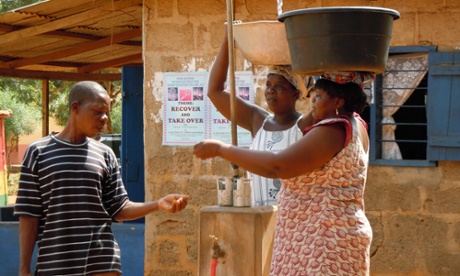
Access to a safe and functioning toilet or clean and reliable water in your house is something that about one third of the world’s people cannot take for granted.
According to the 2014 joint monitoring programme of Unicef/WHO, which counts infrastructure installed, 2.5 billion people still lack a basic toilet facility and 748 million people don’t have an ‘improved’ water source. And these are the positive numbers! Research by the Water Institute at the University of North Carolina suggests that if we consider things like water quality, these estimates need to be downgraded by a factor of two or three.
Research by the IRC in The Netherlands found one in three rural water systems not working at any point in time and as few as 2% providing the basic level of service they were intended to (Adank et al, 2012 and Schouten and Smits, forthcoming).
There are strong public health and economic imperatives for addressing this failure in water, sanitation, and hygiene. Yearly, it is estimated that more than 3.4 million deaths could be avoided and $260bn saved.
The sustainable development goals (SDGs) that will be agreed later this year and will guide development efforts in the coming 15 years will (hopefully – negotiations are still ongoing) set ambitious targets for water sanitation and hygiene. These include universal coverage by 2030, reaching everyone and making services last, while protecting ecosystems and water resources (as explained by Amanda Marlin from the Water Supply and Sanitation Collaborative Council in her blog).
Providing water and sanitation for everyone, forever, will require a profound change in the way the sector works and is funded. It will call for strong civil society and private sector engagement – and most of all – strong government leadership. This leadership will have to drive a shift from piecemeal (often charity driven) projects to countrywide service delivery – and it will have to provide the money to enable this.
This does not automatically mean that service should be delivered through a government agency, nor that the private sector, charities or indeed citizens themselves have no role to play – or money to pay. But it does mean that greatly increased levels of public finance are required to ensure universal access.
Public finance - money derived from national or local taxation - is not very fashionable, but it is the cornerstone of universal water and sanitation services everywhere in the developed world.
Public funds can be used to catalyse and stimulate innovative financing mechanisms, which involve the private sector, civil society and citizens. In fact when governments invest, private sector investments increase as well (OECD/DAC Development Co-operation Report 2014).
Even the most committed supporters of market solutions accept that public finance for water, sanitation and hygiene is necessary in four areas:
1) Bridging the “pioneer gap” between piloting, proof-of-concept and taking innovations to scale
2) Covering difficult to finance aspects of services (for example, transporting and treating faecal sludge)
3) Tackling inequalities and reaching consumers which the market doesn’t, and
4) Creating a favourable environment for leveraging and supporting private investment.
Taxation is likely to be a central issue in the post-2015 agenda. Oxfam has warned that global inequalities are increasing and addressing this will require actions at international, national and local level. Developing countries are losing $10 of every $100 they make due to illicit financial flows, profits taken out by foreign investors and interest payments on foreign debt, according to Eurodad, the European Network on Debt and Development. Both tax systems and water and sanitation services need strengthening.
In Nigeria the WSSCC is supporting an innovative programme where the $5m Global Sanitation Fund support is supplemented by $2.2m from both of the two states where the behaviour change programme is implemented. In addition, National, State and Local Government are committing to provide counterpart funds.
In Mozambique, Ghana and Kenya, Water and Sanitation for the Urban Poor(WSUP) is working with local governments to develop local sanitation taxes collected via the water bill and ring-fenced finance from municipal property taxes.
In 1858, the ‘Great Stink’ in London mobilised the political will that led to sustained public investment in sanitation, drastically reducing child mortality rates. Across the globe, there are many terrible stinks that will not be solved by the market alone. Political will, backed by finance will make or break our efforts towards a world where water, sanitation and hygiene services are fundamental utilities that everyone can take for granted, for good.
IRC are working with WSUP and Trémolet Consulting on a new initiative to raise the profile of public finance for water, sanitation and hygiene, and to explore how it can be applied for maximum impact.
Content on this page is paid for and provided by WSSCC sponsor of the Guardian Global Development Professional Network.