MINNEAPOLIS _ Minnesota's final Islamic State conspiracy defendant was given a stunning 35 years in prison Wednesday afternoon _ the longest sentence among the nine young men indicted _ after a federal prosecutor told the judge: "You can't fix manipulative, you can't fix deceitful, you can't fix Guled Omar. He has blood on his hands."
The sentence by U.S. Senior Judge Michael Davis concluded an emotional hearing that saw families sobbing and one relative led out of the room wailing.
"I understand the seriousness of what I've been convicted of, and I understand that I will not be able to go home anytime soon," Omar told the judge earlier, as his mother cried nearby. "I always had energy for justice as a young man but I lost my way."
The federal prosecutor, however, urged Davis to take Omar's contrition skeptically.
"He was like a well that people kept going to to get information, to get advice and he kept doling it out," said Assistant U.S. Attorney Andrew Winter.
Davis, too, seemed to have doubts after Omar's statement. The judge presided over trials in Minnesota's al-Shabab terror prosecutions several years ago, and recalled that Omar had an older brother who fled the United States to fight with that group in Somalia. He said he has kept track of Omar's history.
"I know your family," Davis said. "Your brother is in trouble because of you."
Omar, 22, was the last of nine defendants to be sentenced this week as Davis put final touches on the federal government's largest Islamic State recruitment case.
The day was marked by somber statements from the defendants, sharp clashes between prosecutors and defense attorneys, and emotional reactions from relatives and supporters gathered at the federal courthouse in Minneapolis.
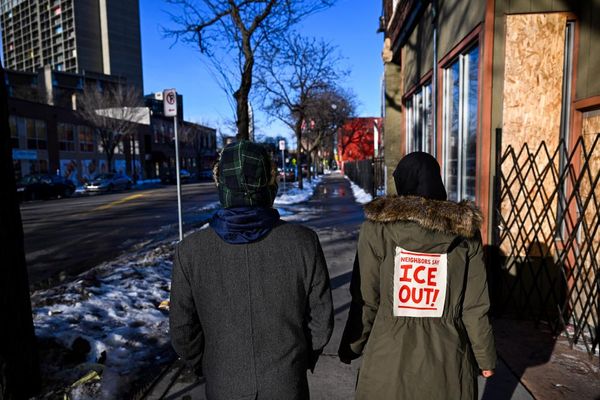
Outside, a multiracial crowd of demonstrators gathered on the courthouse plaza, marching, waving homemade signs and chanting, "No hate, no fear. Somalis are welcomed here."
Earlier Wednesday, in the eighth sentencing hearing of the week, defendant Abdirahman Daud was given 30 years in prison.
Daud, 22, was arrested in California in 2015 after trying to buy an illegal passport and cross into Mexico. Thirty years was the sentence prosecutors had requested.
A contrite Daud, dressed in a suit, was blunt and remorseful before the judge Wednesday.
"I was not going (to Syria) to pass out medical kits or food to the people I believed at the time to be innocent," Daud said. "I was going there strictly to fight and to kill on behalf of the Islamic State, your honor. Looking back, it's not who I like to believe I am. I lied and deceived everyone to achieve those goals."
In a voice breaking with emotion, he added: "I want to send a final message, despite (having) a legal right not to say anything. I am certainly not being persecuted (for) my faith. And I was certainly not entrapped nor lured into doing any of these crimes."
Daud's attorney, Bruce Nestor, said that even though his client fought the federal charges at trial, they weren't trying to prove his innocence so much as explain a troubled young man to the jury.
"We tried to focus on the only thing we could argue: the complexities of what brings a young man who has led an exemplary life to try to adopt such beliefs."
Nestor added that he believes his client poses no risk to society, but told Davis: "I recognize that you cannot and will not take that risk."
Assistant U.S. Attorney Julie Allyn, however, dismissed Daud's apparent remorse as another lie.
Daud, she said, "knows how to play a role. It's just him playing a role again."
Allyn described how Daud told Abdullahi Yusuf, the youngest member of the conspiracy group, to watch terrorist videos, and provided him phone numbers of Islamic State, or ISIL, contacts in Turkey. Daud was no mere follower, Allyn said.
"In the grand jury he just lied, he was slippery, he was evasive and he tried to play this role of a victim," Allyn said. "There's been nothing said or done by this defendant that he feels differently than what he did that day."
Earlier Wednesday, defendant Mohamed Farah was also given 30 years in prison.
Farah, 22, was one of three defendants who refused to plead guilty or cooperate with prosecutors, instead taking his case to a jury trial last spring. Farah and two other co-defendants appearing Wednesday were convicted of conspiracy to support the terrorist group ISIL and conspiracy to commit murder abroad. Federal prosecutors had recommended 30 years in prison.
Addressing Davis on Wednesday morning, Farah said he now disavows terrorist groups and realizes that extremist organizations such as ISIL "don't stand for peace."
"We ended up on a road nobody expected," Farah said. "Your honor, that's the allure and the dangers of terrorism."
Farah also looked back at his parents and siblings in the courtroom. "For them to see me today in an orange jumpsuit is not my idea for what a role model should be," he said.
Farah, the eldest of six siblings in a Somali-American family in Minneapolis, was stopped at New York's JFK Airport in 2014 while trying to leave for Syria and was later caught on tape saying he would kill any FBI agents who got in his way.
Farah's attorney, Murad Mohammed, asked Davis to sentence his client to 15 years.
"These are young kids, young men, that are battling each other, one-upping each other with their level of religiosity," he said. "They saw religion as a refuge. In essence they radicalized each other."
Mohammed also said that, in retrospect, his client should have pleaded guilty with other co-defendants last spring to a charge of conspiracy to support ISIL before more serious charges were added to his indictment.
The prosecution, for its part, pointed out that in 2014 and 2015 Farah showed every sign of being a determined ISIL recruit _ trying twice to leave the United States for Syria _ and that he lied repeatedly to investigators after his arrest, while declining opportunities to cooperate with the government.
Davis, too, returned to the gravity of the accusations leveled against Farah. As he had done Monday and Tuesday, he had prosecutors show one of the grisly ISIL recruiting videos the young defendants had watched. The 12-minute clip, one of the most notorious ISIL propaganda pieces, concludes with the burning alive of a captured Jordanian fighter pilot in early 2015.
"Understand they were watching these for hours at a time, day after day after day," Davis said.