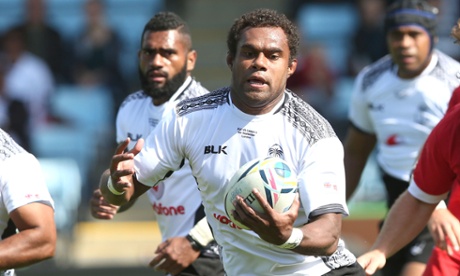
The stereotypes might portray Friday night’s World Cup opener as a contest between England’s team unity and Fiji’s individual brilliance but John McKee, Fiji’s coach, considers team spirit to be one advantage his side will hold over their westernised opponents at this World Cup.
“Our players have a fierce pride in representing their country,” the New Zealander said. “It’s the societal traditions they have. Western societies have become very individualistic whereas Fijian society is still very much based on the vanua, which is where they come from, and their family-based values. It makes team building easy.”
As if that were not enough for Stuart Lancaster to think about, McKee unveiled a team bristling with talent and physicality. Niko Matawalu has recovered from a groin injury and will keep England’s back row honest. Leone Nakarawa, the star of Glasgow’s Pro12-winning campaign, will line up at lock. And where do we start when it comes to the firepower beyond the front five?
Nemani Nadolo is the most obvious threat, as a goalkicking, 19st wing, but he is but one. He was hobbling about in the hotel, wincing with an ice pack on a knee, but the man himself dismissed any concerns, putting the niggle down to his advancing age (he is 27). He insists he will be fine for Friday.
It is not news to report that Fiji seemed in a relaxed mood but McKee is in a position to provide further insight into what drives them. Their relaxedness is yet another weapon. “I imagine England have very high goals for the competition and with that comes pressure,” he said. “Maybe there’s more pressure on England in the opening game than there is on Fiji. We’re not expected to win, which eases the pressure on us.”
A Fiji team not feeling the pressure is a force to be reckoned with. McKee remains confident they will make it out of the most treacherous pool in World Cup history. “I believe we are good enough to make the play-offs. Yes, we have a mountain to climb, but if we can bring our best game we can challenge these teams.”
If they do proceed, it will be some achievement. The bookies have given them a 26-point handicap against England, which means a win for them would be international rugby’s biggest upset of recent times, surpassing Samoa’s win over Australia, when their Island cousins prevailed against a 21-point handicap.
The challenges beyond the field that the Pacific Island nations must overcome have been well documented. They are not as outrageous at this World Cup as they have been. The fixture schedule for the tier-two nations is far more equitable than at previous tournaments, and player release from clubs has improved. The Pacific Nations Cup has given the Island nations, among others, meaningful competition (Fiji won this year’s event). But hurdles remain.
Semesa Rokoduguni, Nathan Hughes and Taqele Naiyaravoro are among the native Fijians who have pledged allegiance to other countries. “We certainly would have considered Roko,” admitted McKee. “We were tracking his form. If he wasn’t capped by England, he could well have been part of our squad. But we have other good players. It’s not the end of the world for us, and we move on. The payments to players to represent Fiji are very small compared to some other countries, but the fact that our players have made sacrifices to represent Fiji is a motivating factor. It helps them work harder.”
Nakarawa agreed that more could be done by the tier-one nations to help rugby in the Islands, particularly if they were to visit more often. “I think that would be a very good idea,” said Nakarawa. “It helps the players get used to intense rugby at a higher level. The last time we played a tier-one nation was in 2012 when Scotland visited.”
Far from enjoying home fixtures against the big boys, Fiji are the only team at this World Cup obliged to play two teams enjoying the comforts of a home stadium. Even Uruguay have been spared the challenge of England at Twickenham. Where Australia were able to force Wales to play them at Twickenham, no such grace was extended to Fiji, who must not only face England in their fortress on Friday night but Wales in theirs a couple of weeks later.
“That’s the tournament draw,” said McKee. “We don’t dwell on that. We played Wales at the Millennium Stadium last year. The boys loved it and have a great tradition against Wales. When they’re iconic stadiums I think they’re not such a great home advantage than some lesser stadiums might be, because the players are all so motivated to play there. We’re happy to play wherever we play.”
If there were points awarded for turning disadvantages into positives, Fiji would certainly make it out of pool A. Whether they can in the real world remains to be seen. The World Cup is not quite a level playing field yet.