
There is a saying, said to be first coined by the former Tory foreign minister, Douglas (now Lord) Hurd, that Britain punches above its weight. It is still used though it is becoming increasingly threadbare.
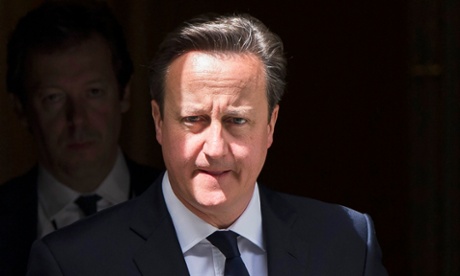
Ministers seem now more to shout above Britain’s weight. David Cameron was at it again this week in his attacks on Isis, saying the extremely violent, brutal, terror group posed an “existential” threat to Britain in “the struggle of our generation”.
Britain, he added, would offer a “full spectrum” response. He did not offer a clear idea of what that meant though he did say the danger should be attacked “at source” - ie, in Iraq and Syria.
He added on Monday’s BBC Radio 4’s Today programme: “It’s much easier to just invade a country, I absolutely accept that. It’s easy and faster and that has consequences. A missile can kill a terrorist but it is good governance that kills terrorism.”
Wise words. However, Cameron did not offer any specific suggestions.
Sir David Omand, former director of GCHQ and Whitehall’s top security and intelligence adviser, did.
“The key”, he told me, “is information to pre-empt attacks including digital intelligence from bulk access, identifying the active terrorists, their locations, movements, associations, financing and intentions.”
He added: “To allow such intelligence to be used effectively at source, parliament should authorise British forces including RAF Reaper RPAS [remotely-piloted air systems, commonly called unmanned drones] to operate across the border from Iraq into Syria when necessary.”
Omand went on: “Domestically, the government must press on with their stated intention to produce draft legislation on interception in the autumn. But it is more important to get this right for the long haul against terrorism, building a national consensus on the need for these powers and rebuilding confidence in the oversight of UK digital intelligence gathering, than to rush it “.
Omand has two clear messages. Firstly, MPs must give British forces more latitude in Syria, overturning the 2013 Commons vote and enabling RAF unammaned Reapers and Tornado jets to attack Isis targets there.
(In addition to the sporadic air strikes over northern Iraq by RAF Tornadoes, and the few hundred trainers of Kurdish peshmerga fighters and Iraqi troops, there are almost certainly scores of British special forces in the region. Despite their growing importance, Cameron told the BBC on Monday: “We never comment on what our special forces do and it is very important we maintain that position.”)
On his second, domestic, front, Omand made it clear the government’s plans to extend the powers of the security and intelligence agencies, notably GCHQ, to get access to bulk data must have the trust of the public.
That must mean judicial control of interception warrants, as proposed by David Anderson QC, the government’s independent adviser on terror laws.
Cameron also spoke earlier this week of the need to promote liberal values and combat radicalisation.
The army has just set up a special unit, the 77th Brigade, to use psychological operations and social media to help fight enemies in the “information age”. Though inspired initially by the army’s experiences in Iraq and Afghanistan, and by Russia’s intervention in Ukraine, it could also be relevant, I suggest, to combatting “non-state” enemies, such as Isis.
The army’s 77th Brigade is modelled partly on the Chindits, commandos who operated behind enemy lines in Burma in the second world war, conducting psychological warfare and winning “hearts and minds”.
Brigadier Alastair Aitken, commander of the new brigade, explained its role in an address on Tuesday to a conference on Land Warfare organised by the Royal United Services Institute, (RUSI), a London-based military and security thinktank.
The brigade is responsible, he said, for the “delivery of all non-lethal and non-military effects...”
Its job was to enable commanders to “get at the real motivations of why people fight...and start to target their motivations with the right non-lethal weapon system”.
Aitken said the brigade was recruiting from “the widest possible talent of the nation”, including “award winners from the creative arts”.
Army commanders had learned the hard way in Iraq and Afghanistan, said Aitken. “We must have the capability to counter potential adversaries and we must be able to defend information, especially defence of the truth as the very lowest bar”.













