
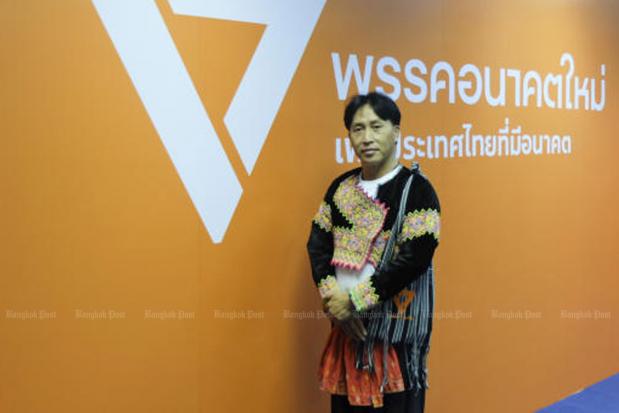
When the House convened early on the morning of May 25 to vote for the House Speaker, Nattaphon Suepsakwong was among 498 MPs who took the oath of office. However, he had made the longest journey to the parliament because he is a hilltribe man.
"I travelled by bus for eight hours from my remote village on the mountain in Tak to Bangkok. When an MP from the Palang Pracharath Party asked to delay the vote for the House Speaker, I laughed off the idea," said Mr Nattaphon, 53, who is known as Uncle Keng or Lung Keng in Thai.
He told the Bangkok Post that he is proud to be an MP. "It is the most impressive event of my life. I am grateful that parliament allows me to represent our cultural identity in traditional attire," he said.
Uncle Keng said the winds of change have blown now that the ethnic group is setting foot in national politics. "In the past, hilltribe people ran only local affairs. This year, however, we have seen our clans in the election. The Future Forward Party (FFP) fielded 11 ethnic MP candidates in the race. In the future, I hope to see an ethnic political party," he said.
FFP MP contenders come from Karen, Hmong, Yao, and Tai Yai communities. The Prachachat Party also fielded ethnic candidates to promote multiculturalism.
While Uncle Keng is the first and only ethnic MP who managed to step into the House, he did not enter politics for fun.
"To be honest, hilltribe people are miserable. I am determined to help my compatriots. It is an opportunity to be a middleman who can raise our problems with the government. We have long been ignored," he said.
"We really need a body for hilltribe people in Thailand. The total ethnic population exceeds one million, not including those who are yet to register with the authority."
LIFE ON THE BATTLEFIELD
His campaigns for the ethnic group are things he had never seen in the past. Uncle Keng recalled his painful childhood in a war-torn village.
"I was born in Phetchabun's Khao Kho district when war broke out. Men with green caps and red stars [the Communist Party] and armed soldiers [the government] entered our village and fought each other," he said.
Uncle Keng said hilltribe people were caught in the middle of the ideological war. "We didn't know anything about political conflict because we were isolated from the outside world. We were suddenly torn apart. Some of us fled to the forest with the Communists, but my family followed soldiers and lived in their camp," he said.
Unfortunately, the war resulted in the tragic loss of his family members. "The battle went on for many years. The two sides exchanged fire regularly. I was in the first group of students who rode on a helicopter to the local school. One day, a cannonball struck my house, killing my grandmother, aunt and uncle," he said.
Uncle Keng spent his war-ravaged childhood moving to new places for a better life. "The conflict forced my family to settle in another village for some time. We thought of returning home, but it was declared a national forest. Finally, my parents decided to relocate to Tak, but I headed for Bangkok," he said.
It never rains but it pours for him. Uncle Keng studied economics at Ramkhamhaeng University for three months before dropping out. "I didn't have enough money. Besides, I had to work to support my family," he said.
Nevertheless, a series of unfortunate events turned out to be a blessing in disguise. Uncle Keng said life experience could compensate for the lack of a stable environment for an ethnic child. "I worked for a restaurant, a hotel, and an airport. I might be the first Hmong who worked for Renaissance Cruises in French Polynesia," he said.
Uncle Keng went the extra mile to become a film star by chance. "When I returned to Thailand, I featured in many Hmong movies. However, it was Hmong Songkraam Weeraburut or Hmong Blood for Freedom in 2012 which gave me widespread recognition. Everybody knew me," he said.
PROBLEMS ON THE MOUNTAIN
With fame and money, people can get lost in the spotlight. However, Uncle Keng never forgets how hard it is for his compatriots on the hill. When the FFP launched its party, he passed screenings and became one of its ethnic MP candidates.
Uncle Keng thought the most urgent issue is forest encroachment. "We lived here long before the Forest Act drew boundary lines. When the law was enforced, we became illegal inhabitants on our land. Anyone who collects mushrooms or bamboo shoots in the area will be prosecuted," he said.
Forest encroachment should be tackled because it hinders the development of communities. "Government budget is automatically withdrawn because the village is invading the forest. Without financial support, it couldn't improve facilities, such as electricity and water," he said.
The FFP will establish a special cultural zone for the ethnic group to preserve their way of life. "We will consider settlements which came before the law and make revisions to allow for the coexistence of humans and nature," he said.
The zone will help promote agriculture and other activities. "The amendment will permit us to cultivate coffee in the forest because it is an agricultural product in high demand. It will make room for cultural tourism. In the future, we can legally run local businesses and homestay," he said.
Another issue is the fundamental human rights concerns of the ethnic group. Uncle Keng proposed nationality be granted for access to education and health care. "Many ethnic children have potential. Some can become doctors in our villages. Among sensational cases is Yonladee Phiyatat or Ploy. In the end, she obtained Thai nationality to attend a science competition in the US," he said.
He indicated some hilltribe people do not have nationality because of overly-complex processes. "Many regulations prohibit ethnic parents from submitting applications. They have to secure guarantors and shoulder other expenses. For us, every baht is valuable because we live in remote areas. Accordingly, they have to let it be," he said.
Uncle Keng called for equality for all people. "It is unfair. After all, we are as Thai as everyone," he said.













